
Maritime Myths and Sailors' Superstitions
The vastness of the oceans, coupled with the seemingly mysterious workings of their currents and winds and the frightening intensity of their storms, has led over time to the growth of a large body of beliefs. These include myths about supernatural beings presiding over the waters and living in them, legends about lost and doomed ships, and sailors’ and fishermen’s superstitions about their life at sea and the behavior of their vessels.
Myths about great floods, such as those described in Greek mythology, the Mesopotamian Epic of Gilgamesh (eighteenth century BCE), and the book of Genesis, were common in both hemispheres in prehistoric times and have been traced by some researchers to actual events such as rapid rises in sea level and the breaching of ice dams holding back glacial lakes.
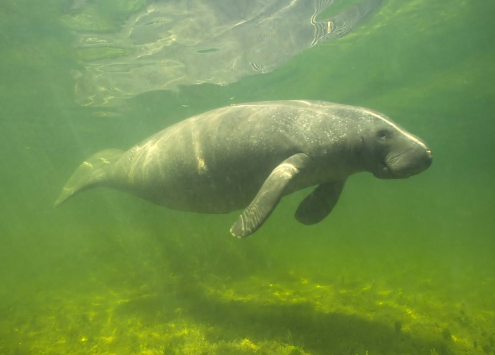
A manatee swimming underwater. It is possible that aquatic mammals such as manatees and the related dugong inspired belief in mermaids and mermen, mythical beings who were half-human and half-fish and who were thought to inhabit the sea (Wayne Johnson/Dreamstime.com).
Careful When You Wish “Good Luck" to a Sailor. The persistent threat to a sailor’s life makes individuals in this profession some of the most superstitious. Among the many items signifying bad luck in several cultures around the world, one encounters superstitions ranging from proscriptions against setting sail on particular days of the year to having women on board. Similarly, no sailor was allowed to wear the clothes of another who had passed away, nor to save one from drowning if encountered in the open ocean. Having tattoos and wearing old shoes and gold hoop earrings were among the numerous practices to counter bad luck. However, not everyone was cognizant of the whole array of sailors’ superstitions. It was thus possible that if a landlubber wished a sailor “good luck” for his voyage, he might have found himself flat on the ground with a solid punch on the nose. The reason behind this rather rude response was the sailors’ belief that this well-meaning gesture would curse the upcoming voyage. The only way to reverse this jinx was to draw blood from the well-wisher. Elibet Valencia and Rainer F. Buschmann
Most ancient societies that flourished near an ocean recognized sea deities. In Greek mythology, Poseidon was worshiped as the god of the sea. He plays an important role in The Odyssey (eighth century BCE), a Greek epic usually credited to the poet Homer that also features lesser sea beings such as sirens, half-human, half-bird sea nymphs who attempt to lure Odysseus and his men to their death with beautiful songs. In his dialogues, the Greek philosopher Plato (428/427-348/347 BCE) identifies Poseidon’s domain as Atlantis, one of many mythical islands and “lost continents” of ancient and medieval legend. The Roman god Neptune was Poseidon’s counterpart, and somewhat similar sea deities, including the Irish god Ler and the Maori god Tangaroa, were worshiped in other cultures.
The creatures referred to as “sea serpents” have figured prominently in myth and legend for millennia. One early example is the enormous Jormungandr of Norse mythology, which was thought to encircle the world. Serpents sighted at sea in seemingly authentic reports have been tentatively identified as real animals, such as oarfish, which can grow up to 36 feet in length. The Kraken of Norse mythology may originally have involved sightings of whales, although in more recent times the creatures have been identified with giant squids. Cryptozoologists, on the other hand, have suggested that relict marine reptiles may be responsible for many such reports.
Light Your Cigarette on a Candle and You Shall Kill a Sailor. Smoking is, of course, very detrimental to your well-being, and lighting your cigarette on a candle might harbor additional health risks. In northern Germany, there is an additional spin on this procedure, which points to a cultural survival of a long bygone era. Especially widespread in northern German port cities (e.g., Bremen and Hamburg) is the belief that lighting one’s cigarette on a candle means killing a sailor. Why is that? Apparently, before the onset of the Industrial Revolution, many sailors who were unable to land paid employment on a ship complemented their dwindling savings by manufacturing matches while waiting for their next commission. A careless, greedy individual not using a match to light his or her cigarette would deprive sailors of this much-needed income and thus threaten their livelihood. Rainer F. Buschmann
The half-human, half-fish beings known as mermaids and their male counterparts, mermen, were also thought to inhabit the sea. Similar beings include the fish-god Oannes (or Adapa) of ancient Mesopotamian mythology, the son of Poseidon named Triton, and the composite Japanese creature known as the ningyo. It is possible that such aquatic mammals as manatees, dugongs, and Steller’s sea cows (the last extinct since the eighteenth century) fueled belief in such creatures. The selkies of Irish and Scottish folklore were believed to live as seals in the water but as human beings on land.
One of the more enduring examples of nautical folklore involves ghost ships manned by ghostly crews, the sighting of which is traditionally regarded as an omen of doom. The particular legend of the ghost ship known as the Flying Dutchman apparently dates from the seventeenth century and features a vessel destined to sail the seas forever. The legend has been incorporated into a number of literary works, including The Phantom Ship (1839) by Frederick Marryat (1792-1848). The term “ghost ship” has also been applied to derelict ships sometimes encountered at sea.
Superstitions among sailors, whose occupation has always been one of the most dangerous in the world, appear to have been commonplace since ancient times. For instance, the concept of the Jonah refers to someone whose presence aboard a ship brings bad luck. It was felt that whistling aboard a ship amounted to a challenge to the winds themselves and could summon a storm. It has also been considered bad luck to kill an albatross, a superstition at the heart of the 1798 poem The Rime of the Ancient Mariner by Samuel Taylor Coleridge (1772-1834). On the other hand, cormorants were considered good omens by Scandinavians, who believed that they were the spirits of loved ones lost at sea.
FURTHER READING: Baker, Margaret. 1979. Folklore of the Sea. Newton Abbot/North Pomfret, VT: David & Charles. Beck, Horace Palmer. 1973. Folklore and the Sea. Middletown, CT: Marine Historical Association/ Wesleyan University Press.
Ellis, Richard. 1994. Monsters of the Sea. New York: Knopf.
Jeans, Peter D. 2004. Seafaring Lore & Legend: A Miscellany of Maritime Myth, Superstition, Fable, and Fact. Camden, ME: International Marine/McGraw-Hill.
Date added: 2026-02-14; views: 347;