
Northwest Passage: Finally Open After Centuries of Search?
The Northwest Passage (sometimes, passages) is a sea route connecting the Atlantic Ocean with the Pacific Ocean by sailing through the Arctic. European mariners have searched for this passage since the fifteenth century, rightfully arguing that it would cut down on sailing time by avoiding the lengthy sail around the Americas. John Cabot, Francis Drake, and James Cook were among the most famous individuals who failed to locate this passage, mostly due to the sea ice blocking the way. Global climate change and advancements in science (most notably icebreakers) have made sailing through the Northwest Passage (and the alternative Northeast Passage) a distinct possibility at the dawn of the twenty-first century. According to a report released during 2002, Gary Brass, director of the US Arctic Research Commission, said that both the Northwest Passage and the Northern Sea Route (Northeast Passage) could be open soon to vessels lacking reinforcement against the ice for at least a month in the summer, assuming that recent trends in reducing ice coverage continue.
Both routes may soon be open for the entire summer, according to this report. German explorers asserted on October 10, 2002, that global warming and unusual wind patterns had enabled them to become the first navigators to sail unaided in a yacht through the usually icebound route along Russia’s Arctic coast. A twelve-man team, led by the explorer Arved Fuchs, made the trip on its fourth attempt west to east during the summer in a 60- foot, sail-driven, wooden trawler that they had converted into a yacht.
NASA’s Advanced Microwave Scanning Radiometer aboard the Aqua satellite observed open water along nearly the entire route on August 22, 2007. “Although nearly open, the Northwest Passage was not necessarily easy to navigate in August 2007,” NASA noted. “Located 800 kilometers (500 miles) north of the Arctic Circle and less than 1,930 kilometers (1,200 miles) from the North Pole, this sea route remains a significant challenge, best met with a strong icebreaker ship backed by a good insurance policy.” By 2011, both routes became a reality in the summer, as the Arctic ice cap steadily melted. Russian tugboats were traversing the country’s northern coast rather routinely.
As ice has melted, these shipping channels have widened. With the tugboats came explorers for oil and other resources that long had been locked under the ice at all seasons.
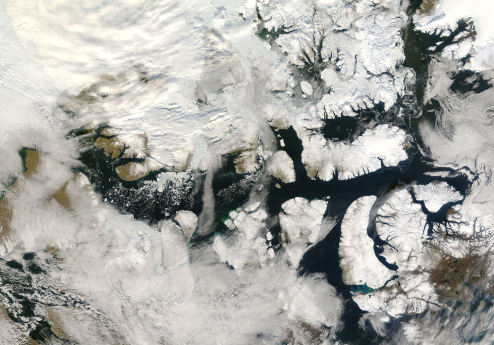
This satellite image shows the Northwest Passage in 2007, the first time the passage was free of ice since satellite records began. The Northwest Passage is a sea route along the northern coast of North America connecting the Atlantic Ocean with the Pacific Ocean. European mariners have searched for the fabled passage since the fifteenth century, but only recently has it become a viable sea route due to reduced ice coverage and new technologies (Photo12/UIG via Getty Images).
ExxonMobil signed a contract to explore the Russian sector of the Arctic Ocean. Rosneft, the Russian state oil company, signed a partnership with ExxonMobil. The irony here is that melting ice caused by the combustion of fossil fuels creates an opportunity to find, and burn, more of them. “It is paradoxical that new opportunities are opening for our nations at the same time we understand that the threat of carbon emissions has become imminent,” said Iceland’s president, Olafur Ragnar Grimsson.
The Northeast Passage cuts 4,000 to 5,000 miles off a more southerly route between Western Europe and Japanese or Chinese ports, with attendant savings in time, payroll, and fuel, saving shippers hundreds of thousands of dollars per trip. Ships also use the route without contracting expensive services from icebreakers. The Russians have occasionally been occasionally cutting a path along this route for a century by searching for favorable summer conditions and remaining as close to land as possible because it is the only route across trackless northern Siberia. Ships have competed with each other to break the speed record for traversing the Northeast Passage. During the summer of 2011, a tanker carrying natural gas condensate did it in six and a half days, besting the previous record of eight days.
Some industrialists are gleefully anticipating the melting of polar ice so that they can open new shipping lanes and ports, drill for oil, or engage in other profitable activities. Bad news for polar bears, for example, may be good news for Pat Broe, a Denver entrepreneur, who bought the derelict port of Churchill, Manitoba, on Hudson’s Bay, from the Canadian government in 1997 for about $10 Canadian. By Broe’s calculations, once the Arctic ice cap melts, Churchill could bring in as much as $100 million a year as a port on Arctic shipping lanes between Europe, Asia, and the Americas—the fabled Northwest Passage— shorter by thousands of miles than present southerly routes. In the meantime, tourists also have been swarming to the Arctic. One day during the summer of 2005, residents of Pangnirtung, on the east coast of Baffin Island, were greeted by a surprise: a 400-foot European cruise ship, which had dropped anchor unannounced and sent several hundred tourists ashore in small boats.
Oil companies have been pushing into the frigid Barents Sea, seeking undersea oil and gas fields made accessible not only by melting ice but also by advances in technology. But now, as thinning ice stands to simplify the construction of drilling rigs, exploration is likely to move even farther north. In 2004, scientists found evidence of oil in samples taken from the floor of the Arctic Ocean, only 200 miles from the North Pole. All told, one-quarter of the world’s undiscovered oil and gas resources lies in the Arctic, according to the US Geological Survey.
FURTHER READING: Kerr, Richard A. 2002. “A Warmer Arctic Means Change for All.” Science 297 (August 30): 1490-2.
Kramer, Andrew E. 2011. “Warming Revives Dream of Sea Route in Russian Arctic.” The New York Times, October 18. http://www.nytimes.com/2011/10/18/business/global/warming-revives-old -dream-of-sea-route-in-russian-arctic.html
Kramer, Andrew E. and Andrew C. Revkin. 2009. “Arctic Shortcut Beckons Shippers as Ice Thaws.” The New York Times, September 11. http://www.nytimes.com/2009/09/11/science/earth /11passage.html
Kraus, Clifford, Steven Lee Myers, Andrew C. Revkin, and Simon Romero. 2005. “As Polar Ice Turns to Water, Dreams of Treasure Abound.” The New York Times, October 10. http://www .nytimes.com/2005/10/10/science/10arctic.html
NASA Earth Observatory. 2007. “Northwest Passage Nearly Open.” http://earthobservatory.nasa .gov/Newsroom/NewImages/images.php3?img_id = 17752
Date added: 2026-02-14; views: 361;