
Panama Canal: History, Expansion, and the Struggle for Control
The Panama Canal is a 77-kilometer-long waterway connecting the Pacific Ocean and the Caribbean Sea with the purpose of moving goods and people across the Isthmus of Panama. Efforts to construct a canal go back to Spanish colonization when Panama was part of the Vice-Royalty of New Granada. After Colombia achieved independence in 1819, the idea for a canal was revived, but work on a canal did not begin until 1881 when the Panama Canal Company, headed by French engineer Ferdinand de Lesseps, who earlier oversaw the construction of the Suez Canal, attempted to dig a waterway across the Isthmus of Panama. The canal was conceived to increase the speed and volume of the shipment of goods between the nations of the Atlantic and Pacific Oceans, as well as trade from the Far East to the Americas, Europe, and Africa. In 1879, the “International Society of the Interoceanic Canal” was established to carry out the construction of the canal. Plagued by labor shortages, tropical diseases, and the rapid destruction of equipment due to tropical downpours, de Lesseps’s efforts failed, and in 1889 the company went bankrupt.
Following the bankruptcy, the US government, which had originally planned a canal in Nicaragua, shifted its emphasis to the Colombian province of Panama. The Colombian government denied the United States the right to construct the canal, and with the backing of US president Teddy Roosevelt, a Panamanian delegation declared independence. In exchange for US recognition, Panama granted the United States direct control over the “Canal Zone.” US control caused resentment among Panamanians and resulted in a number of conflicts between the United States and Panama. As a result of these tensions, the canal zone has been under Panama’s control since 1999, administered by a “Canal Commission.”
In 1899 the US Congress’ “Isthmian Canal Commission” recommended Nicaragua as the best location for a canal because there would be no need for locks to raise and lower vessels. The American financier J. P. Morgan, however, purchased controlling shares in the bankrupt Panama Canal Company at discounted prices and, through bribery and coercion, induced Congress to shift the canal to Panama and thus greatly increase the value of the company now controlled by Morgan. The Colombian Assembly, however, refused to allow the United States to construct the canal. So, Morgan and his supporters conspired to declare Panama an independent country. With the help of US president Teddy Roosevelt, who ordered the US Navy to protect Panama’s harbors from an assault by the Colombian military, Panamanian independence was declared on November 6, 1903. Twelve days later, on November 18, the Hay-Bunau-Varilla Treaty was signed, granting the United States exclusive control over the 10-mile-wide Panama Canal Zone. Philippe Bunau-Varilla, a French citizen, signed on behalf of Panama, and thus there were no Panamanians present when the treaty was signed.
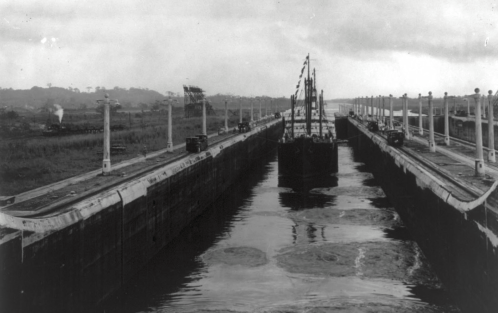
The SS Ancon enters the Panama Canal’s lower locks at Gatun Lake on August 15, 1914, inaugurating the opening of the canal. The celebration planned for the opening of the Panama Canal initially called for a fleet of international warships to pass through the canal at the beginning of 1915, but no such celebration occurred because of the onset of the First World War. Instead, the SS Ancon, a canal cement boat, inaugurated the passage and no international dignitaries were present (Library of Congress).
The creation of Panama was not without scandal, and President Roosevelt threatened newspaper publisher Joseph Pulitzer with prison if Pulitzer did not stop criticizing Roosevelt’s role in creating the nation of Panama. Nonetheless, the Panama Canal was an engineering marvel that increased trade worldwide. Opened in 1914, the canal spawned both San Francisco’s Pan-Pacific Exposition in 1915 and San Diego’s California-Pacific Exposition of 1915-17.
Panamanian opposition to the United States has flared up periodically, most notably with the “Martyrs Day” riot of 1964, when twenty-two Panamanians and four US soldiers were killed during protests against US control of the Canal Zone. In 1977, the Torjillos-Carter treaties handed control of the Canal Zone to Panama. US-Panamanian hostilities reached another boiling point when the United States invaded Panama in 1989, justified by the United States to protect the lives and property of people living in the Canal Zone.
Because the original size of the canal, known as “Panamax,” could not accommodate the ever-increasing size of ships, an expanded canal was opened in 2016. Whereas the original canal accommodated ships up to 950 feet long and 106 feet wide, the “New Panamax” accommodates vessels up to 1,201 feet long and 161 feet wide.
Currently, Nicaragua continues to work on constructing its own canal across the isthmus, and the “Northwest Passage” that runs through the Bering Strait, the Arctic Sea, and northern Canada also threatens to diminish the Panama Canal’s dominance in shipping between the Atlantic and Pacific Oceans.
FURTHER READING: Diaz-Espino, Ovidio. 2003. How Wall Street Created a Nation: J. P. Morgan, Teddy Roosevelt, and the Panama Canal. New York: Basic Books.
McCullough, David. 1977. The Path Between the Seas: The Creation of the Panama Canal, 18701914. New York: Simon & Schuster.
Roosevelt, Theodore. 1917. “The Panama Canal.” In The Pacific Ocean in History, edited by H. Morse Stephens and Herbert E. Bolton. New York: Macmillan Company, 137-52.
Date added: 2026-02-14; views: 351;