
Piracy and Privateering: A Global History from Ancient Raiders to Modern Maritime Crime
The birth of piracy coincides with the beginnings of maritime commerce and history. We cannot precisely date the beginning of this type of maritime robbery, but in the second millennium BCE, we encounter the first historical traces of such actions.
It was during this time that raids were conducted on land and sea by a population group called “Peoples of the Sea” in the eastern Mediterranean. The Greeks also did not hesitate to resort to this type of action. In fact, it is they who coined the phrase “peirates” (i.e., to roam the sea) from which the term “pirates” takes its origins. To the Greeks, this maritime raid was not an ignoble action, and they did not repudiate the search for loot or plunder by swift punishment. The famed Odysseus (Ulysses), for example, gained his reputation through piracy. Throughout most of the ancient era, Mediterranean piracy constituted a parasitic phenomenon that disturbed trade relations, and this called into action strong city-states such as Athens and Rome. By the third century CE, the arrival of the Germanic peoples contributed to an increase in sea raids in the region.
The Middle Ages saw maritime assaults from the Vikings and the Saracens. But they were not alone. Between the thirteenth and fifteenth centuries, pirates organized into brotherhoods such as the Vitalienbruder to raid commercial lines in the North Sea and the Baltic.
This time period also saw the transformation of unbridled piracy into an organized form of privateering: states sought to control violence and robbery at sea by sponsoring such actions in their interest. Privateering is, in fact, an attempt at legalizing and regulating maritime violence through national and international legal texts and a slowly expanding state bureaucracy. Unlike piracy, the dating of privateering is specific. Privateering appeared in the twelfth century CE and faded with the end of the nineteenth century when most countries abolished the practice. Yet the boundaries between piracy and privateering were always blurred and subjective. Contemporary descriptions of piracy and privateering reflect this ambiguity. The confusion emerges from the fact that maritime actors frequently switched roles between pirates and privateers. The best example of this fluid category is the Dutch “freebooters” (vrijbuiter) who were active in the Caribbean Sea and along the American coast. These adventurers solicited a license, or letter of marque (identifying them as acting in the interest of their home country), to raid Spanish ships, but they did not hesitate to also carry out acts of maritime violence and robbery without such a letter.
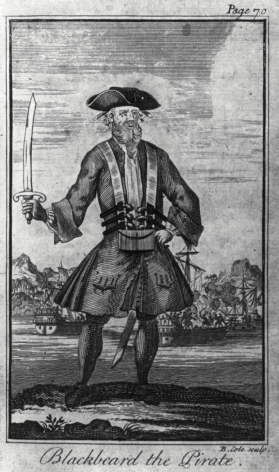
An illustration of the infamous pirate Edward Teach, better known as Blackbeard, included in Charles Johnson’s A General History of the Pyrates, Fourth Edition, 1726. Blackbeard gained notoriety first as a privateer and later for terrorizing the North Carolina coast in the early eighteenth century (Library of Congress).
Whereas in modern times piracy in the waters around Europe is almost nonexistent, the focus of piratical activities moved to other maritime regions. Between 1713 and 1730, European piracy reemerged in the Atlantic and Indian Oceans, triggered by an economic depression following the War of Spanish Succession. In the Indian Ocean region, where piracy also has a long history, European pirates intersected with various groups of Asian raiders. A prominent example in the South China Sea region was the peoples called waku who acted both as traders and as pirates, switching fluidly between the two roles depending on the situation. Some famous pirate leaders, like Koxinga, who dominated the South China Sea for a period in the seventeenth century, and Kanhoji Angria, who commanded a powerful following in the waters off India’s west coast in the eighteenth century, attempted to create their own states with mixed success.
Buccaneers. The term “buccaneer” evokes images of outlaws terrorizing ships off the coast of the Caribbean, famous pirates such as Blackbeard, or more sympathetic portrayals of imaginary persons such as the infamous Captain Jack Sparrow of the Pirates of the Caribbean movie franchise. Yet the term has far more fascinating origins. Hunters in the woods of Tortuga and Hispaniola (the island that hosts the contemporary countries of the Dominican Republic and Haiti) would often roast meat over an open flame in order to preserve it for future consumption, and ships could easily spot the fire at night. This process of preserving meat was called “buccan” from the French term “boucan,” and the men performing this task were better known as “boucaniers.” When these “boucaniers” eventually ventured out into the open ocean, where they began to prey on European ships in the Caribbean in the seventeenth and eighteenth centuries, these pirates would become known by the Anglicized term of “buccaneers.” Blake Diaz and Rainer F. Buschmann
It is in this part of the world that piracy would continue throughout the nineteenth century, and would return to the spotlight of the international media after the 1980-90 period. At the end of the Cold War, piracy was mainly concentrated around the Strait of Melaka, but in the 1990s, new zones of piracy emerged. A combination of cultural, economic, environmental, and political factors created a dangerous swath of the Indian Ocean stretching from the Yemen coast, through the waters off Somalia, and south to the Seychelles, where piracy became commonplace. The explosion of maritime raids in this region triggered national and international attention and military intervention. When piracy sharply increased around the East African coast in the twenty-first century, international policing became necessary. The European Union organized “Operation Atlanta” to combat piracy, and the United States convened several international task forces with the same intention. The relative success of these operations against pirates along the East African coast has since led to a shift of illegal activity to other regions. As Somali piracy declined, piratical activity reemerged in the Strait of Melaka and increased in the area of the Gulf of Guinea on Africa’s west coast.
Despite its shifting forms, the long, relatively unbroken history of global piracy makes this “profession” one of the oldest in the world. With the development of new means of transportation and communication, piracy has now moved into the air and the World Wide Web, though maritime piracy is still widespread. The image of the pirate character as a revolutionary and sometimes sympathetic adventurer, frequently depicted by books, comics, and film, is more fictional and not rooted in reality. This image continues to be perpetuated by Halloween costumes and the yearly celebrated “Talk Like a Pirate Day” (September 19). Roberto Barazzutti
FURTHER READING: Amirell, Stefan E. and Leos Muller. 2014. Persistent Piracy: Maritime Violence and State-Formation in Global Historical Perspective. New York: Palgrave Macmillan.
Andrade, T. 2011. Lost Colony: The Untold Story of China's First Great Victory Over the West. Princeton, NJ: Princeton University Press.
Antony, R. and S. Prange. 2012. “Piracy in Asian Waters.” Journal of Early Modern History 16 (6): 455-62.
De Souza, P and A. Eckstein. 2000. “Piracy in the Graeco-Roman World.” The International History Review 22 (4): 862-79.
Rediker, M. 2014. Outlaws of the Atlantic: Sailors, Pirates, and Motley Crews in the Age of Sail. Boston: Beacon Press.
Starkey, Eyck van Heslinga and David J. Starkey. 1997. Pirates and Privateers: New Perspectives on the War on Trade in the Eighteenth and Nineteenth Centuries. Exeter: University of Exeter Press.
Young, A. 2007. Contemporary Maritime Piracy in Southeast Asia: History, Causes and Remedies. Leiden, the Netherlands: International Institute for Asian Studies (IIAS).
Date added: 2026-02-14; views: 368;