
Poseidon: Greek God of the Sea, Earthquakes, and Horses
Poseidon was one of the twelve major deities in Greek mythology and was worshiped as the god of the sea. He was also regarded as a horse tamer and an “earth shaker” who set off earthquakes, which are common in Greece. Poseidon was adulterous (often taking the form of an animal or flowing water) and vindictive and was traditionally depicted with a trident, a three-pronged fishing spear with which he could cause shipwrecks as well as earthquakes. Horses and dolphins were sacred to him, and his chariot was drawn across the waves by dolphins or half-horse, half-fish creatures known as hippocampi. The Isthmian Games were held in Poseidon’s honor at a sanctuary near the Isthmus of Corinth, which links the Peloponnesian Peninsula with the mainland.
Ancient Greek mythological references are often fragmentary and contradictory, but most posit that Poseidon was the second son of Rhea and the cruel Cronus, the latter of whom was the leader of an earlier body of gods known as the Titans. Along with his brothers Zeus and Hades, he overthrew Cronus and the other Titans, after which the three divided the cosmos. Thus, he became the ruler of the sea in what was known as the Olympian pantheon.
Poseidon figures in The Iliad and, more prominently, The Odyssey, epic poems dating to approximately the eighth century BCE and usually credited to Homer. In the latter account, Greek sailor Odysseus is returning with his men to their island home of Ithaca after the Trojan War, a conflict in which the disguised Poseidon had actually participated. After stopping off at an island in the Aegean Sea, Odysseus angers the god by blinding his single-eyed giant of a son, Polyphemus, and taunting him cruelly. In revenge, the god curses Odysseus, dooming the sailor to lose his ships and crew and wander for years. However, Poseidon is not all-powerful, and he is unable to prevent the beleaguered sailor from eventually reaching Ithaca.
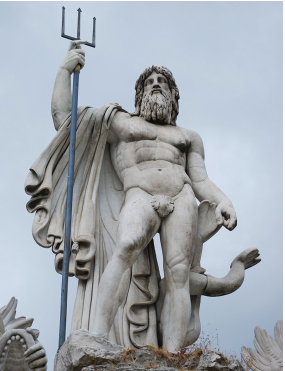
A statue of Poseidon holding his trident, located in Piazza del Popolo, Rome, Italy. In Ancient Greek mythology, Poseidon was considered the god of the sea, and his weapon and main symbol was the trident (Morenina/Dreamstime.com).
Ostensibly, Poseidon dwelt with the other major gods on Mount Olympus, although he was portrayed as spending much of his time in the sea. In the dialogues Timaeus and Critias (both c. 360 BCE), on the other hand, the Greek philosopher Plato (428/427-348/347 BCE) identifies Poseidon’s domain as the mythical “lost continent” of Atlantis beyond the Pillars of Hercules. According to the philosopher, Poseidon settled Atlantis with children he fathered with a mortal woman.
Many members of Poseidon’s family were minor water deities. His wife, Amphitrite, was one of the nereids, nymphs who ruled over fresh waters. Wooed by Poseidon, she attempted to hide in Oceanus, the enormous ocean-stream that the ancient Greeks believed encircled the world. However, a dolphin-shaped spirit named Delphin found her and convinced her that she should marry the god. In gratitude, Poseidon placed the spirit in the night sky as the constellation Delphinus.
Poseidon’s many offspring include not only Polyphemus, whose mother was the sea nymph Thoosa, but also the fish-tailed Triton. Another son was the mortal Euphemus, who became one of the Argonauts accompanying Jason on his journey aboard the Argo to retrieve the Golden Fleece. Yet another son, Proteus, has been identified with the Phoenician sea god Melkart and was responsible for herding Poseidon’s seals. Poseidon’s daughter Benthesikyme was a goddess of the waves, and another daughter, Cymopoleia, presided over the sea waters during storms. A third daughter, Rhode, was a water nymph. Poseidon was also the father of many horses, including the winged horse Pegasus.
Unlike the Greeks, the earliest Romans were not seafarers, and initially, their god Neptune was a minor freshwater deity presiding over rivers, lakes, and springs. Although he later came to be identified with Poseidon, he remained relatively unimportant in the Roman mythological pantheon.
FURTHER READING: Homer. 1996. The Odyssey. Translated from ancient Greek by Robert Fagles. New York: Viking. Murgatroyd, P. 2015. “The Wrath of Poseidon.” Classical Quarterly 65 (2): 444-8.
Pevnick, Seth D., ed. 2014. Poseidon and the Sea: Myth, Cult, and Daily Life. Tampa, FL: Tampa Museum of Art in assoc. with D. Giles Ltd., London.
Suhr, Elmer G. 1967. Before Olympos; A Study of the Aniconic Origins of Poseidon, Hermes, and Eros. New York: Helios Books.
Date added: 2026-02-14; views: 373;