
Jules Verne's Twenty Thousand Leagues: Maritime Innovation, Anti-Colonialism, and Environmental Foresight
Twenty Thousand Leagues Under the Sea is a famous novel penned by the French writer Jules Verne (1828-1905). He is considered by many to be the creator of the science fiction genre. Twenty Thousand Leagues Under the Sea published its first edition in France in 1869. Over the next 100 years, the book has been translated into many different languages and is frequently, maybe exaggeratedly, cited as one of the first adventure novels about submarines. More recently, some more environmentally inclined individuals regard Verne’s work as foreshadowing a more sustainable harvest of the ocean’s supposedly bountiful resources.
The story is initiated with news about a strange sea monster attacking global shipping. The United States dispatches an investigative expedition, including a French professor, the story’s main narrator. The encounter with the sea monster leads to the sinking of the American vessel, and a few survivors, including the French professor, find themselves on top of the beast. The monster is quickly revealed to be a submarine guided by the enigmatic Captain Nemo—Latin for nobody. Nemo displays a hatred for Western warships, which he sank with the help of his submarine, the Nautilus. This new naval technology had barely existed for over a decade since Verne published his novel. One must forgive the author’s license to depict the craft as a luxurious vessel that carried an extensive library and could reach an underwater speed of 50 knots an hour. Verne had inspected the first French prototypes of this new submerged weapon and infused it with his fictional vision. While foreshadowing the submarine’s lethality during the two world wars of the twentieth century, he did not envision the cramped conditions and the slow speed mariners had to operate under during these conflicts.
The French professor and his fellow travelers trapped on the Nautilus quickly learn that Nemo’s hatred for the West is connected to the massacre of his entire family in a non- disclosed conflict. While the guests voice their desire to leave, Nemo holds them prisoner on the vessel. Toward the end of the story, they manage to escape, only to be stranded on a deserted island near Norway. Meanwhile, the Nautilus disappears to an unknown fate into a vortex.
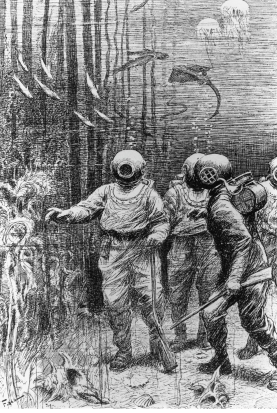
Captain Nemo and his companions walk on the sea floor, illustration by Fabio Fabbi (1861-1946) for Twenty Thousand Leagues Under the Sea by Jules Verne (1828-1905) (DEA PICTURE LIBRARY/Getty Images).
Verne’s novel continues in The Mysterious Island, published five years later, although the characters and the setting are changed. This work reveals Nemo as the South Asian Prince Dakkar, who joined the Sepoy Rebellion against the British Empire in 1857. Throughout this ultimately failed rebellion, British soldiers or their allies kill his entire family, and Dakkar takes his revenge on British shipping on the high seas. This surprisingly early nineteenth-century statement supporting decolonization did not translate well from French to English. Verne’s translators, fearing the alienation of many English readers, decided to omit or transform critical passages, such as Dakkar learning the West’s teachings to overthrow British rule in India. In the English version, this anti-colonial vision is altered to Prince Dakkar visiting the West to learn about the wickedness of his primitive people residing in British India. In what is perhaps the best-known screen adaptation of Verne’s novel and Disney’s first live-action film in the mid-1950s, Nemo—played by James Mason—oscillates between genius and madman as a pacifist who uses the violence of the Nautilus to end all wars. Only newer translations dating to the late twentieth century have captured Verne’s intentions more faithfully. Ironically, Verne was never a radical and opposed the first communist commune in Paris, the rising tide of feminism, and the many intellectuals who advocated French officer Alfred Dreyfus’s wrong conviction in the late nineteenth century.
Besides revealing maritime innovation and anti-colonial messages, environmentalists have, more recently, recognized Twenty Thousand Leagues Under the Sea as an essential novel to engage the delicate balance between ocean exploration and exploitation. In this iteration, Nemo advocates for world peace, colonized populations, and the sustainable use of ocean resources. Nemo feared the West’s “barbarism and greed” incursion into his watery domain, where he had fled from humanity’s terror. In his many discussions with the French professor, Nemo saw the bottom of the ocean as a new realm where relentless overexploitation could be avoided. Nemo’s sustainable harvest of resources from the sea to feed his crew and power his submarine are essential examples.
Given his rather conservative leanings, it is debatable whether Verne was indeed an environmental steward. His novel, however, was one of the first to explore new maritime technology—submarines—and, at least in the imagination, opened the possibility of the depths of the oceans as a new frontier for resources and, unfortunately, for future conflict.
FURTHER READING: Duarte, Carlos M. and Dorte Krause-Jensen. 2020. “The Restoration Imperative to Achieve a Sustainable Ocean Economy Nobody Foretold in 1871.” One Earth 3: 669-71.
Taves, Brian. 2015. Hollywood Presents Jules Verne: The Father of Science Fiction on Screen. Lexington: University Press of Kentucky.
Verne, Jules. 1999. Twenty Thousand Leagues Under the Sea. Tr. William Butcher. Oxford: Oxford University Press.
Date added: 2026-02-14; views: 405;