
Vikings: Exploration, Raids, and Settlements of the Viking Age
Between the late eighth and late tenth centuries CE, seafarers from Scandinavia, known as the Vikings, engaged in explorations and raids against neighboring peoples to the south. Venturing outward in their longboats from places such as Sweden, Norway, and Denmark, their journeys eventually took them as far away as eastern North America and southward into present-day Russia. Known at times by other names like Norsemen, Northmen, or Danes, in the case of those from Denmark, their most recognizable name, Vikings, likely comes from the Norse word “vik,” meaning creek or bay, in reference to the hollowed shorelines and fjords of Scandinavia from which they launched their expeditions. The Viking raids initially caused considerable destruction and hardship, yet they also affected the history of some of the neighboring regions in significant ways.
Although the region of Scandinavia was inhabited by people for millennia prior to the eighth century CE, very few historical details are known about them apart from archaeological finds. The Roman Empire never reached as far north as Scandinavia, and Greek and Roman writers had little to say about them. Existing as they did far to the north on the periphery of Europe, their impact on world history was insignificant until they began the voyages that made them both feared and famous. Long before their expeditions abroad, the ancestors of the Vikings traversed the coastlines of Norway and Sweden and among the numerous islands of Denmark. As seafarers with a talent for navigation, their means of transport and raiding were shallow-draft longboats, capable of holding roughly fifty men, powered by both sail and oars and guided by rudders. Large enough to be stable on the high seas, yet with a hull shallow enough to traverse inland rivers, the Vikings were well equipped to start venturing far from their own coastlines and often far into the interior of the regions they targeted. The reasons for which they began making these longer voyages are the subject of debate and speculation among historians and scholars.
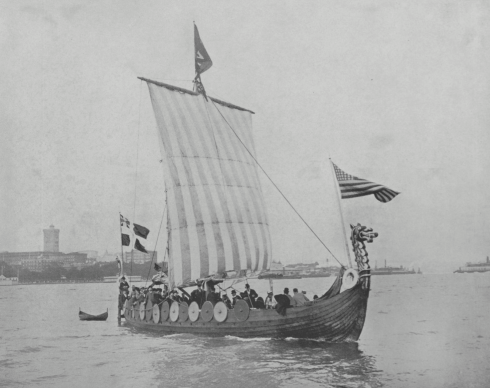
A replica Viking ship on display at the World’s Columbian Exposition in Chicago, Illinois, 1893. The ship was constructed for the exposition in Norway as a replica of the Gokstad Viking ship, which was uncovered in a burial site dating to the ninth century CE (Museum of Science and Industry, Chicago/Getty Images).
According to some, climate change may have forced them to look for additional food resources in warmer areas to the south. Others have suggested that population pressure created the need to seek out new areas for colonization. Increased commercial activity, especially among the Danes, may have generated a desire for trade opportunities. Historically, the decline and fall of the Western Roman Empire in the late fifth century CE, accompanied by Rome’s retreat from Britain, created a political opening in Europe, which allowed for several groups of invaders in the centuries afterward to take advantage of the ensuing chaos and lack of order. It is important to note here that the Viking voyages were never part of an organized, planned invasion. Although Norway, Sweden, and Denmark had monarchies, Scandinavian society was composed of semi-independent chieftaincies in which war parties and expeditions were frequently launched spontaneously, suggesting that all of the earlier reasons probably accounted for the raids at one time or another. Some writers, reacting to the destruction that usually accompanied the raids, have pictured the Vikings as representing an especially violent culture that valued plunder and pillaging. Violence in the name of conquest was the norm across the European world in this era, and to thus suggest violence was a trait unique to Scandinavians is a form of cultural chauvinism best avoided.
Regardless of the specific reasons, Viking raiders first made their presence felt on the coasts of the British Isles in the late eighth century. The object of these initial raids was coastal towns and settlements along the eastern seaboard, wherein treasure, food, and slaves, especially women, were plundered and taken. Monasteries and churches, frequently situated on vulnerable small islands and housing valuable ornaments, were decidedly tempting targets. The destruction and killing that accompanied these attacks, especially on the churches and Christian communities, contributed mightily to the sullied reputation of the Vikings. The most infamous Viking attack of the era was the raid on the monastery at Lindisfarne Island off the eastern shore of Britain in 793 CE. The Lindisfarne raid is usually regarded as the formal beginning of the Viking Age, leading to the so-called Viking Wars in English history. The effect was to ultimately cause the separate Anglo-Saxon kingdoms of England to unite in defense under a West Saxon king known as Alfred the Great (849-99).
Additional raids over the ninth century against the Frankish kingdoms, carried out mostly by Norwegian and Danish Viking groups, pushed into the interior of Europe as far as Paris and Hamburg. Over the course of the second half of the century, various Viking groups established winter encampments, some of which eventually grew into permanent settlements. Norwegian Vikings settled in Ireland by 850, and Danish Vikings occupied northeast England from an earlier settlement at present-day York. For a time, northeastern England was known as the Danelaw. Further expansions by the Norwegian Vikings resulted in permanent settlements in Iceland and Greenland, founded by Erik Thorvaldsson (“Erik the Red”; c. 950-1003), and temporarily in Newfoundland, Canada, at a site known as L'Anse aux Meadows, credited by some to Erik the Red’s son, Leif Erikson (c. 9701020). Recent research by archaeologists suggests the Vikings may have pushed as far south as Connecticut and New York, making them the first European discoverers of North America centuries before Columbus. In 911, a Viking group under Rollo (c. 846-930) settled in northern France along the valley of the Seine River, in an area known now as Normandy, named after the Norsemen. In the late ninth century, Swedish Vikings, known in Russian history as Varangians, penetrated northern Russia, traversing southward along the river until attacking Constantinople. Under a chief called Rurik (c. 830-879), they are credited with founding the state known as Kievan Rus. As the various Viking colonies were established, they came under the sway of Christianity and embraced a more settled lifestyle. By roughly 1000 CE, the Viking Age was over.
FURTHER READING: Brink, Stefan, ed. 2008. The Viking World. New York: Routledge.
Jones, Gwyn. 1984. A History of the Vikings. Oxford: Oxford University Press.
Winroth, Anders. 2014. The Age of the Vikings. Princeton, NJ: Princeton University Press.
Date added: 2026-02-14; views: 361;