
Age of Sail Warships: From Carracks to Ships of the Line
At the beginning of the colonial period, the dominant warship type was the three-masted ship, known in England as a carrack, in France as a caraque, and in the Netherlands as a kraeck. The carrack predominated in Europe until the seventeenth century. The earliest types had a rounded stern in a carvel-built hull, with the planks flush rather than overlapping. The ships were rigged with square sails on the fore and main mast and a lateen sail on the mizzen. A centerline ladder led to the round top of the main mast. By the sixteenth century the carrack had become a larger vessel of up to 125 feet in overall length by about 34 feet in the beam. They also gained a fourth mast aft: an extra mizzen, known as the bonaventure mizzen, or bonaventure for short.
Traditionally, in times of war, merchant ships were simply fitted out to carry weaponry. With the introduction of gunpowder weapons at sea in the fourteenth century, the carrack’s armament might range from as few as eighteen to as many as fifty-six small guns, some of them placed in the tops of the masts (“the fighting tops,” as they became known).
The carrack had a considerable advantage as a gun ship over the rowed galley, which mounted only a few guns forward. Because fighting at sea was very much like that on land, the higher structures fore and aft, which might actually be built up in time of war to gain a height advantage, were known as the castles: the forecastle and aftercastle.
Around 1500, a major change occurred in the way ships were armed with the invention of gun ports cut in the side of the ships. Up until this point, most guns were lighter types, carried high in the ship. Gun ports have been credited to a French shipwright at Brest named Descharges in 1501. Gun ports could be lowered shut in bad weather, and they allowed the placement of larger guns on the lower decks, producing greater stability, although at least two great warships—the Mary Rose in England in 1545 and the Vasa in Sweden in 1628—were lost when they suddenly heeled over with too much weight topside and the gun ports open.
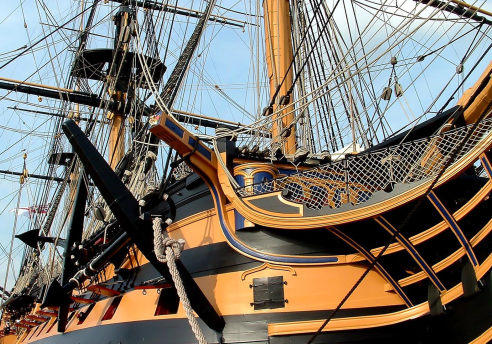
Lord Horatio Nelson’s flagship HMS Victory at Portsmouth, England. The HMS Victory is most famous for its role in the defeat of the French and Spanish at the Battle of Trafalgar. The ship now serves as a living museum (Shutterstock).
The caravel was another important ship type, at least for the Age of Discovery. The lateen-rigged caravel was able to sail into or against the wind. Although Christopher Columbus’s Santa Maria was a carrack, both the Nina and Pinta were caravels. Long and narrow, caravels were some 50 to 60 feet in overall length and had two or three masts. As warships, caravels were employed primarily on scout and escort duty.
Ship’s Cat. Having a cat aboard a ship has been common since ancient times in many seafaring civilizations. Not only did they provide excellent pest control for disease-carrying rodents, but they were morale-boosting companions for long voyages and, in some cultures, were seen as good luck charms. There have been many famous ship’s cats throughout history, especially during the Second World War when cats like “Blackie” (aboard the HMS Prince of Wales) and “Unsinkable Sam” served on both Allied and Axis sides. The prevalence of cats aboard ships, however, has not always been a positive thing. For example, shipboard cats are thought to have contributed to Australia’s feral cat problem, as they may have arrived in the country as early as the seventeenth century with Dutch shipwrecks in the country’s northwestern regions. Laura G. Buschmann
Galleons were the predominant warship types of the early sixteenth century. Appearing by about 1525, galleons predominated until about 1650. The galleon was essentially a streamlined carrack, being both longer and narrower. The carrack had a forecastle that projected far out over the bow. In the galleon, this was both lowered and moved back into the hull. With heavier guns now mounted low in the ship, such structures were no longer required. The galleon’s most distinctive feature, however, was a large beakhead projecting forward from the stem designed to assist in working the sails.
Although usually associated as the ship type utilized by the Spanish in transporting treasure from the New World and forming the armada of 1588 sent against England, most warships of the period were galleons. King Henry VIII’s large Henry Grace a Dieu was rebuilt in the 1530s in galleon form, and the English ships that opposed the Spanish Armada were sleeker vessels of the galleon type, employing longer-range cannon to good advantage.
Gradually, the larger warships evolved into the type of warship most identified with the Age of Fighting Sail, the ship of the line. By 1650, such ships had emerged with two and three gun decks. Warships grew both longer and wider in beam, to the maximum size their wooden frames could sustain without “hogging,” that is, drooping at the ends. Improvements in rigging and sail systems enhanced the maneuverability of the largest ships.
The largest and most majestic vessels of the period of fighting sail were ships of the line, or line of battle ships (a term that yielded in the late nineteenth century to “battleship”). These ships were so known because, with up to 30 inches of wooden planking protection, they were capable of standing in the main battle line that characterized naval tactics of the day. They were heavily timbered, three-masted, square (full) rigged vessels with two to four gun decks.
More than 200 feet in length and 50 feet in beam, ships of the line carried crews of 600 to 800 men. The bigger the ship, the more expensive it was to build. Conversely, larger warships were less expensive to maintain per gun than smaller vessels.
In the ship of the line, the three masts—the foremast, the mainmast, and the mizzenmast— held up to five separate sails each. The mainmast usually consisted of three separate sections that could tower 200 feet above the waterline, with the main yard extending horizontally over 100 feet across. A large ship of the line could take seven years to complete and consume 2,000 trees (approximately 60 acres of mature forest). Oak was the preferred construction wood.
Ships were first known by “establishment,” then were “rated” according to the number of guns they carried. Thus, the largest ship of the line was a first rate mounting 100 guns or more, whereas the fourth rate mounted 64. Despite this rating system, armament varied widely from ship to ship, even those of the same class. Individual captains had their own preferences, and there were frequent changes in regulations.
Ships often carried more guns than their rate because captains generally wanted as much ordnance on their vessels as possible. This was partly a matter of prestige and partly the desire to be ready to meet an opponent with the maximum possible firepower; but overloading a ship affected her sailing qualities and could actually damage a vessel by producing hogging, thus impede the chances of it escaping pursuing ships.
By the end of the colonial period, the smallest ships of the line were those of sixty-four guns, although there were those who believed the smallest that could effectively stand in the line of battle was one rated at seventy-four guns. The third-rate seventy-four was, in fact, the most prevalent English ship of the line at the end of the colonial period.
Complementing the ships of the line were smaller specialized warships. The next largest warship was the frigate, the workhorse of navies in the Age of Sail. It was comparable in function to the later cruiser. Fast and powerful, frigates scouted ahead of the main battle fleet in order to provide warning of the approach of enemy vessels. They also served on detached service and as commerce destroyers.
Frigates were square-rigged ships (each mast had cross-yards) mounting their principal ordnance on a single covered gun deck. The open (spar) deck carried the lighter guns. Armament varied greatly, depending on ship size. Small frigates might mount twenty-four to thirty guns; the larger ones, fifty to sixty. Frigates grew in size over the years and, at the beginning of the eighteenth century, were up to 175 feet in length and up to 2,000 tons or more.
“Sloop” was a general term applied to small warships capable of great range that carried their main battery guns on a single deck. This category of light warships might mount between eight and twenty-four guns. Small vessels were used where a larger warship was not required, such as in carrying dispatches and escorting merchantmen. Large sloops could also be used to attack enemy commerce. These warships were comparable to the frigates and destroyers of the twentieth century.
Brigs, two-masted, square-rigged ships, were next in line, followed by cutters, single- masted, fore-and-aft rigged ships. The smallest warships were gunboats; carrying a variety of rigs, they mounted only one or several guns.
Probably the single most important ship type in American waters during the colonial period was the schooner. The name is American. These small, fast, and inexpensive-to- build ships were usually two-masted vessels carrying chiefly fore-and-aft sails and whose aftermast is no shorter than the foremast. Often employed for fishing and smuggling, they could in wartime carry four to ten guns. Schooners served notably as privateers during the French and Indian War (1754-63). Among specialized vessels was the bomb brig or bomb ketch, usually referred to simply as a “bomb.” The French successfully employed five such vessels in the shelling of Algiers in 1682 and against Genoa two years later. Bomb vessels were about 100 tons burden and 60 to 70 feet long on deck. Bombs were strongly built to enable them to withstand the shock of the discharge of their heavy mortars. The bomb was a fore-and-aft rigged vessel with a tall mainmast and smaller mizzenmast. Armament consisted of one or two high-angle fire mortars, usually of 10- or 13-inch bore size.
Transports and storeships were essential in expeditionary operations. Fireships were any expendable vessels that would be loaded with combustibles and explosives and sent against an enemy anchorage. Blockships were other expendable vessels, such as hulks, that might be sunk in channels to prevent an enemy access to one’s own harbor.
Although wooden warships required frequent repair and refit, they could also have extraordinarily long service lives. HMS Victory, possibly the world’s most famous wooden warship, was commissioned in 1765. Although it underwent a number of refits, it remained in active sea service for more than half a century.
Contrary to popular conception, the British did not always build the best ships. Many French and Spanish vessels were more strongly constructed and faster than their British counterparts, and some were more heavily armed. Such differences were not major. In any case, Britain’s rivals at sea often failed to utilize their ships properly—the result of a lack of government commitment, poor leadership, and insufficient training and practice. A vessel’s speed was determined less by its design than by her condition and especially whether her hull was clean or fouled with barnacles.
Sailing warships were highly efficient and developed instruments of war. They were also self-contained communities designed to store supplies sufficient for their crews for months at sea in varying weather conditions without revictualing. Supplies included not only food, shot, and shell, but any resources the crew might require, including spare cordage and spars sufficient to make most repairs at sea. By the end of the colonial period, beginning in the 1770s, the introduction of copper sheathing and bolts below the waterline slowed the buildup of marine growth that hindered a ship’s sailing qualities.
FURTHER READING: Chapelle, Howard I. 1949. The History of the American Sailing Navy: The Ships and Their Development. New York: Bonanza Books.
Fioravanzo, Giuseppe. 1979. A History of Naval Tactical Thought. Annapolis, MD: U.S. Naval Institute Press.
O’Brian, Patrick. 1995. Men-of-War. New York: W W Norton and Company.
Date added: 2026-02-14; views: 429;