
Whaling History: Early Methods, Industrial Expansion, and Conservation
As the largest mammals on the planet, whales have been seen as a tremendous resource for groups of people with the skills to navigate the oceans in pursuit of them. Whereas early whaling peoples tended to hunt the giant sea animals primarily in coastal waters, an entire industry grew to expand whaling grounds into the open ocean. This expansion of whaling coincided with the development of industrial capitalism in the 1800s and led to the pursuit of several types of whales to near extinction in the present day.
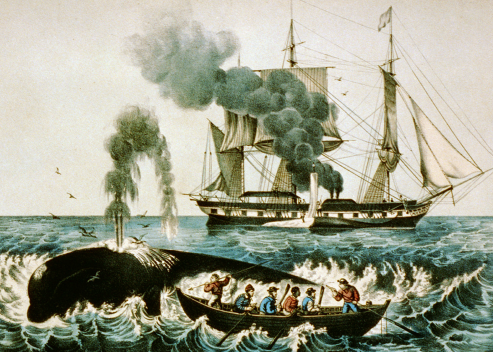
A nineteenth-century engraving depicting the hunt for a right whale. In the foreground, a whaleboat comes alongside a wounded right whale. The harpooner stands in the bow with the killing lance to dispatch the whale. The mother ship is in the background (Library of Congress).
Of the many varieties of whales inhabiting the oceans, some of the earliest to be pursued by people were right whales, pilot whales, humpback whales, bowhead whales, and occasionally even sperm whales. Those hunting these whales, such as the Ainu, Vikings, Malagasy, and Basques, as well as the Inuit and other Arctic peoples, sought not only the meat that they provided but also their blubber for making oils. Additionally, the baleen that many whales have instead of teeth provided material for making tools, baskets, and ceremonial art, and the ambergris in the whale’s digestive system could be used for incense, medicines, and perfumes. The variety of resources provided by whales made them attractive targets to these groups, who mostly hunted in coastal waters, though some, such as the Basques, pursued them into the open ocean.
Gold from the Whale’s Gut? Cultivating in the hindgut of the wholly mysterious sperm whale awaits a treasure that holds both historical significance and contemporary value: the ever-fabled ambergris. This otherwise unpleasant, waxy mass of whale secretion and indigestible fish parts was, and still is, highly sought after for its use as a fixative ingredient in perfumes, as well as a flavoring agent in cooking. It is said that the eighteenth-century Italian adventurer Casanova enjoyed ambergris in his chocolate mousse as an added aphrodisiac and that it was a common component in delicate seventeenth-century Persian cocktails. Indeed, ambergris was a valued trade commodity in many regions of the world, due in part to its rarity. Like a bottled wine, ambergris refines with time: once escaped from the fourth stomach of the sperm whale either by death or by expulsion, a piece of ambergris can drift at sea for decades, acquiring a unique and earthen quality as well as a pleasant smell. Its current market value is estimated at over $25 per gram, which makes it almost as valuable as gold. Juliet Glennon and Rainer F. Buschmann
The tactics employed by these early whaling groups often included the use of drogues, which are harpoons connected to some sort of floating object. When the whale was struck with the harpoon, the drogue would float and create drag as the whale tried to swim away. Eventually, the whale would tire of swimming and it could be killed. Right whales were among the most commonly hunted whales, in part because they swam relatively close to shore, and when they died, their bodies floated to the surface rather than sinking, which made them easy to harvest. Consequently, they were deemed the “right” whale to hunt. As sailing technologies developed, however, so, too, did the ability to kill different types of whales, and nations such as the United States joined in on the hunt.
The most prized target of whalers during the industrial era was the sperm whale. What made them most appealing to the capitalists of the 1800s was not only their blubber but also the huge spermaceti reservoir in their heads. Spermaceti oil had a high melting point and burned very cleanly, making it the material of choice for high-quality candles throughout the nineteenth century. As with other whales, sperm whales are huge when compared to humans and their hunting boats. Male sperm whales, for example, grow to sizes of over 60 feet in length and can weigh more than 50 tons. When they were threatened or harpooned, many of the whales would violently retaliate and destroy boats, making the entire proposition a dangerous pursuit.
Throughout the nineteenth century, American whaling ships used technologies such as exploding harpoons, steam-powered and iron chase boats, compressed air to inflate carcasses, and factory ships for ocean-going processing to establish the United States as the preeminent whaling nation of the day. The result was that American whalers killed over 200,000 sperm whales and 190,000 right whales by the 1870s. Within the American whaling fleet itself, the groups actually doing the whaling consisted of Black Americans and Africans, Native Americans, Pacific Islanders, and white Americans and Europeans. In fact, by the 1850s, nearly 20 percent of the American whaling crew were Pacific Islanders, indicating a very diverse industry. Although the potential profits and sense of adventure made whaling an appealing option for those who could withstand the long voyages and harsh conditions, the majority of the profits from a given voyage tended to go to the ship captains and owners, who were mostly white Americans from New England.
As the nineteenth century transitioned to the twentieth, the United States was surpassed by other whaling nations such as Norway, Japan, and Russia who continued the practice, especially in the Arctic and Antarctic regions of the world. The twentieth century has seen a rise in conservation efforts with regard to whales, and in 1946, the International Whaling Commission was formed in order to regulate the industry by establishing quotas for how many whales of specific types can be hunted. These efforts have, at various times, been championed and challenged by different nations and, to this day, are the subject of intense international diplomacy regarding the world’s oceans.
FURTHER READING: Chappell, David. 1997. Double Ghosts: Oceanian Voyagers on Euroamerican Ships. New York: M. E. Sharpe.
Dolin, Eric Jay. 2007. Leviathan: The History of Whaling in America. New York: W W Norton. Dorsey, Kurkpatrick. 2014. Whales and Nations: Environmental Diplomacy on the High Seas. Seattle: University of Washington Press.
Shoemaker, Nancy. 2015. Native American Whalemen and the World: Indigenous Encounters and the Contingency of Race. Chapel Hill: University of North Carolina Press.
Date added: 2026-02-14; views: 361;