
Earth's Atmosphere: Composition, Structure, and Dynamic Systems
The Earth's atmosphere is the thin, gaseous envelope surrounding the planet, retained by gravity. It is primarily composed of nitrogen (78%), with oxygen (21%), argon (0.9%), and trace gases including carbon dioxide (0.04%), neon, and helium. Atmospheric pressure, the force exerted by the weight of overlying air, compresses most of its mass within the lowest 3.4 miles (5.5 km), though it extends hundreds of kilometers upward. This dynamic system is fundamental to climate, weather, and the protection of life on Earth.
Vertical Structure of the Atmosphere. The atmosphere is divided into distinct layers based primarily on temperature gradient. The lowest layer, the troposphere, extends up to approximately 36,000 feet (11,000 m) and is where temperature decreases with altitude and all weather occurs. Its upper boundary is the tropopause, a transitional zone where temperature stabilizes. Above this lies the stratosphere, reaching about 31 miles (50 km) high, which contains the protective ozone layer that absorbs ultraviolet radiation, causing temperatures to increase with height in its upper regions.
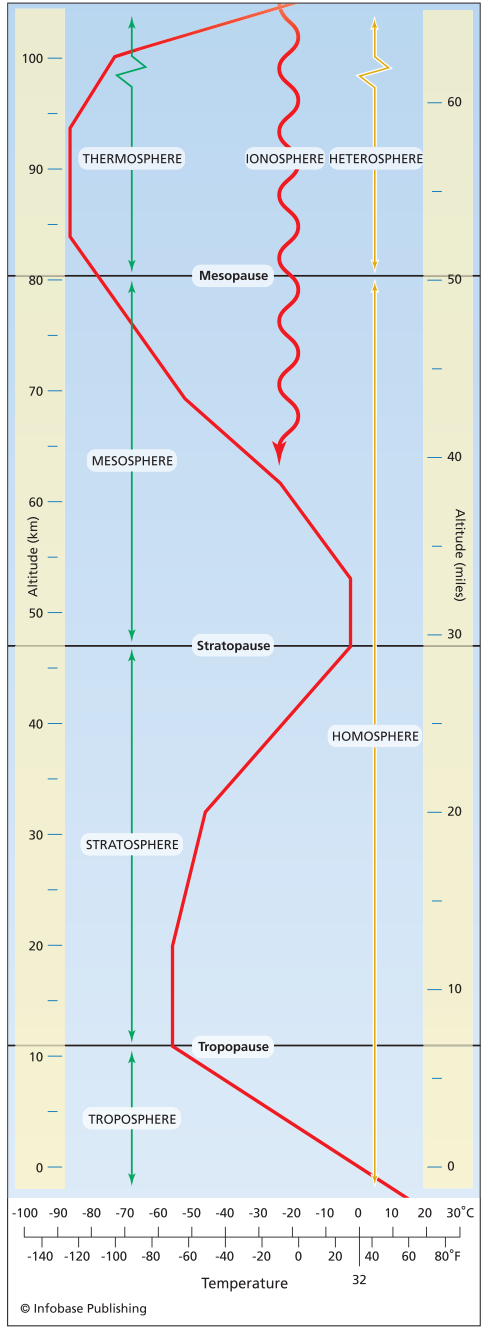
Structure of the atmosphere showing various layers and temperature profile with height
The mesosphere extends from 31 to 53 miles (50-85 km), where temperatures plummet to a minimum of -130°F (-90°C) at the mesopause. Above this, the thermosphere experiences rapidly rising temperatures exceeding 150°F (80°C) due to the absorption of high-energy solar radiation by sparse gas molecules. The outermost region, sometimes called the exosphere, gradually fades into space where atoms can escape Earth's gravity. The accompanying diagram (Figure 1) illustrates this layered temperature profile with height.
Atmospheric Circulation and Wind Patterns. Global air circulation is driven by unequal solar heating, with the equator receiving more energy per unit area than the poles. Heated air rises at the equator, flows poleward, cools, and sinks, creating circulation loops called Hadley cells. This pattern, modified by the Coriolis effect—which deflects moving air to the right in the Northern Hemisphere and left in the Southern—generates prevailing wind belts. These include the trade winds, westerlies, and the calm doldrums. Similar Ferrel cells and Polar cells dominate mid and high latitudes.
Key Gases and Their Roles. Beyond its major components, trace gases critically impact Earth's systems. Water vapor concentration is highly variable (0-4%) and vital as the source of all precipitation and clouds. It is also the most significant greenhouse gas, absorbing outgoing infrared radiation and releasing latent heat during condensation, which powers storm systems. Carbon dioxide (CO₂), though a minor component, is another crucial greenhouse gas. Its concentration has risen over 15% since 1958 due to fossil fuel combustion and deforestation, enhancing the atmospheric greenhouse effect and contributing to measured global warming.
Other potent greenhouse gases include methane (CH₄) from agriculture and waste, nitrous oxide (N₂O) from soils and industry, and human-made chlorofluorocarbons (CFCs). CFCs are also responsible for stratospheric ozone depletion, having contributed to the formation of seasonal ozone holes over the polar regions. Ozone (O₃) in the stratosphere is essential for absorbing harmful ultraviolet radiation, protecting surface life.
Chemical and Electrical Layers. The atmosphere can also be divided chemically. The lower homosphere (up to 62 miles/100 km) has a uniform gaseous mixture. Above it, the heterosphere exhibits chemical stratification by molecular weight. The ionosphere, overlapping the upper mesosphere and thermosphere, contains charged particles (ions) that reflect radio waves and facilitate the aurora borealis and aurora australis.
Biogeochemical Cycles and Human Impact. The atmosphere interacts continuously with Earth's biosphere and oceans. Nitrogen is fixed by soil bacteria and released by organic decay, while oxygen cycles via photosynthesis and respiration. Pollutants like sulfur dioxide (SO₂) from burning fossil fuels create sulfuric acid, a primary component of acid rain that damages ecosystems. Increased atmospheric particulate matter from industrial activity poses significant respiratory health hazards and influences climate. The delicate balance of atmospheric chemistry underscores its vulnerability to human activity, making its study essential for environmental stewardship and predicting future climate scenarios.
Date added: 2026-07-14; views: 141;