
The Origin and Evolution of Earth's Early Atmosphere: From Primordial Gases to a Habitable World
Considerable scientific uncertainty surrounds the precise origin and composition of Earth's primordial atmosphere. Prevailing models suggest that the initial, or primary atmosphere, was dominated by light gases like hydrogen, helium, methane, and ammonia, contrasting sharply with the modern nitrogen and carbon dioxide-rich blend. These volatile compounds likely originated from planetary accretion materials and intense volcanic outgassing from Earth's molten interior during the Hadean Eon. A competing and complementary hypothesis proposes that cometary impacts delivered both water and significant quantities of volatile gases, potentially including complex organic molecules, to the early Earth.
This primary atmosphere is thought to have been almost entirely stripped away by two catastrophic events. The first was an intense solar wind during the Sun's energetic T-Tauri stage of stellar evolution. The second was a giant impact event—the same collision with a Mars-sized body named Theia that is credited with forming the Moon. This impact likely vaporized and ejected any remaining primordial gases. Consequently, our present secondary atmosphere formed later, derived from subsequent geological activity after the planet's crust began to solidify.
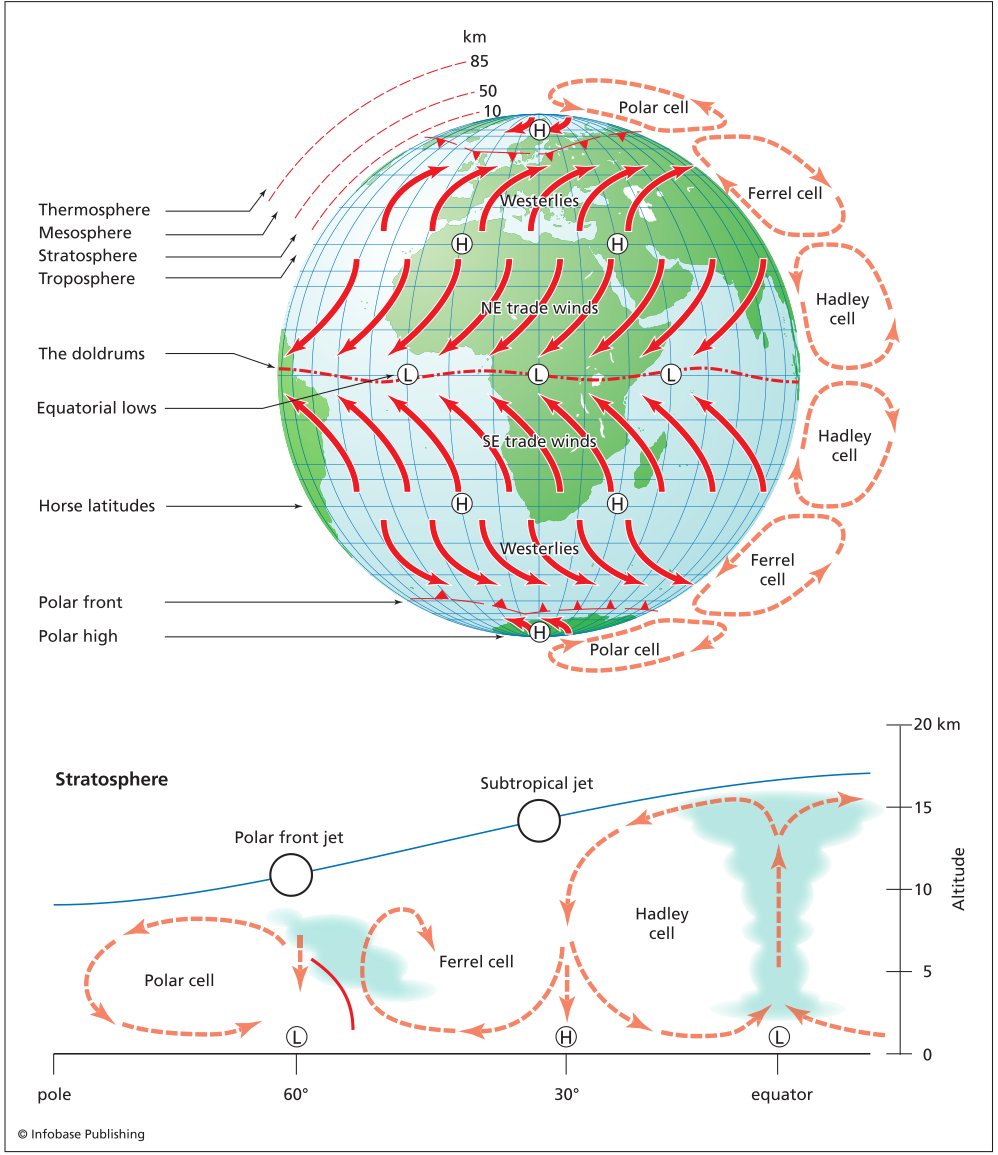
Major atmosphere circulation patterns on the Earth, in map view (top), and in cross section (bottom)
The secondary atmosphere emerged principally from sustained mantle degassing through pervasive volcanism over the first 50 million years of Earth's history. Volcanic emissions released a suite of volatiles including water vapor (H2O), carbon dioxide (CO2), nitrogen (N2), and sulfur compounds, which collectively established the new atmospheric and oceanic reservoirs. Critically, this early secondary atmosphere was anoxic, containing little to no free diatomic oxygen (O2); that vital component would appear billions of years later as a product of photosynthetic life forms, fundamentally transforming the planet's chemistry.
The composition of this early secondary atmosphere created an extreme greenhouse effect. It was dense with gases like CO2, methane (CH4), and possibly ammonia (NH3), conditions somewhat analogous to the present atmosphere of Venus. However, this intense greenhouse was fortuitously counterbalanced by the Faint Young Sun paradox—the early Sun's luminosity was approximately 25-30% lower than today. The greenhouse gases effectively trapped enough heat to maintain global temperatures within the narrow range where liquid water is stable, preventing the Earth from becoming a perpetually frozen snowball and setting the stage for the origin of life.
As the Earth gradually cooled, atmospheric water vapor condensed, forming the first rains and the nascent hydrosphere. This rainwater, infused with dissolved volcanic gases like HCl and SO2, created weak acids such as carbonic acid (H2CO3) and sulfuric acid (H2SO4). These acidic waters initiated chemical weathering of the primitive basaltic crust, breaking down rock minerals (which acted as bases) into dissolved ions and sediments. This process began the planet's long-term geochemical cycling, gradually transferring atmospheric carbon dioxide into the oceans and, eventually, into sedimentary limestone deposits via marine organisms.
Throughout the Archean Eon, with solar luminosity still only around 70% of modern levels, elevated atmospheric concentrations of greenhouse gases like CO2 and NH3 remained essential for climate regulation. They maintained a temperate global climate, keeping oceans liquid and environments suitable for the burgeoning biosphere. The vast majority of that early atmospheric carbon dioxide has since been sequestered, locked away in carbonate rocks like limestone and in fossilized organic matter. Thus, the very carbon that once shrouded the planet in a protective greenhouse blanket now constitutes the fossilized remains of the life it enabled, illustrating the profound and enduring feedback between the geosphere and biosphere.
Date added: 2026-07-14; views: 120;