
The Dynamic Beach: Formation, Profiles, and Seasonal Evolution of Coastal Environments
A beach is defined as an accumulation of unconsolidated sediment—such as sand, gravel, or cobbles—that is actively shaped by wave action along a coastline. In contrast, the broader shoreline environment encompasses all areas influenced by coastal processes, including beaches, barrier islands, cliffs, and nearshore zones. The formal geomorphic extent of a beach stretches from the low-tide line inland to a distinct change in vegetation or permanent landforms, such as dunes, cliffs, forests, or human-made structures like seawalls. Beaches exhibit diverse forms: they may occupy sheltered bays between headlands, form elongated spits projecting into the water, or exist as detached barrier islands parallel to the mainland.
To fully comprehend beach dynamics, one must also consider the nearshore environment, the submerged area extending from the low-tide line through the surf zone. This zone frequently contains sandbars separated by troughs; a common configuration includes an inner bar roughly 30-50 meters offshore and an outer bar at approximately twice that distance. The inner bar is often dissected by rip channels, which funnel returning water seaward and generate powerful, hazardous rip currents. The width and morphology of the nearshore are functions of seabed slope, wave energy, and sediment supply.
Coastal varieties across the United States illustrate this diversity. The eastern coast features Florida's wide sandy beaches, the Outer Banks barrier islands of the Carolinas, and Maine's rugged rocky shores. The western coast is typified by rocky shorelines in Washington, Oregon, and California, while the Gulf of Mexico coast presents low-relief beaches, barrier islands, and mangrove-fringed shorelines. Each setting reflects a unique balance of tectonic history, sediment source, and wave climate.
Beach Profile and Zonation. A typical sandy beach profile is divided into distinct, seasonally variable zones from seaward to landward: the ridge and runnel, foreshore, backshore, and storm ridge. The most seaward component, the ridge and runnel, consists of a low sandbar (ridge) and a landward trough (runnel) within the intertidal zone. This area, often less than 10 meters wide, is a biologically active environment where organisms burrow into the rippled sand.
The foreshore, or beach face, is the seaward-sloping, flat surface that is actively washed by waves. It grades into the ridge and runnel or, if absent, directly into the intertidal zone. The foreshore is the primary site of swash and backwash, where wave uprush moves sediment diagonally, and gravity-driven return flow moves it directly downslope. This process generates a net lateral transport known as longshore drift, powered by longshore currents.
Landward of the foreshore lies the backshore, extending from the berm—a crest marking the limit of normal wave uprush—to the permanent coastal feature (e.g., dune, seawall). This area is generally dry, shaped predominantly by wind, and may exhibit multiple berms or none. In high-energy gravel beaches, the backshore is often replaced by a prominent storm ridge, a several-meter-high accumulation of gravel. This forms because permeable gravel allows swash to percolate, preventing backwash from removing the coarse sediment.
Beach Morphology and Energy Regimes. Beaches vary greatly in the dimensions and prominence of these zones. Beach slope is a critical determinant of its interaction with wave energy. Dissipative beaches have low gradients and wide, flat profiles that progressively dissipate wave energy across broad intertidal zones and multiple offshore bars; these are typically depositional and accretional. In contrast, reflective beaches feature steep slopes, lack nearshore bars, and reflect much wave energy seaward, making them more prone to erosion.
The predominant shaping agents are waves, tides, and currents. Waves provide the energy for onshore sediment transport, while longshore currents facilitate lateral movement. Tides periodically shift the vertical focus of wave energy, redistributing sediment. Of all processes, wave-generated currents—including longshore, rip, and swash zone currents—are the most significant in daily beach morphodynamics.
Seasonal Beach Cycles. Beaches are highly dynamic, undergoing constant change from daily to seasonal timescales. A pronounced seasonal cycle involves winter erosion and summer accretion. Summer beaches, or accretionary beaches, are wide and built by lower-energy waves with shorter wavelengths and heights that gradually push sediment onshore. Winter storms, however, generate high-energy, long-wavelength waves that erode the beach face, carrying sediment seaward to form nearshore bars and creating a narrow storm beach. In extreme cases, such as on some Pacific coasts, winter storms can strip all sand, exposing bedrock until calmer summer conditions allow recovery. This cycle is temporary, as beaches often begin rebuilding between intense storms, demonstrating the resilient, cyclical nature of these sedimentary systems.
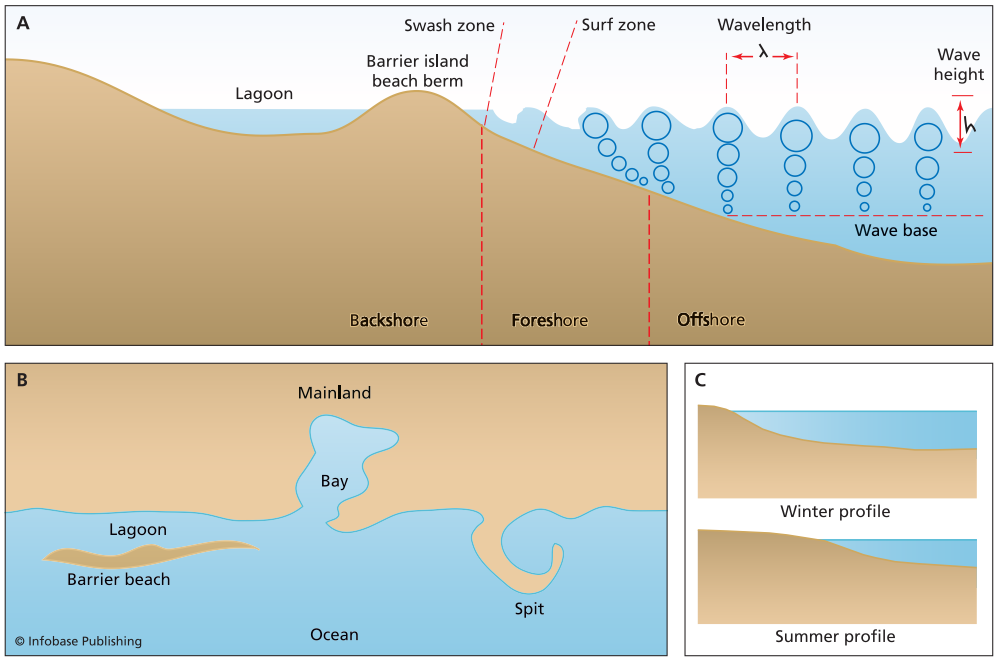
(A) Diagram of beach profile showing the major elements from the backshore to offshore; (B) different types of coastal environments, including barrier beaches, bays, and spits; (C) typical beach profiles in summer and winter showing how large winter storms erode the beach and smaller summer waves rebuild the beach.
Date added: 2026-07-14; views: 101;