
A Biocultural Framework for Language Evolution: Integrating Biological and Cultural Perspectives
Understanding the origins of language remains a pivotal scientific challenge for defining humanity. This paper presents an empirical, multifaceted framework that leverages interdisciplinary synergies to rigorously study language evolution. This approach views language emergence as the convergence of distinct capacities, each with independent evolutionary pathways. Crucially, it adopts an explicit biocultural perspective, systematically incorporating both biological preparedness and cultural transmission, alongside their dynamic interactions. While such perspectives gain traction, a unified framework demonstrating their explanatory power is needed, an aim fulfilled here through three targeted case studies.
The first case study investigates vocal production learning, defined as an organism's ability to expand and alter its vocal repertoire via auditory experience. This capacity is essential for spoken language acquisition, is notably limited in nonhuman primates, but evolved convergently in certain birds, bats, cetaceans, and pinnipeds. Synthesizing data from molecular studies of speech and language disorders, genetic animal models, and ancient DNA research, this study reveals how ancient genetic and neural substrates were modified and recombined to support uniquely human skills. It thus illustrates deep evolutionary repurposing underlying a critical linguistic faculty.
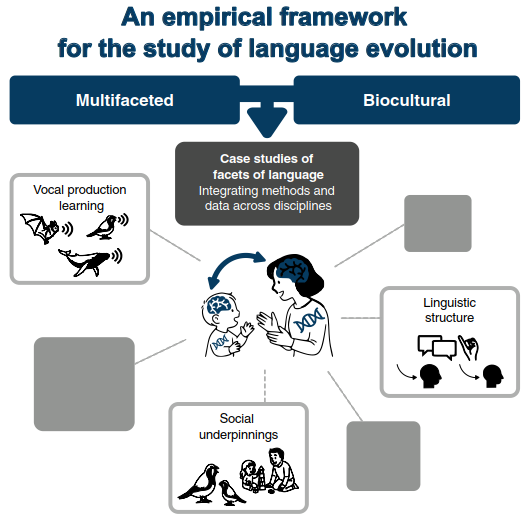
Our framework is both multifaceted and explicitly biocultural and is grounded in empirical investigations spanning a diverse array of fields and benefiting from major advances in methods, analyses, and theory. We demonstrate the potential of this integrated framework through three example case studies, each focused on a different facet with its own distinctive evolutionary history (other facets relevant to language, not discussed in the present paper, could be similarly investigated under this framework; these facets are represented by the empty gray boxes). Drawing on data from multiple disciplines and several species, including humans, primates, and songbirds, the case studies highlight the importance of both biological preparedness and cultural processes, as well as the interactions between them, in the emergence of language.
Case study two analyzes the emergence of linguistic structure, a core, defining property of human language. It integrates evidence from natural experiments like homesign systems and emerging sign languages, laboratory studies of cultural evolution, and comparative research on nonhuman animals including songbirds and primates. Findings underscore the indispensable roles of transmission and social interaction, positing that structural complexity arises from a specific confluence of biological, cognitive, and cultural conditions. Although component traits may exist in other species, their particular combination appears uniquely human.
The third case study focuses on the social underpinnings of communication across species. While social interaction supports language learning in humans and culturally transmitted behaviors in species like songbirds, humans exhibit a distinctive, powerful intrinsic motivation to share information socially. This communicative drive is rarely observed in nonhuman animals and represents a key social foundation for language. This comparison highlights that the evolution of language required not only cognitive machinery but also profound shifts in social motivation and prosociality.
Collectively, these studies demonstrate how modifying and recombining ancestral abilities, coupled with cultural transmission across generations, can yield human linguistic capacity. This broadens the comparative landscape, as relevant traits are distributed across the evolutionary tree. The framework explicitly shows how biological evolution and cultural evolution jointly shape language. Critically, language evolution operates across three interacting timescales: ontogenetic (learning), glossogenetic (cultural), and phylogenetic (biological).
A promising avenue for future research involves the role of biological reward systems, including motivations to communicate and endogenous rewards for successful imitation. This integrative biocultural framework establishes how converging data, methods, and disciplines can address fundamental questions of human origins. It sets a new agenda for empirical research into the synergistic biological and cultural roots of humanity's defining trait: complex language.
Date added: 2026-02-14; views: 464;