
Lateral Magma Propagation and Seismicity: Mechanisms, Hazards, and New Models from Santorini
Introduction to Magma Transport Mechanisms. Traditional volcanology posits that magma—a complex mixture of molten rock, crystals, and volatiles—ascends vertically from deep reservoirs to central volcanic conduits. Contemporary research, however, demonstrates that magma can propagate laterally over distances exceeding tens of kilometers within Earth's crust, driven by extensional stress fields. This lateral transport can trigger hazardous eruptions away from primary volcanic centers, significantly complicating risk assessments. As migrating magma intrudes, it either exploits pre-existing crustal weaknesses, known as faults, or generates new fractures, inducing pronounced seismic activity. A pivotal study by Lomax et al. in Science (2025) analyzed early 2025 seismicity near the Greek island of Santorini, providing direct evidence that earthquakes were generated by a vertical fault activated by laterally intruding magma, offering transformative insights for eruption forecasting.
The Diking Process and Modeling Complexities. The primary mechanism for shallow magma transport is diking, wherein magma injects into blade-like fractures, propagating by cracking rock and deforming the surrounding crust. Accurately modeling this diking process requires integrating the intricate physical properties of both the multiphase magma and the heterogeneous host rock. Magma properties evolve spatially and temporally; viscosity and density change during ascent due to crystallization and gas exsolution as temperature and pressure drop. Concurrently, crustal rocks possess variable composition and pre-stress states, affecting their fracture mechanics. Consequently, comprehensive models must unify concepts from fracture mechanics and fluid dynamics, a challenge current three-dimensional simulations cannot fully capture. Present model validation relies heavily on indirect data, including surface deformation measurements and magma-induced seismicity, underscoring the need for direct observational constraints.
Lateral magma flow within Earth’s crust. Instead of a vertical eruption, magma can flow horizontally into a dike from a deep reservoir that is located underneath a volcanic center. The diking process creates a pumping system in which alternating cycles of contraction and expansion of the dike promote magma to travel laterally underneath Earth’s surface. This creates a potential hazard for unexpected eruption and associated seismicity.
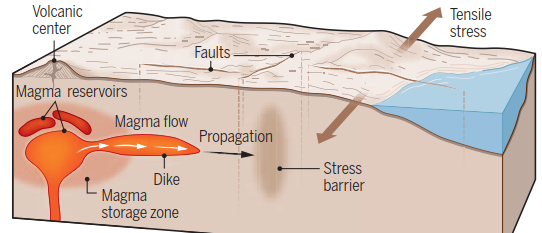
Dike growth. Under the e ect of extensional stress, magma flows horizontally into a dike from a reservoir.
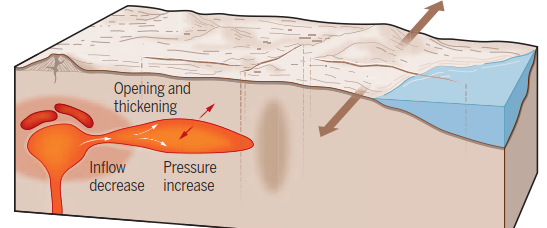
Temporary stop. Transported magma builds up pressure in the dike, which causes a decrease in subsequent magma inflow.
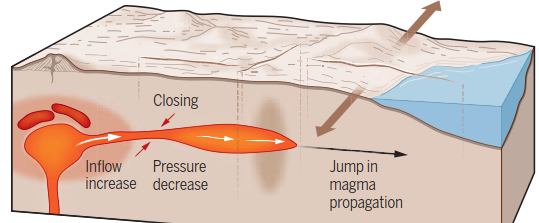
Sudden acceleration. Pressure from magma breaks the stress barrier, which triggers a jump in the propagation front, the closure of the dike at the back, and an increase in magma inflow.
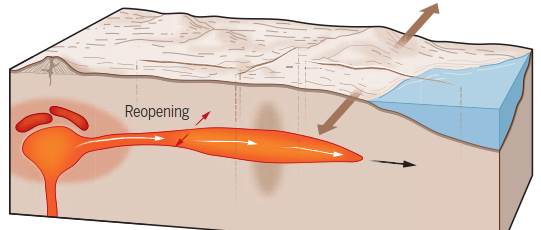
New magma inflow. Magma continues to flow into the dike, traveling tens of kilometers beneath Earth’s surface.
Seismic Tracking of Magma Intrusion at Santorini. Lomax et al. precisely located tens of thousands of earthquakes recorded in January-February 2025 in the Aegean Sea between Santorini and Amorgos. The team used the high-resolution spatiotemporal distribution of this seismicity along a 50-km, southwest-northeast trending zone as a dynamic stress indicator. This detailed catalog enabled the reconstruction of the evolving geometry of the magma-filled fracture through time. Unlike prior studies that inferred dike geometry from sparse ground deformation data, this analysis interpreted the back-and-forth migration of hypocenters to track changes in fracture opening. This method yielded an unprecedented view of pressure evolution within the propagating dike, revealing complex fluid-solid interactions during intrusion.
Dynamic Pressure Changes and Dike Pumping Mechanisms. The seismic analysis revealed a dynamic intrusion process characterized by episodic pressure changes. When increasing magma pressure overcame a local stress barrier, a rapid jump in the propagation front occurred, triggering a pressure wave along the dike's entire length. This sudden acceleration influenced magma influx from the source reservoir. Notably, the study identified alternating phases of dike contraction and expansion following this jump, functioning as a crustal-scale pumping system. This dynamic, where the dike acts as a reciprocating pump, was previously unaccounted for in models which typically dismissed dike closure phases. This process is illustrated in the accompanying figure, which schematically shows the seismicity migration tied to dike opening and pressure pulses.
Cascading Hazards from Lateral Magma Propagation. Santorini is the site of the immense Late Bronze Age eruption and shows signs of modern magmatic recharge, raising concerns about future explosive activity. The Lomax et al. study proposes a critical alternative hazard scenario: a diking event could trigger a distal underwater eruption or destabilize major faults in this seismically active region, potentially generating a tsunami. This underscores the significant risk when magma reaches the surface far from a recognized volcanic center, impacting unprepared populations. An emblematic case is at Lake Kivu in East Africa, where magma propagated beneath the gas-saturated lake roughly 17 km from the volcanic source, elevating the risk of a catastrophic limnic eruption releasing lethal gases. Such high-consequence events highlight the urgent need for improved transport models integrated with real-time monitoring.
Toward Advanced Models and Predictive Forecasting. The findings pave the way for new dynamic models of magma transport that incorporate spatial variations in host rock fracture resistance. Beyond tracking magma movement, detailed seismicity can illuminate the state and evolution of the broader crustal stress field. For instance, lateral propagation may be favored where increasing extensional stress with depth counteracts magma buoyancy. Magma flow is also modulated by its interaction with pre-existing faults. Integrating high-resolution seismic catalogs into numerical models will enhance stress field characterization, especially in regions prone to lateral propagation. Ultimately, merging real-time observations with advanced models through data assimilation or machine-learning techniques promises improved prediction of eruption location and timing, directly benefiting hazard mitigation efforts globally.
Date added: 2026-02-14; views: 432;