
Metamorphosis: The Science of Biological and Human Transformation in Oren Harman's Natural History
In his work "Metamorphosis: A Natural and Human History," historian of science Oren Harman presents a profound exploration of change, examining both the remarkable biological transformations in nature and the profound personal evolutions humans undergo. Through a mosaic of loosely connected essays, Harman contemplates processes as diverse as a caterpillar becoming a butterfly and the ways people are reshaped by new experiences and ideas. This structure allows for a wide-ranging meditation, weaving together scientific fact with philosophical inquiry into the universal principle of metamorphosis.
The biological phenomenon of insect metamorphosis has a deep evolutionary history. According to the fossil record, this process evolved approximately 280 million years ago. However, Harman notes that its ultimate success was catalyzed by the rise of flowering plants some 150 million years later, driving a powerful coevolutionary partnership. This relationship spurred the diversification of insects utilizing complete metamorphosis, or holometaboly, a distinct and highly successful life history strategy.
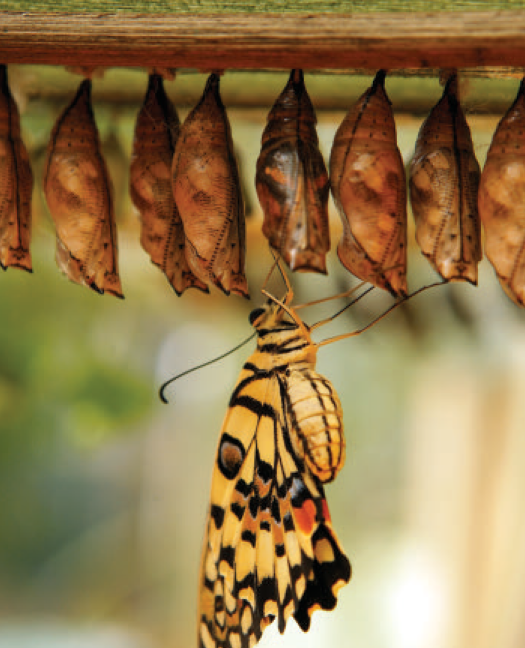
There are many advantages to having drastically different life stages
Insects undergoing complete metamorphosis progress through four distinct life stages: egg, larva (e.g., caterpillar), pupa, and adult. This contrasts with incomplete metamorphosis (hemimetaboly) seen in insects like grasshoppers, where juveniles are nymphs resembling miniature adults. For years, the evolutionary homology between these stages was debated. One hypothesis, from entomologist Antonio Berlese, suggested the larval stage represented a precociously hatched pronymph. Conversely, scientist Howard Hinton argued that larvae were equivalent to the nymphal stages of hemimetabolous insects.
Regardless of its precise evolutionary origin, complete metamorphosis is undeniably a successful adaptation. Scientific consensus highlights key advantages: it eliminates intraspecific competition for resources between juveniles and adults, as their forms and ecological niches are utterly different. Each stage becomes specialized, with larvae optimized for feeding and growth, and adults dedicated to dispersal and reproduction. This division of labor is a masterstroke of evolutionary innovation.
A narrative highlight from Harman's first section, "Where Do We Come From?," is his empathetic portrait of 17th-century naturalist Maria Sibylla Merian. Harman details her meticulous documentation of insect life cycles and her daring voyage to the Dutch colony of Suriname with her daughter, Dorothea Maria, to study tropical species. This recounting celebrates not only Merian's seminal scientific contributions to entomology but also her extraordinary personal courage and humanity in an era hostile to women in science.
In Part Two, "Where Are We Going?," Harman traces the history of evolutionary thought from the 18th century onward. He vividly contextualizes the ideas of figures like Johann Wolfgang von Goethe, Ernst Haeckel, and Charles Darwin, intertwining their theoretical contributions with insights into their personal lives and intellectual milieus. This approach breathes life into the historical narrative of how scientific understanding of transformation itself has evolved over centuries.
The book's final section brings the story into the modern laboratory, chronicling the work of contemporary entomologists Lynn Riddiford and Jim Truman. Harman traces the arc from foundational studies by Vincent Wigglesworth—a pioneer of insect physiology—to modern breakthroughs in evolutionary developmental biology ("evo-devo"). This research has identified key genetic regulators, such as juvenile hormone and ecdysone, which orchestrate the precise hormonal cascade of metamorphosis.
Harman also turns introspection, considering his own experience of becoming a father for the third time as a profound human metamorphosis. He reflects that people and relationships are among the most powerful agents of personal change. However, some readers may find the connection between these personal reflections and the book's broader scientific themes less explicitly drawn, desiring a clearer articulation of how such life events catalyze internal transformation.
A potential area for deeper exploration is the inherent bittersweetness of change—the necessary loss of a former state. The vulnerable, liminal pupal stage serves as a powerful metaphor for the human experience of shedding an old identity without certainty of the new form to come. In an increasingly unstable world demanding constant adaptation, the radical transformations seen throughout nature offer instructive lessons on resilience and navigating profound change. The accompanying figure illustrates the comparative life cycles of holometabolous and hemimetabolous insects, highlighting the key morphological stages discussed.
Date added: 2026-02-14; views: 391;