
Coastal Sand Dunes and Lagoons: Formation, Ecology, and Geomorphic Significance
Coastal sand dunes represent significant geomorphic features in many backshore environments, often attaining heights of several tens of meters. Their presence, morphology, and dimensions are primarily governed by the volume of available sediment, although wind energy regimes and vegetative cover distribution are also critical controlling factors. These fragile ecosystems are highly susceptible to disruption from anthropogenic activity or altered beach dynamics, yet they serve an essential protective function. Specifically, coastal dunes shield inland areas from storm wave energy, surge inundation, and other oceanic hazards, including tsunamis.
The most prevalent dune type is the linear foredune, which forms elongated ridges parallel to the shoreline just landward of the foreshore. Multiple foredune ridges may develop in sequence, with the most landward ridges typically being the oldest. Younger dunes form progressively seaward, creating a chronosequence that records coastal progradation. These structures originate from the aeolian transport and accumulation of sand derived from the beachface. Unobstructed by topography or development, these sands can migrate considerable distances inland.
Vegetation plays a paramount role in stabilizing mobile sand sheets and facilitating dune growth. Plants effectively trap windblown particles, a process observable on coastlines globally. However, despite slow constructive processes, dunes are vulnerable to rapid degradation during high-energy events. Elevated sea levels during storm surges can drive intense wave attack, eroding years of accumulation within hours. This was starkly demonstrated by Hurricanes Katrina (2005) and Ike (2008), which caused massive dune scarping and sediment redistribution.
Catastrophic events like tsunamis can obliterate entire dune fields instantaneously, as evidenced by the Indian Ocean tsunami of December 2004. Furthermore, long-term sea-level rise presents an existential threat, as even modest increments can force extensive shoreline transgression. For instance, a 0.3-meter sea-level rise on a low-gradient coast can translate to a shoreline retreat exceeding 300 meters, potentially displacing or completely eradicating existing dune systems.
Coastal lagoons constitute a distinctive and relatively rare class of restricted coastal embayments. They are defined by separation from the ocean via an efficient barrier that minimizes tidal exchange and by negligible freshwater influx from the mainland. Their hydrology is dominated by direct precipitation and occasional storm overwash, leading to net evaporation. This excess evaporation typically results in elevated salinity levels, fostering unique hypersaline environments and specialized biotic communities.
Most lagoons are elongate, shore-parallel features sheltered behind barrier islands or, in tropical settings, reefs. They thrive in arid to semi-arid climatic zones where limited freshwater runoff prevents dilution. Consequently, notable lagoon systems are found along the coasts of the Persian Gulf, North Africa, Australia, Texas, and southern Brazil. These environments exhibit pronounced seasonal salinity fluctuations, ranging from near-fresh conditions during rains to hypersaline or even desiccated states in dry periods.
Such extreme salinity variability excludes most typical marine and estuarine organisms. Instead, lagoonal biota are characterized by low species diversity but high abundance of specially adapted forms. Certain euryhaline fish, like the killifish, possess advanced osmoregulatory capabilities, allowing them to thrive. Similarly, some gastropod species exhibit high salinity tolerance and can dominate lagoon sediments. The ecological simplicity of these systems makes them highly sensitive to environmental change.
As lagoon waters evaporate, particularly in summer months, they precipitate chemical sediments known as evaporites and carbonates. This generates a characteristic mineralogical sequence from aragonite to calcite to gypsum and finally to halite (rock salt). In the geological record, ancient lagoon deposits are frequently identified by repetitive sequences of these evaporite minerals interlayered with carbonate muds.
Lagoonal hydrodynamics are dominated by wind rather than waves or tides. Wind stress can induce circulatory currents and generate small waves. It can also setup wind tides that transport water and suspend fine-grained sediments to one end of the lagoon, where they settle as the wind abates. During major oceanic storms, surges may overtop the confining barrier, importing pulses of seawater and sediment. Furthermore, onshore winds can transport sand from adjacent beaches and dunes into the lagoon, contributing significantly to its sedimentary budget.
Lagoon sediments comprise layered chemical precipitates, fine-grained carbonate muds like micrite, and clastic grains transported by wind and overwash. The margins are often covered by mucilaginous micrite layers hosting mat-forming cyanobacteria (blue-green algae). These microbial mats can dry and form desiccation cracks, creating thin flakes susceptible to aeolian transport. Sediments also include biogenic remains from lagoon-dwelling organisms. Storm-derived sand often forms distinct wash-over fans on the seaward margin of the lagoon, creating fan-shaped sedimentary bodies.
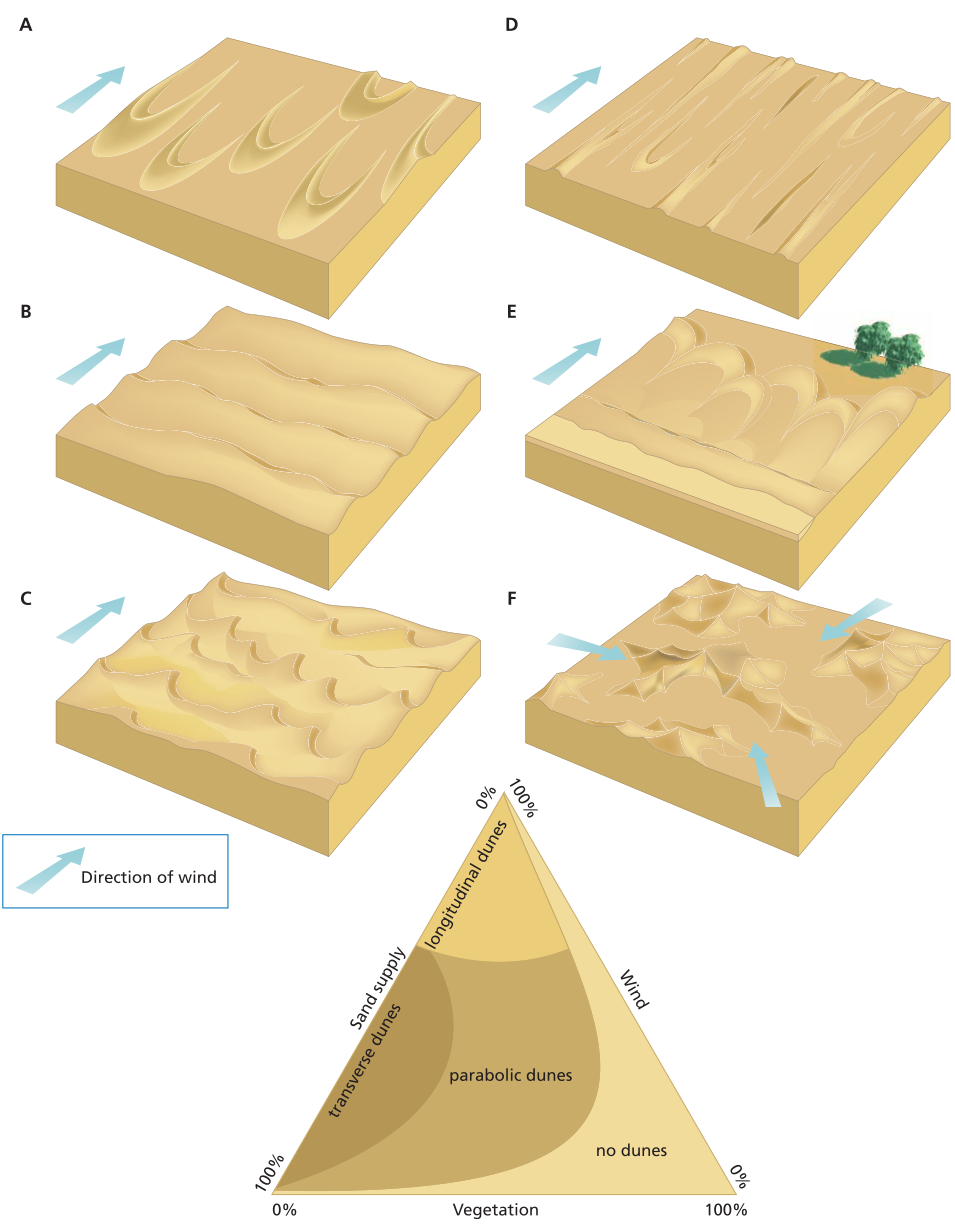
Block diagram of types of dunes including (A) barchan, (B) transverse, (C) barchanoid, (D) linear, (E) parabolic, and (F) star. Graph (triangular) illustrates which types of dunes form under different conditions of wind, sand supply, and vegetative cover.
The accompanying figure illustrates the primary dune morphological types: barchan, transverse, barchanoid, linear, parabolic, and star. Their formation is contingent on the interplay of three key variables: wind regime, sand supply, and vegetative cover, as depicted in the triangular graph. This model highlights how environmental parameters control the resulting dune geometry, from sand-starved barchans to vegetated-stabilized parabolic forms. Understanding these relationships is crucial for coastal management and forecasting landscape response to changing conditions.
Date added: 2026-07-14; views: 116;