
Archean Cratons: Formation, Accretionary Growth, and Cratonization of Continental Crust
Introduction to Cratons. Cratons are vast, stable regions of thick continental crust that have remained largely undeformed since the Archean Eon. These ancient cores of continents are characterized by low heat flow, minimal seismic activity, and the presence of a deep, cold, refractory mantle root or tectosphere. This thick lithospheric keel formed through the extraction of basaltic melts during the Archean, contributing to the craton's long-term stability and rigidity. Understanding their origin is central to deciphering the growth and evolution of continental crust through geological time.
The Growth of Continental Crust. The formation of stable continental cratons is linked to processes that change the volume and composition of the crust. Geological evidence indicates continental growth since the early Archean, though the rates and mechanisms of crustal growth versus recycling are debated. The oldest known rocks, the ~4.0-billion-year-old Acasta gneisses from the Slave Province, show chemical signatures akin to modern suprasubduction zone settings. Similarly, the 3.8-billion-year-old Isua sequence in Greenland represents an ancient accretionary complex. These findings suggest that approximately half of today's continental mass was extracted from the mantle during the Archean, with subduction zone magmatism playing a crucial role.
Archean Craton Terranes. Exposed Archean cratons are broadly divided into two types. Granite-greenstone terranes consist of deformed mafic volcanic rocks, metasediments, ancient gneisses, and abundant late granitoids. Conversely, high-grade gneiss terranes are dominated by quartzo-feldspathic rocks. Relatively undeformed cratonic cover sequences overlie these terrains, notably on the Kaapvaal craton in southern Africa. Some Archean covers include extensive carbonate platforms, analogous to younger Phanerozoic examples, indicating early stable, subsiding lithosphere.
Mechanisms of Crustal Accretion. Continental crust predominantly grew via accretionary and magmatic processes at convergent plate boundaries since the early Archean. The arc-like geochemical signature of crust confirms the importance of subduction zone magmatism. Accretionary growth is categorized into five mechanisms: oceanic plateau accretion, juvenile island arc accretion, normal oceanic crust accretion/ophiolite obduction, back-arc basin accretion, and accretion through arc-trench migration or Turkic-type orogeny. These are typically followed by late-stage anatectic granite intrusion, gravitational collapse, and strike-slip faulting, which help stabilize new crust.
Juvenile Island Arc Accretion. Many Archean granite-greenstone terranes are interpreted as accreted juvenile island arcs that formed above subduction zones and later amalgamated during collisions. Geochemical studies support this, as the bulk composition of continental crust resembles that of arcs. These complex systems can accrete ophiolite fragments, oceanic plateaus, and preserve back-arc basins. While a major growth mechanism, some argue that oceanic arc accretion alone cannot account for the rapid crustal growth seen in Precambrian shields, especially given the mafic composition of most arcs versus the andesitic bulk crust.
Ophiolite Accretion. Ophiolites are distinctive assemblages of allochthonous rocks formed at spreading centers, back-arc basins, or other extensional settings. A complete sequence includes pelagic sediments, pillow basalts, a sheeted dike complex, layered gabbros, and tectonized peridotite. Few complete Phanerozoic-like ophiolites are recognized in Archean greenstone belts, though many contain dismembered sections. Thicker Archean oceanic crust, possibly resembling modern oceanic plateaus, likely led to accretion of only the upper basaltic sections during orogenies.
Examples of Archean Ophiolites. Several Archean belts contain inferred ophiolitic fragments. The disputed ~3.5-Ga Jamestown ophiolite in the Barberton greenstone belt (Kaapvaal craton) includes peridotite tectonite, an intrusive-extrusive sequence, and a chert-shale cap, showing evidence of high-temperature seawater alteration. In the Slave Province, a Point Lake sequence exhibits pillow lavas, dike complexes, gabbros, and a basal shear zone of mafic mylonites. A 2.5-billion-year-old dismembered ophiolite in the North China craton includes faulted pillow lavas, gabbros, cumulate ultramafics, and mantle peridotites. The abundance of such fragments suggests buoyant Archean oceanic lithosphere often delaminated during subduction.
Oceanic Plateaus Accretion. Oceanic plateaus, formed from mantle plumes, are thicker and more buoyant than normal oceanic crust, making them resistant to subduction and prime for accretion. This mechanism is proposed for many orogenic belts. Plateaus may be sites of komatiite formation, as seen in the correlation of Cretaceous Caribbean oceanic plateau rocks with allochthonous komatiites. In Archean terrains, like parts of the Zimbabwe craton, komatiite-tholeiite sequences are interpreted as dismembered ~2.7-Ga oceanic plateaus. Accreted plateaus are often overprinted by arc magmatism and may constitute a significant portion of the lower continental crust.
Back-Arc Basin Accretion. The formation, closure, and preservation of back-arc basins is a model for some greenstone belt evolution. This presents a paradox, as Archean subduction is thought to have been more compressional, while back-arc basins require extension. Nevertheless, the analog is frequently invoked, suggesting these extensional basins played a role in crustal assembly despite the different early tectonic regime.
Arc-Trench Migration and Turkic-Type Orogeny. Turkic-type orogeny describes the building of vast accretionary complexes on a continent prior to collision, through which magmatic arcs migrate. These wedges contain flysch, mélange, ophiolites, plateaus, and island arcs. This orogeny is a principal continental crust builder. Archean terrains show early accretion phases followed by arc magmatism, possibly from arc migration through large accretionary wedges, as seen in the Superior Province. Late strike-slip faulting adds complexity, similar to Phanerozoic examples like the Altaids. This model provides a unified framework for crustal growth via accretion.
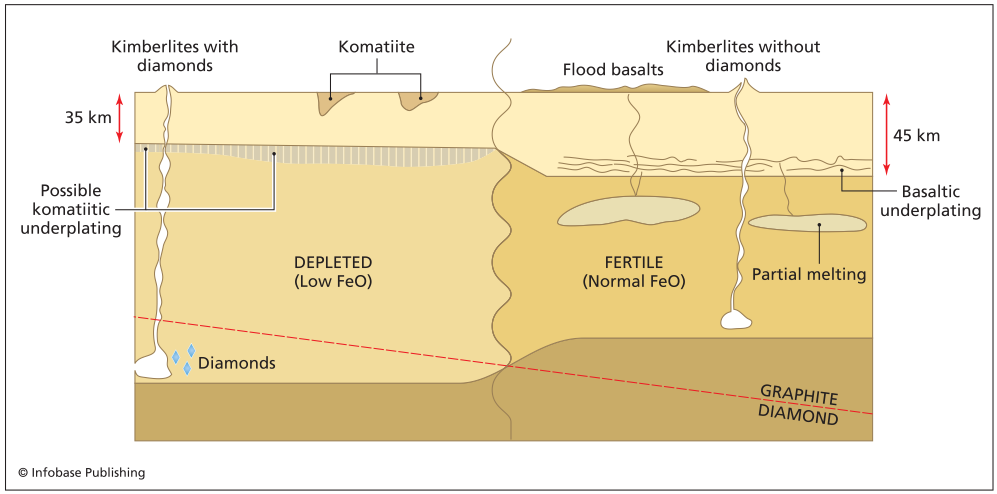
Idealized cross section of craton, showing thick mantle root
Late-Stage Granites and the Cratonization Process. Archean cratons are ubiquitously intruded by late- to post-kinematic granitoid plutons, associated with the stabilization or cratonization of the crust. This process is linked to the development of a thick, refractory, cold mantle root. Growth via accretion allows for the underplating of depleted oceanic lithospheric slabs. These cold, buoyant slabs contribute to forming the cratonic root. A key difference in the Archean was the buoyancy of subducted slabs, preventing deep subduction and enabling root formation.
Model for Craton Stabilization. In this model, late orogenic collapse leads to decompressional melting of fertile mantle wedges. The resulting basaltic melts intrude the lower crust, causing anatexis and generating silicic magmas that ascend as late-stage granitoids. Concurrently, the mantle root becomes compositionally buoyant and cold, forming a stable tectosphere that shields the crust from deformation. Furthermore, late strike-slip faults act as conduits for fluid escape from the lithospheric mantle, enhancing root stabilization and facilitating large-scale granite emplacement in the upper crust.
Date added: 2026-07-14; views: 162;