
Corals and Coral Reefs: Formation, Evolution, and Geological Significance
Corals are marine invertebrate organisms belonging to the phylum Cnidaria, characterized by radial symmetry and a simple sac-like body plan without true organs. They are closely related to jellyfish, sea anemones, and hydroids, sharing the defining cnidarian trait of specialized stinging cells (cnidocytes) used for capturing prey. Corals are exceptional within the phylum for their preservation potential because they secrete a durable external skeleton of calcium carbonate (calcite or aragonite). The individual coral animal, or polyp, consists of a central mouth surrounded by tentacles, leading to a blind gut cavity, and functions as a passive predator.
These organisms exhibit a life cycle with alternating generations, though in corals the medusa (jellyfish) stage is absent. Corals exist predominantly in the asexual polyp form, which reproduces by budding to form colonies. Taxonomically, true or stony corals belong to the subclass Zoantharia within the class Anthozoa. This distinguishes them from the jellyfish (class Scyphozoa) and the hydroids (class Hydrozoa), which often have prominent medusa stages and include freshwater species.
Corals inhabit a broad bathymetric range, from shallow tidal pools to abyssal depths exceeding 19,700 feet (6,000 meters). The organism's living polyp occupies the top cup of a secreted cylindrical or conical skeleton. This skeletal structure features radial internal partitions called septa that connect to the outer wall (theca), and often displays horizontal plates known as tabulae, resulting from the polyp's periodic upward growth within its calice.
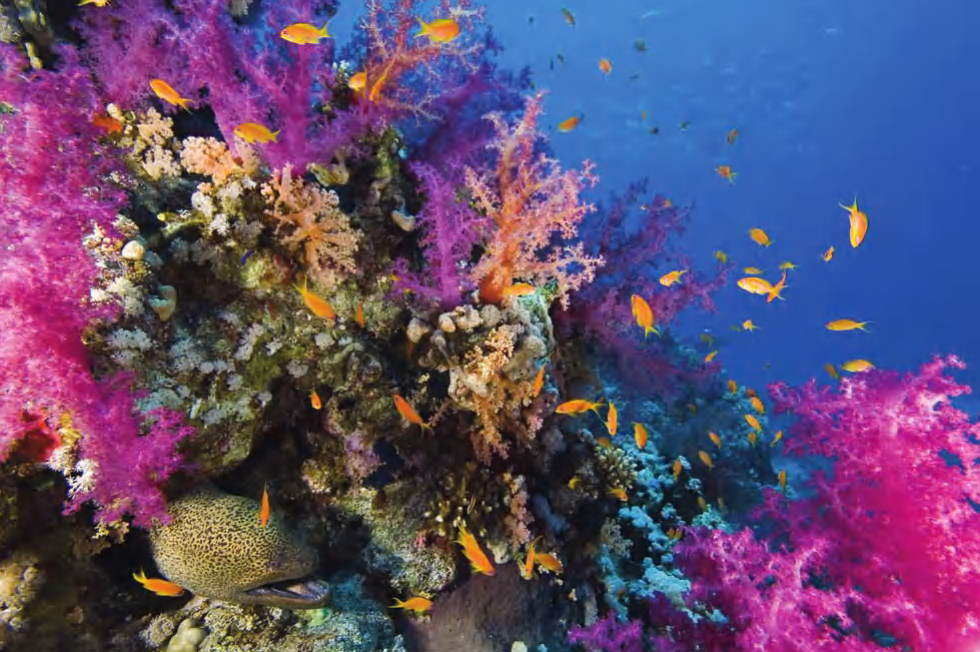
Coral reef in the Red Sea, Egypt
The fossil record of corals is extensive, beginning with the Tabulata in the Early Ordovician period, followed by the Rugosa (rugose corals) in the Middle Ordovician. Both groups suffered a major extinction in the Late Devonian, with rugose corals recovering more robustly. These ancient forms ultimately went extinct in the Early Triassic, succeeded by modern Scleractinia (scleractinian corals), which likely evolved independently from soft-bodied ancestors and are the primary reef-builders today.
Most reef-building corals are colonial, with interconnected polyps constructing massive communal skeletons. These formations provide critical ecosystem advantages, including shelter for juvenile marine life and protection for coastlines. A coral reef is specifically a wave-resistant, framework-supported carbonate structure built by living organisms, predominantly corals and coralline algae. The spaces within this biological framework are filled with skeletal debris and sediment, which become cemented to form a robust topographic feature.
Modern reef-building (hermatypic) corals have strict environmental requirements, surviving only in shallow, sunlit (photic zone) waters warmer than 77°F (25°C) and typically less than 300 feet (90 meters) deep. This restriction exists because they rely on a symbiotic relationship with photosynthetic dinoflagellate algae called zooxanthellae. The algae reside within the polyp's tissues, providing nutrients through photosynthesis in exchange for shelter and carbon dioxide, a partnership essential for rapid calcification and reef growth.
Reef ecosystems are constructed by a consortium of organisms, including corals, coralline algae, sponges, and mollusks. Colonial scleractinian corals are the dominant modern architects, secreting an aragonite skeleton characterized by intricate septa. The polyps facilitate calcification by converting calcium bicarbonate from seawater into calcium carbonate, which is deposited at their base, continually accreting the reef structure.
Reefs are classified morphologically based on their proximity to land. Fringing reefs grow directly adjacent to a shoreline, often separated by a shallow channel. Barrier reefs develop farther offshore, separated from the coast by a deeper, wider lagoon; the Great Barrier Reef is the planet's largest such example. These structures exhibit clear ecological zonation, with a high-energy, fast-growing windward side facing the open ocean and a quieter leeward side bordering the lagoon.
Atolls are ring-shaped coral reefs that rise from deep water and encircle a central lagoon, often with no volcanic island inside. They typically range from half a mile to over 80 miles in diameter and are common in the Pacific and Indian Oceans. The most active coral growth occurs on the atoll's outer margin, where nutrient-rich upwelling supports prolific growth, sometimes forming overhanging ledges.
The origin of atolls was famously explained by Charles Darwin following his voyage on the HMS Beagle. His subsidence theory proposed that atolls begin as fringing reefs around a volcanic island. As the oceanic plate slowly subsides, the coral grows upward, maintaining its position in the photic zone, sequentially forming a barrier reef and finally an atoll as the central island disappears below sea level. This hypothesis was confirmed a century later when drilling on atolls like Enewetak found volcanic basalt beneath kilometers of carbonate rock.
Plate tectonics provides the mechanism for subsidence: oceanic crust cools, densifies, and sinks as it moves away from mid-ocean ridges. Volcanoes forming on this crust initially rise above sea level but gradually subside. If located in tropical waters, corals can keep pace with this subsidence, forming an atoll. If subsidence outpaces coral growth or conditions are unfavorable, the summit is eroded flat by waves, forming a submerged guyot.
Coral reefs are extremely sensitive environments, vulnerable to temperature changes, pollution, sedimentation (turbidity), and physical destruction. They face threats from coastal development, mining, and historical activities like nuclear testing. This ecological fragility underscores the importance of conservation efforts for these biodiverse marine habitats.
Due to their high primary porosity and organic content, ancient fossil reefs are significant reservoirs in hydrocarbon exploration. Notable examples in the geological record include the Permian Capitan Reef of Texas, the Devonian reefs of Canada, and Triassic reefs in the Alps. While the dominant reef-building organisms have changed through Earth's history—from stromatoporoids and rudist bivalves to modern corals—the fundamental ecological structure of the reef ecosystem has remained remarkably consistent for hundreds of millions of years.
Date added: 2026-07-14; views: 162;