
Convergent Plate Margins: Processes, Geology, and Arc System Variations
Structural, igneous, metamorphic, and sedimentary processes occurring due to lithospheric plate convergence are collectively termed convergent plate margin processes. These dynamic boundaries are fundamentally categorized as subduction zones or collision zones. Subduction zones are further divided: ocean-ocean convergence, where one oceanic plate descends beneath another (e.g., the Marianas), and ocean-continent convergence, where an oceanic plate subducts beneath a continental plate (e.g., the Andes). The southern Alaska margin exemplifies a transitional setting, shifting from ocean-continent to ocean-ocean convergence along the Aleutian chain.
Convergent arcs possess distinct geomorphic zones defined by topography and structure. The active arc is the volcanic topographic high, while the backarc region extends from the arc away from the trench, potentially terminating at a rifted older arc or continent. The forearc basin is a typically flat-lying basin containing shallow to deep-water sediments, often overlying accreted materials or ophiolitic basement. The accretionary prism comprises intensely deformed rocks scraped off the downgoing slab along thrust faults. The deep trench marks the surface boundary between plates, with the outer trench slope rising to a forebulge on the subducting plate.
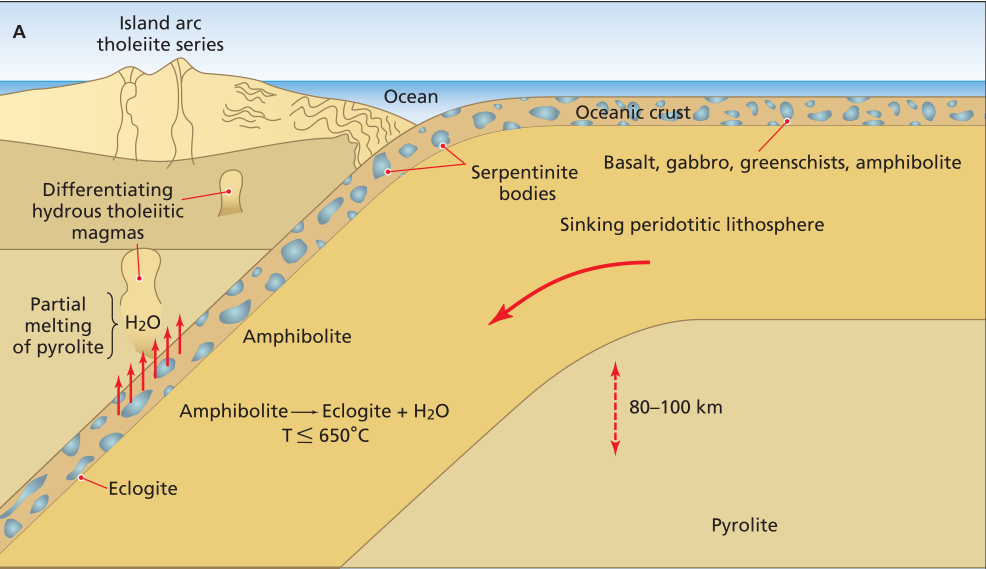
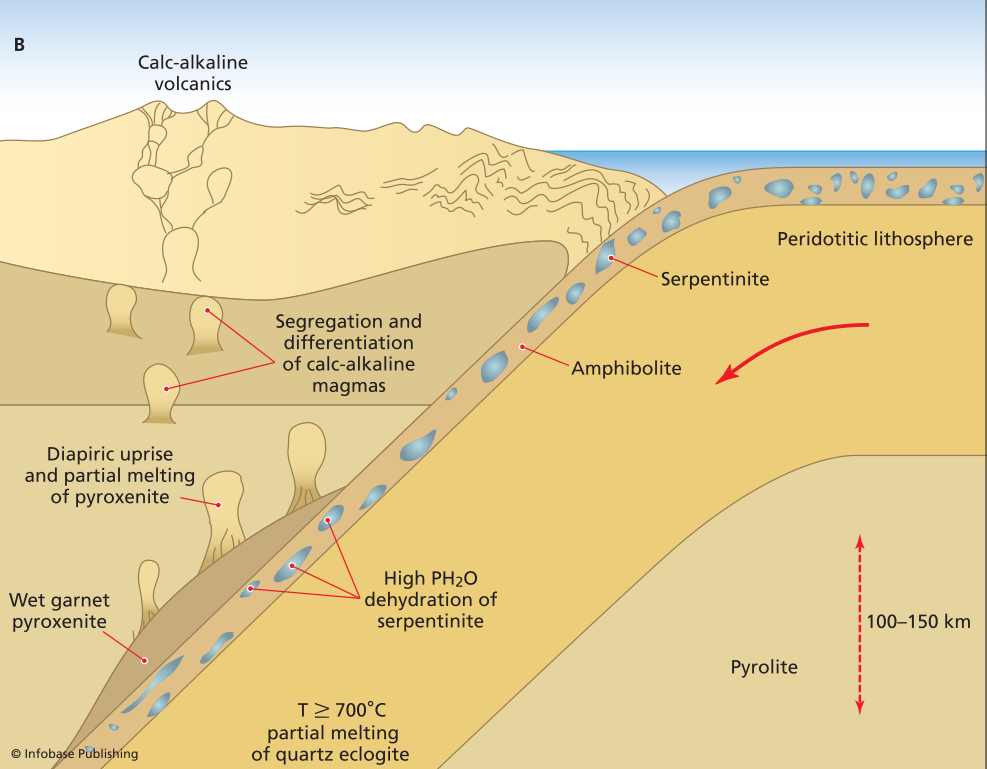
Physiography and geology of arcs: (a) Pacific-type; (b) Andean-type
Trench floors are triangular in profile and commonly filled with greywacke-shale turbidite sediments eroded from the accretionary wedge. These sediments can be transported axially for thousands of kilometers from their source in the convergent orogen. Flysch refers to rapidly deposited, deep-marine syn-orogenic clastic turbidites. Trenches also contain chaotic olistostromes, interpreted as submarine landslide deposits with blocks (e.g., limestone) in a muddy matrix, formed from slope oversteepening. Accreted sediments may include pelagic sediments like red clay, siliceous ooze, chert, and calcareous ooze from the subducting plate.
Flat-lying trench turbidites are progressively incorporated into the accretionary wedge via folding and fault propagation. This subduction accretion process uplifts and rotates the prism in a steady-state manner as new material is added at its toe. New faults propagate beneath older ones, rotating prior structures to steeper attitudes, creating a seaward-younging deformation age. This mechanism systematically increases the wedge's size over geologic time.
Basement rocks of the subducting slab are often scraped off as tectonic slivers, incorporating basalt, gabbro, and ultramafic rocks into the prism. Partial or complete ophiolite sequences may be preserved within these slivers. They are commonly embedded in melanges, which are chaotic, tectonically mixed units containing blocks of oceanic crust or limestone in a sheared muddy, shaly, or serpentinitic matrix. Melanges are hallmark rock units of convergent boundaries, formed by intense tectonic mixing in the forearc.
Significant process differences exist between Andean-style and Marianas-style arc systems. Andean-type arcs have shallow trenches (<6 km) and subduct young oceanic crust on shallow-dipping slabs, whereas Marianas-type arcs have deep trenches (~11 km) subducting old crust on steep Benioff zones. Andean backarcs feature foreland (retroarc) fold-thrust belts and sedimentary basins on thick continental crust (~70 km), while Marianas-type backarcs often have extensional backarc basins with seafloor spreading on thin oceanic crust (~20 km).
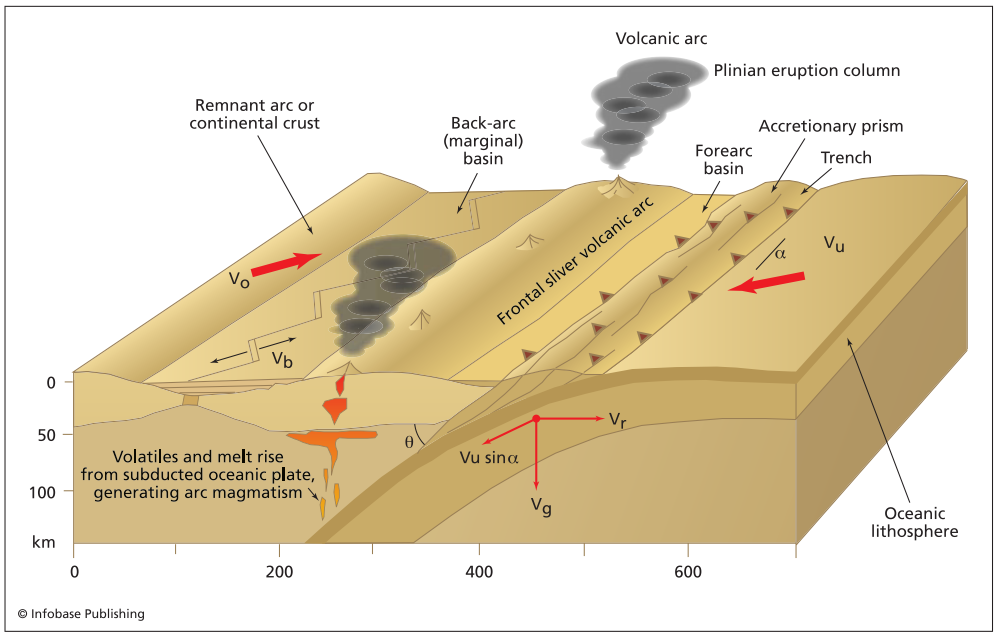
Relative motion vectors in arcs. Changes in relative motions can produce drastically different arc geology. Vu = velocity of underriding plate; Vo = velocity of overriding plate; Vb = slip vector between overriding and underriding plates; Vg = velocity of sinking; Vr = velocity of rollback. Note that Vu sin a = velocity of downdip component of subduction, and Vr = Vg cot θ.
Magnatism also differs markedly: Andean arcs have sparse, silica-rich rhyolitic and andesitic volcanoes and abundant plutonism, while Marianas-type arcs exhibit frequent eruptions of low-silica basalt. Many arcs are transitional between these end-members, with some involving significant strike-slip motion. Convergence rate has minimal influence on these variations; the subducted crust's age and relative plate motion vectors are primary controls. Old, dense crust sinks steeply, causing slab rollback that can drag the forearc and promote backarc basin formation.
Variations in arc processes are largely attributable to the relative convergence vectors between the overriding and underriding plates. In kinematic models, the active arc, a surface expression of the ~110 km depth isobath on the slab, separates the overriding plate into a frontal arc sliver (trench to arc) and the main plate. The sliver often moves parallel to the margin, accommodating oblique convergence. The convergence angle determines strike-slip motion, while slab rollback (age-dependent) influences whether the sliver rifts to form a backarc basin. This model explains the spectrum from extensional to compressional arcs.
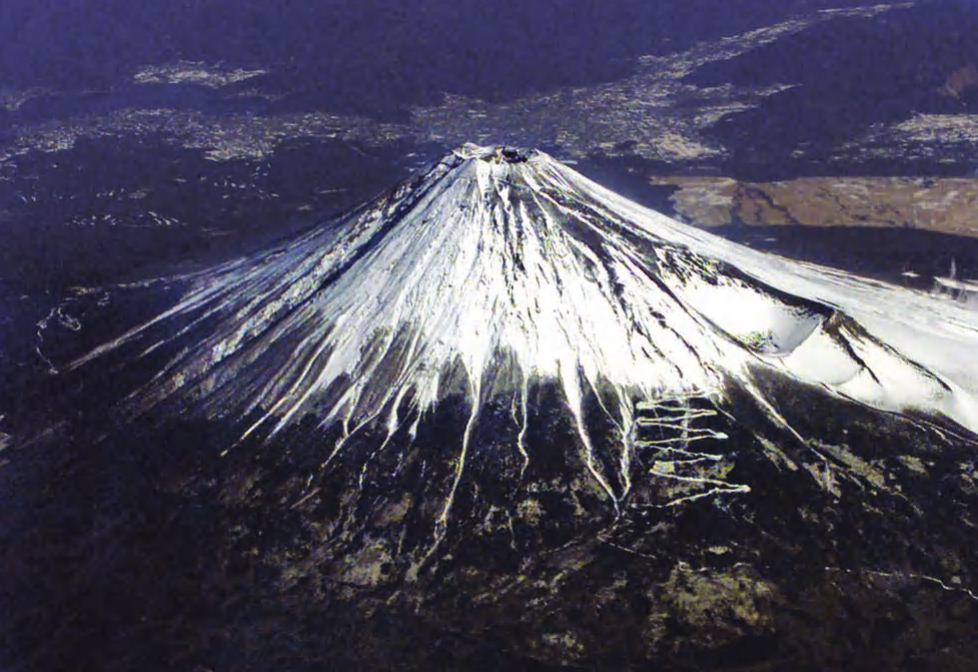
Snow-covered Mount Fuji in Japan—a classical, active convergent margin volcano
The thermal structure of arcs is dominated by the cool, subducting slab, which refrigerates the forearc. Fluids released from the slab beyond ~110 km depth facilitate partial melting in the overlying mantle, generating arc magmas. This thermal regime creates paired metamorphic belts: the trench records low-temperature, high-pressure blueschist facies metamorphism, while the arc exhibits high-temperature facies. Index minerals like glaucophane, jadeite, and lawsonite in paleo-trenches indicate cool conditions extended to great depths, uniquely preserved by subduction.
Forearc basins accumulate kilometers of sediment due to tectonic loading or thermal subsidence. California's Great Valley is a fossil forearc basin on oceanic crust, preserved as ophiolitic fragments. Alaska's Cook Inlet is an active forearc basin fronting the Aleutian-Alaska Range volcanic arc. These basins archive the tectonic and sedimentary evolution of the convergent margin.
Active arc rock facies are diverse, including subaerial flows, tuffs, volcaniclastic sediments, and pelagic rocks. Debris flows and thick ash deposits from Plinian eruptions are common. Volcanic series are predominantly calc-alkaline, showing early iron enrichment, with compositions ranging from basalt to rhyolite. Immature island arcs erupt more mafic rocks like tholeiitic basalts and picrites, while mature continental arcs produce more felsic magmas and large caldera complexes.
Backarc and marginal basins form behind extensional arcs or are trapped oceanic crust fragments. The southwest Pacific has many extensional backarcs with active spreading, while the Bering Sea is considered trapped crust behind the Aleutian arc. These spreading centers resemble mid-ocean ridges, though lavas often show geochemical signatures influenced by water and volatiles from the nearby subduction zone, marking them as suprasubduction zone environments.
Compressional arcs like the Andes feature broad, high mountains (>7,000 m), significant plutonism, and shallow-dipping slabs. They are characterized by thick continental crust, major compressional earthquakes, and a retroarc foreland basin. Some segments experience subduction erosion, where material is scraped from the overriding plate and dragged down. The Andes exhibit sharp along-strike variations linked to subducted features and plate vectors: steep slab segments correlate with volcanism, while shallow subduction segments are devoid of volcanoes.
In conclusion, convergent margins are complex, dynamic systems where the interplay of plate kinematics, subducted slab age and composition, and thermal-fluid processes generates a diverse spectrum of geologic phenomena. From the deep-sea trench to the volcanic arc and beyond, these zones are fundamental to understanding crustal growth, mountain building, and Earth's tectonic evolution.
Date added: 2026-07-14; views: 169;