
Mantle Convection: Earth's Primary Heat Engine Driving Plate Tectonics and Geodynamics
The dominant mechanism for heat transfer within the Earth's interior is mantle convection, a thermally-driven process fundamental to planetary dynamics. Heating at depth causes mantle material to expand, reducing its density and triggering ascent, while cooler, denser surface material sinks in a complementary flow. This cyclical motion forms an efficient planetary cooling cycle, as rising material releases heat upon ascent and cooling, while sinking material is reheated to eventually rise again. While other processes like conduction and radiation contribute, mantle convection is the principal mechanism by which Earth loses its internal heat and is the core driver of the plate tectonic cycle.
This convective heat transport profoundly shapes the surface. Mantle convection brings heat to the base of the lithosphere, where partial melting generates magmas that form new oceanic crust at mid-ocean ridges. These ridge axes are sites of intense hydrothermal circulation, expelling heat through features like black smoker chimneys. As tectonic plates move away, they cool conductively and subside, following the square root of their age, deepening from approximately 2.5 to 4.0 kilometers below sea level. Thus, the moving lithospheric plates represent the conductive, cooling boundary layer of Earth's large-scale mantle convection systems.
The energy powering this engine originates from multiple sources: the decay of radioactive isotopes like Uranium-235, Thorium-232, and Potassium-40; remnant heat from planetary accretion and core formation; and latent heat from ancient impacts. Early in Earth's history, intense heat likely resulted in a partially molten mantle, with the planet cooling convectively ever since. Although precise quantification is challenging, scientific estimates suggest the mantle may have been several hundred degrees Celsius hotter during the Archean Eon than it is today.
The efficiency of convection depends critically on the mantle's material properties, specifically its viscosity—a measure of resistance to flow defined as the ratio of shear stress to strain rate. The mantle's present viscosity is estimated at 10^20–10^21 Pascal-seconds in the upper mantle and 10^21–10^23 Pascal-seconds in the lower mantle. These values permit a complete convective overturn cycle approximately every 100 million years. As viscosity is temperature-dependent, a hotter early Earth would have facilitated faster, more vigorous convective cycling, accelerating early plate tectonic processes.
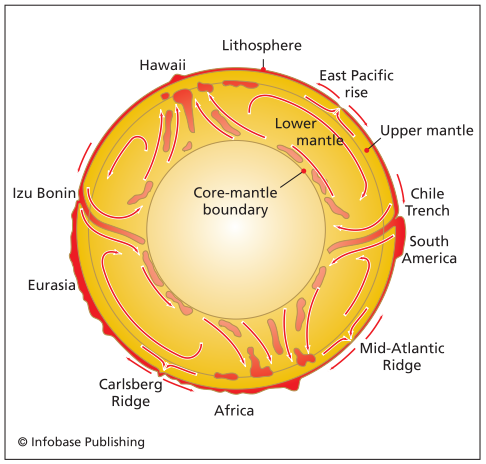
Cross section of Earth showing possible modes of mantle convection
A central debate in geophysics concerns the style of mantle convection. The mantle is divided into the heterogeneous upper mantle (extending to the 670-kilometer discontinuity) and the more homogeneous lower mantle (extending to the D" layer at the core-mantle boundary). One model proposes whole-mantle convection as a single system. Alternatively, a two-layer convection model suggests separate systems for the upper and lower mantle. A prevailing hybrid model, supported by seismic data, holds that while layering exists, subducting slabs can penetrate the 670-km boundary from above, and mantle plumes from the D" layer can rise through it from below.
The surface expression of convection cells is mirrored in the global tectonic arrangement. Subduction zones mark regions of downwelling, while mid-ocean ridge systems correspond to broad areas of upwelling. For instance, broad upwelling beneath the Atlantic and Indian Oceans contrasts with concentrically arranged downwelling around the Pacific Rim's circum-Pacific subduction zones. This large-scale planiform flow is punctuated by narrow mantle plumes rising from the deep mantle, whose paths are distorted by the prevailing upper mantle convection currents.
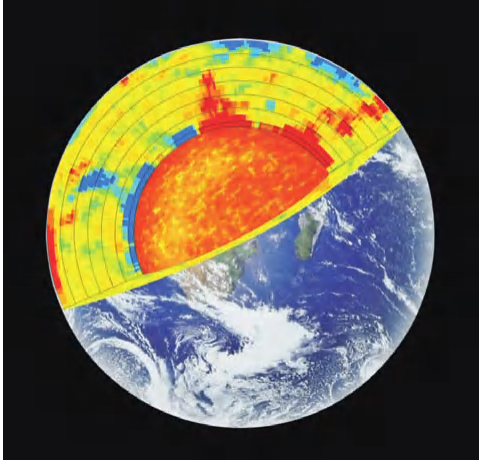
Real data on a cutaway of Earth showing movement of deep slabs of rock in mantle. Sinking slabs are blue, mantle is yellow, and rising molten rock is red. The sinking slabs, including one (at upper left) descending from the Caribbean, are up to 930 miles (1,500 km) across and penetrate up to 1,800 miles (2,900 km) to the D" region at the core-mantle boundary. The deep slabs can be detected by measuring the arrival times at points around the world of seismic shear waves produced by earthquakes. These waves travel faster through dense, cool rock than warm rock. (Steve Grand, Texas University/Photo Researchers, Inc.)
Seismic tomography provides tangible evidence for these processes, imaging subducting slabs—cold, dense remnants of oceanic lithosphere—penetrating deep into the mantle, some reaching the core-mantle boundary. These slabs, detectable because seismic waves travel faster through cool material, provide critical evidence for whole-mantle mass transfer.
The pattern of convection throughout Earth's deep geological history remains an active area of research. Epochs like the Cretaceous Period appear to have experienced more vigorous convection and widespread volcanism. Different convective regimes, potentially dominated by massive plume events or catastrophic mantle overturn events where pooled slabs sink rapidly into the lower mantle, may have characterized the hotter early Earth, facilitating more efficient heat loss. Future research aims to link the preserved geological record in continents with models to decode the evolving history of Earth's indispensable heat engine: mantle convection.
Date added: 2026-07-14; views: 176;