
The Theory of Continental Drift: From Wegener's Hypothesis to the Foundation of Plate Tectonics
The theory of continental drift, a fundamental precursor to the modern paradigm of plate tectonics, was most comprehensively proposed by Alfred Wegener in 1912. This revolutionary hypothesis posited that continents are relatively low-density, rigid plates capable of moving laterally across the Earth's surface. Initially, the geological community largely dismissed the concept due to the absence of a plausible driving mechanism, rendering it seemingly implausible from a geophysical perspective. However, the core tenets of continental drift were later validated and seamlessly integrated into the unifying theory of plate tectonics.
Early geological investigations successfully identified the planet's primary tectonic provinces. Cratons represent ancient, stable continental cores that have remained tectonically inert since the Precambrian eon, typically exhibiting subdued topographic relief. In contrast, orogenic belts are long, linear zones of structurally deformed and metamorphosed rock, characterized during active periods by volcanism, seismicity, and intense folding. Within ocean basins, abyssal plains constitute the flat, stable regions of the deep seafloor, while oceanic ridges are submerged mountain chains marked by high heat flow, volcanic activity, and earthquakes. To explain these global features, early hypotheses variably suggested a contracting or expanding Earth.
In his seminal 1912 work, The Origin of Continents and Oceans, Alfred Wegener systematically argued that continents had drifted apart from a single, coalesced supercontinent, which he named Pangaea (meaning "all land"). For his reconstruction, Wegener astutely used the continental shelf edge, rather than the coastline, to achieve a remarkable fit between opposing continental margins, such as the Brazilian coast aligning with the Gulf of Guinea in Africa. Despite compelling geographical fits, Wegener's background as a meteorologist led to widespread skepticism among contemporary geologists, though his central thesis is now recognized as essentially correct.
The persistent elevation of continents, averaging about 300 meters above sea level, posed a significant problem given erosion rates that could level them in tens of millions of years. This enigma was resolved through the application of the principle of isostasy, a geophysical concept analogous to Archimedes' principle. Isostasy states that elevated continental crust is buoyantly supported by a thick, low-density root that floats within the denser, underlying mantle. Observations of rapid post-glacial uplift in Scandinavia, explained by isostatic rebound, demonstrated that the mantle possesses a viscous, flowing behavior capable of sustaining vertical adjustments over geological time.
Wegener further bolstered his continental drift theory with multifaceted geological and paleoclimatic evidence. He documented correlations between ancient glacial deposits, desert belts, and the distribution of distinctive fossil assemblages, such as the Glossopteris flora, across now-separated southern continents. His work gained crucial support from South African geologist Alex L. Du Toit, who, in the 1920s, meticulously matched stratigraphic sequences and geological structures across the reconstructed Pangaea supercontinent, providing strong empirical grounds for the theory.
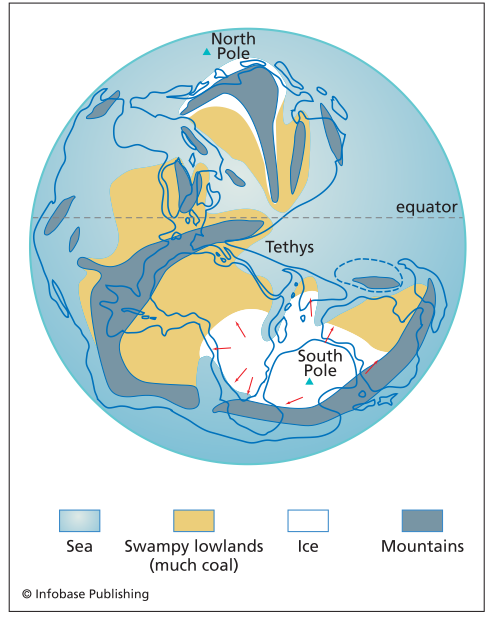
Modification of Alfred Wegener’s reconstruction of Pangaea, originally from Origin of Continents and Oceans
Notwithstanding the accumulating evidence, including transcontinental geological correlations, the scientific establishment remained largely unconvinced due to the persistent lack of a credible driving mechanism. Contemporary geophysicists could not reconcile how seemingly brittle continental crust could plow through the ostensibly solid oceanic crust. Early speculative mechanisms, such as tidal forces, were deemed insufficient, and this critical gap caused continental drift to encounter prolonged and stiff resistance from the broader geologic community.
A pivotal breakthrough came in 1928 when British geologist Arthur Holmes proposed a viable mechanism: thermal convection in the mantle. Holmes suggested that heat from radioactive decay could generate large-scale convective currents within the ductile mantle, and that the overlying continents could be passively rafted atop these moving cells. He logically extended the concept of mantle flow, already accepted for isostatic rebound, to horizontal motion. This proposition of mantle convection as an engine for continental motion laid the essential groundwork for the future plate tectonics theory.
The revival and ultimate acceptance of continental mobility occurred in the 1950s and 1960s with two key discoveries. First, paleomagnetic data from continental rocks revealed apparent polar wander paths that were mutually inconsistent unless the continents themselves had moved relative to each other and the magnetic poles. Second, the identification of seafloor spreading at mid-ocean ridges and the complementary process of subduction at oceanic trenches provided the missing mechanical basis: continents do not plow through ocean crust but are instead carried as passive passengers on larger, moving lithospheric plates that are created and destroyed. This synthesis transformed the marginalized hypothesis of continental drift into the robust, unifying plate tectonic paradigm, revolutionizing all disciplines of the Earth sciences.
Date added: 2026-07-14; views: 155;