
Continental Crust: Structure, Composition, Cratons, Orogens, and Formation
The continental crust constitutes approximately 34.7% of Earth's surface, though only 29.22% is subaerially exposed, with the remainder comprising submerged continental shelves. Its lateral extent is defined by the shelf-slope break, and its base is marked by the Mohorovicic discontinuity (Moho), where seismic wave velocities increase to 4.7-5 miles per second (7.6-8.0 km/s). This crust varies dramatically in thickness, ranging from about 12.5 to 37 miles (20-60 km), with a global average of 24 miles (39 km). Continent interiors are divided into stable cratons and the linear, deformed belts of orogens, which are often younger mountain-building regions.
The global distribution of elevation is effectively displayed on a hypsometric curve (hypsographic curve), a cumulative frequency graph plotting area against height relative to sea level. This curve is distinctly bimodal, revealing Earth’s dominant topographic tiers: continents averaging near sea level and abyssal plains situated 1.9-2.5 miles (3-4 km) deep. The curve confirms that extreme elevations (high mountains) and depressions (deep-sea trenches) occupy relatively little of the planet's solid surface.
Much of Earth's continental mass is preserved within ancient Archean cratons, which form the stable cores of modern continents. These regions are characterized by very low heat flow, minimal seismic activity, and an absence of volcanism, often being overlain by undeformed, shallow-water sedimentary sequences. When this cratonic basement is exposed, it forms a continental shield; where it is sediment-covered, it is termed a continental platform. Their remarkable longevity requires a unique geodynamic explanation.
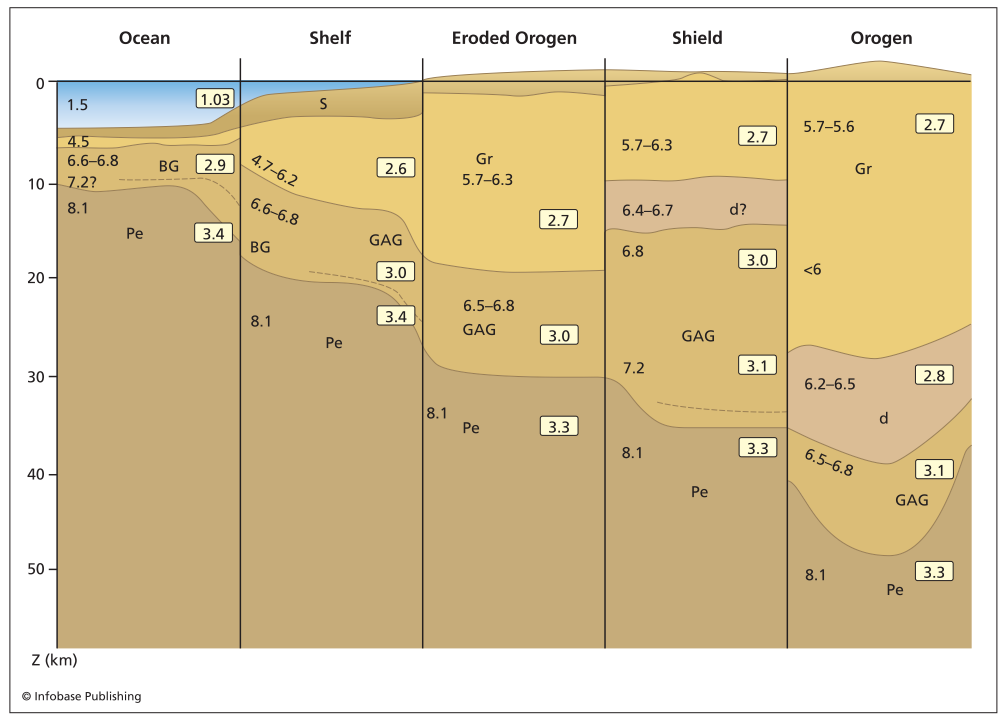
General crustal structure of different provinces as determined by seismology. Numbers in boxes represent densities in grams/cm3, and other numbers represent the seismic velocity of P waves in kilometers per second: BG = basalt-gabbro, GAG = amphibolite and granulite, Pe = peridotite, d = diorite, An Ga = anorthositic gabbro, S = sediments, Gr = granitic-gneiss upper crust, M = Mohorovicic discontinuity.
A defining feature of cratons is their deep, chemically buoyant tectosphere or mantle root, identified seismically and through studies of xenoliths (mantle samples brought up by volcanoes). This root is cold, refractory (depleted of basaltic components), and often exhibits strong mineralogical fabric. Key unresolved questions in geodynamics concern its formation: the required large-volume melt extraction is not evident in the highly evolved crustal rock record, and its tectonic setting (plume versus subduction zone) is debated. Furthermore, while roots beneath cratons like the Kaapvaal and Slave appear eternal, others, such as the North China Craton, have lost their roots, a process that remains enigmatic.
Orogens, or orogenic belts, are elongate zones of concentrated deformation representing eroded mountain ranges. Young orogens like the Rockies and Alps are topographically high, while ancient ones stitch Archean cratons together. Orogens are accreted to continental margins primarily via plate tectonic processes and fall into three main types. Fold and thrust belts are contractional ranges formed by continental collision, where oceanic sediments are scraped off and deformed, marking former ocean basins. Volcanic mountain ranges, like the Cascades, are built by magmatism at subduction zones. Fault-block mountains, such as the Basin and Range Province, result from crustal extension.
Determining the bulk composition of continental crust requires averaging its diverse rock types. Estimates converge on an andesitic or granodioritic composition, significantly enriched in incompatible trace elements (e.g., potassium, uranium, thorium) that concentrate in melts. Seismically, the crust exhibits a broadly layered but variable structure. In shields, an upper granitic layer (velocity 3.5-3.9 mi/s) overlies a middle "granulitic" layer (3.9-4.2 mi/s) and a lower crust of amphibolite and granulite (4.2-4.5 mi/s). Orogens typically possess a thicker, lower-velocity upper crust.
Significant debate surrounds the timing and mechanisms of continental crustal growth from the mantle. Consensus holds that most growth occurred early, with over half the crust being Archean and 80% Precambrian in age. A central controversy is whether Archean tectonic processes resembled modern plate tectonics. The current rate of crustal growth versus recycling into the mantle remains poorly constrained. Petrological models suggest a multi-stage origin: initial mantle melts form primitive crust, which is later reworked and chemically differentiated through processes like island arc magmatism and continental collisions to achieve its evolved andesitic composition.
Date added: 2026-07-14; views: 149;