
Comets: Composition, Orbits, Tails, and Solar System Origins Explained
Comets are celestial bodies composed of ice, dust, and rock that orbit the Sun, developing a transient atmosphere called a coma and a characteristic tail when heated during close solar approaches. Their orbital periods exhibit extreme variation, ranging from a few years to several hundred thousand years, classifying them based on their orbital dynamics. Short-period comets, with orbits completing in fewer than 200 years, generally travel within the plane of the ecliptic in the same prograde direction as the planets, with their aphelion extending to the orbital region of Jupiter. In contrast, long-period comets possess highly elongated, eccentric orbits with periods exceeding 200 years, often reaching tens of thousands of years, which take them far beyond the outer planets while remaining gravitationally bound to the Sun. A distinct class, single-apparition comets, follow hyperbolic trajectories that eject them from the solar system after a single pass through the inner planetary region.
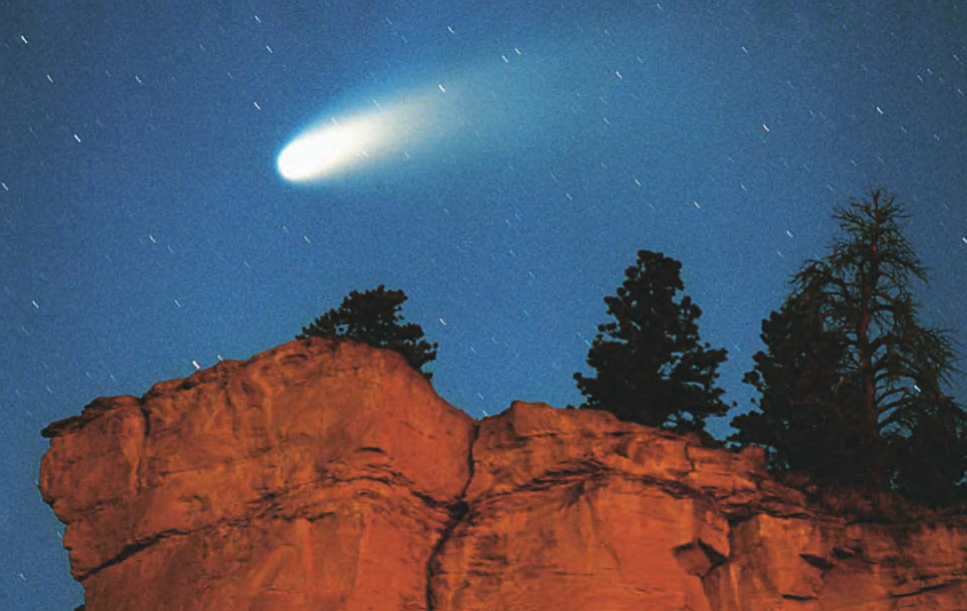
Hale-Bopp comet over Billings, Montana, 1997
Historically perceived as isolated "dirty snowballs" of primarily icy composition, our understanding of comets has fundamentally shifted due to late 20th-century space probes and detailed observations. Comets and asteroids are now recognized as transitional bodies, both in orbital character and physical composition. Modern data reveals that cometary nuclei consist of a rocky core surrounded by or intermixed with ices, often covered by an organic-rich, dark surface layer. Similarly, many asteroids contain rocky material with ice pockets, blurring the traditional distinction. The vast reservoirs of the Kuiper Belt and the Oort Cloud contain innumerable such icy-rock bodies, establishing comets as likely the most abundant class of objects in the solar system, with an estimated population reaching one trillion, of which only approximately 3,350 have been formally cataloged.
The anatomy of an active comet includes several distinct regions: the solid nucleus; the surrounding coma, which is the gaseous atmosphere; and often an extensive, diffuse hydrogen cloud. While the enveloping coma can expand to sizes exceeding that of the Moon or Pluto, most nuclei are surprisingly small, typically ranging from 0.5 to 50 kilometers in diameter. This nucleus is a primordial aggregate of silicate rock, dust, water ice, and frozen volatile gases like carbon dioxide, carbon monoxide, ammonia, and methane. Critically, comets harbor a range of organic compounds, including methanol, formaldehyde, ethane, and even complex hydrocarbons and amino acids, though no life is known to originate from them. These carbon-rich materials contribute to the nuclei being among the darkest known objects, reflecting a mere 2-4% of incident light, a property that aids solar heating and gas sublimation.
As a comet approaches the Sun, solar radiation fractures its dark crust, vaporizing subsurface ices and releasing jets of gas and entrained dust. This process forms an expansive, tenuous atmosphere—the coma—around the nucleus. The combined effects of solar radiation pressure and the solar wind then sculpt this material into a magnificent, multi-component tail. The ion tail (or plasma tail), composed of ionized gases, points directly away from the Sun, often aligning with the interplanetary magnetic field and stretching for over one astronomical unit (150 million kilometers). Simultaneously, liberated dust particles form a slightly curved dust tail that follows the comet's broader orbital path; collectively, these structures can grow to over 80 times the size of the cometary head.
The origin of a comet dictates its orbital period. Short-period comets predominantly originate in the Kuiper Belt, a disk-shaped region beyond Neptune, while long-period comets are believed to originate in the spherical Oort Cloud, located far at the solar system's periphery. Gravitational perturbations from passing stars, galactic tides, or interactions with giant planets can dislodge these bodies, sending them on altered trajectories into the inner solar system. Such orbital modifications can result in close solar flybys or, rarely, catastrophic collisions with planets, events that may have historically delivered water and organic materials to early Earth.
Recent space missions have revolutionized cometary science. NASA's Deep Space 1 mission flew by Comet Borrelly in 2001, revealing an asteroid-like rocky terrain with active icy plains emitting dust jets. The groundbreaking Stardust mission collected particles from the coma of Comet Wild 2 and returned them to Earth in 2006. Analysis yielded profound surprises: instead of primarily ancient interstellar dust, the samples contained silicate grains of familiar solar system composition, including high-temperature calcium-aluminum inclusions that must have formed near the early Sun before being transported outward. This suggests comets are mixtures of materials formed across the entire early solar system. Furthermore, Stardust captured a primitive class of polycyclic aromatic hydrocarbons (PAHs) and alcohol-bearing compounds, providing direct clues about the organic inventory delivered to the primordial Earth and its potential role in the origin of life.
Date added: 2026-07-14; views: 118;