
Aurora Borealis and Aurora Australis: Formation, Science, and Solar Influence
The Aurora Borealis (northern lights) and Aurora Australis (southern lights) are natural luminous atmospheric displays predominantly visible in high-latitude regions surrounding the Earth's magnetic poles. These mesmerizing sky glows originate from interactions between the planet's magnetic field and charged particles from the solar wind. The process begins in the Van Allen radiation belts, toroidal zones where the Earth's magnetosphere traps high-energy particles; the inner belt consists mainly of electrons, while the outer belt contains primarily protons. During geomagnetically active periods, electrons spiral along magnetic field lines toward the polar regions, colliding with gases in the upper atmosphere between 80-125 km (50-200 miles) in altitude and exciting them to emit light.
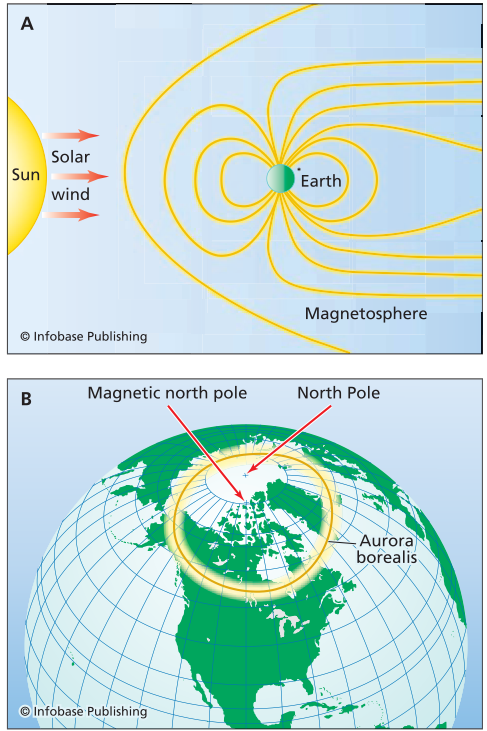
(A) Drawing of magnetosphere, showing asymmetric shape created by distortion of the Earth’s magnetic field by the solar wind (B) Earth, showing typical auroral ring with the greatest intensity of auroral activity about 20–30° from the magnetic pole, where magnetic field lines are most intense
The solar wind, a continuous stream of charged particles (a plasma) ejected from the Sun's corona, travels through space at speeds exceeding one million kilometers per hour. When this plasma encounters Earth, it distorts the planet's intrinsic dipole magnetic field, compressing it on the dayside and stretching it into a long magnetotail on the nightside, forming a protective region called the magnetosphere. This structure acts as a shield, deflecting most solar particles around the planet. However, some particles are channeled by the magnetic field toward the poles, where they penetrate the upper atmosphere, or thermosphere, initiating the auroral process.
During periods of high solar activity, such as solar flares and coronal mass ejections (CMEs), the intensity, density, and velocity of the solar wind dramatically increase. This enhanced solar wind applies greater pressure to the magnetosphere, distorting it further and allowing larger quantities of energetic electrons to be injected into the polar regions. This results in intensified and more frequent auroral displays, which can expand to lower latitudes than normal. The cyclic nature of this activity, tied to the approximately 11-year solar cycle, means auroral frequency and visibility vary over time.
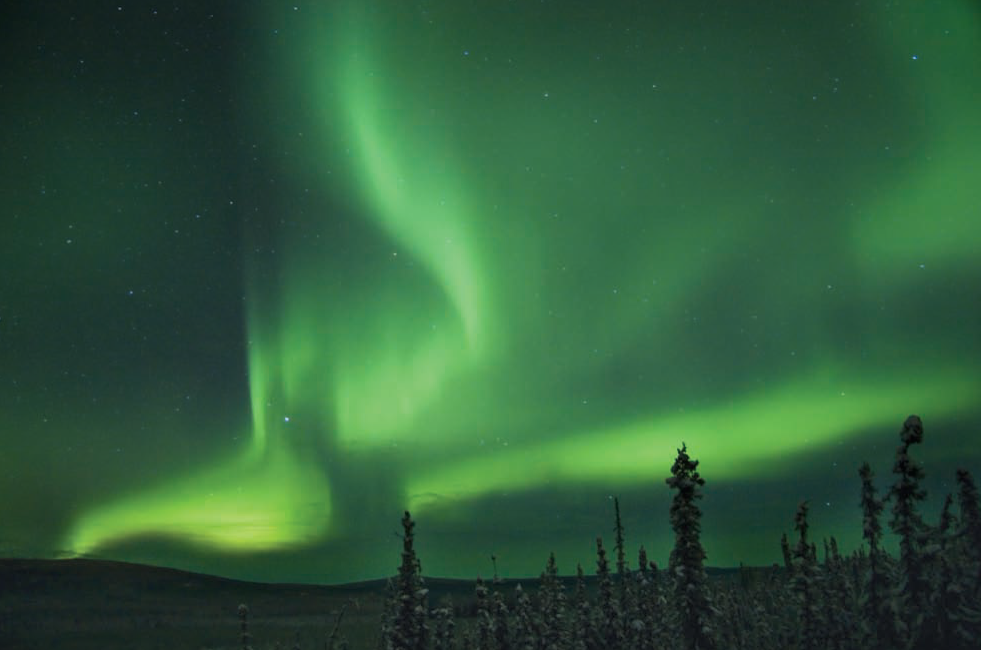
Active aurora borealis arc in Alaska
The visual manifestation of an aurora occurs when injected high-energy electrons collide with atmospheric atoms and molecules, primarily oxygen and nitrogen. These collisions transfer energy, exciting the gases to a higher energy state. As they return to their ground state, they emit photons of specific wavelengths, producing the characteristic light. The varying colors result from different gases and altitudes: green and red hues come from atomic oxygen at higher altitudes, while nitrogen molecules contribute blue and purple tints. The dynamic, shimmering "curtains" and rays are caused by real-time fluctuations in the magnetic field and the density of incoming particles.
Auroras typically appear as rings centered on the geomagnetic poles, known as the auroral oval. The greatest intensity occurs approximately 20-30 degrees from the magnetic poles, around 60-70° geomagnetic latitude, where the magnetic field lines are most concentrated and vertical. This ring expands equatorward during geomagnetic storms. The waving sheets and streaks are a direct visual representation of the complex interplay between the solar wind and Earth's magnetosphere, making auroras not only a stunning natural phenomenon but also a visible indicator of space weather processes that can affect satellite operations and power grids.
Date added: 2026-07-14; views: 154;