
Anthropogenic Influences on Vegetation in Mediterranean, Saharan and Tropical Environments
Human influences have changed the natural vegetation in all climatic regions and biomes. Depending on the environment and the specific human influences, different consequences for the natural ecosystems may arise. Examples from three biomes are shown for the Mediterranean region (keywords “deforestation and soil erosion”), the dry regions of Africa (keyword “desertification”) and the humid tropics of Africa (keyword “destruction of tropical forest”).
Mediterranean Region. Plants in the Mediterranean region are particularly stressed because of the dry periods in summer. The influence of fire must also be considered, particularly when human intervention prevents it. Tree species found within the upper mountainous zones of the Mediterranean listed in the scheme of altitudinal zones in Fig. 17.19 typically have high drought resistance and are stimulated by fire (e.g. Quercus suber). Land-use changes began affecting large areas in the western Mediterranean region (bays of Alicante and Catalonia) in the early Neolithic Age, circa 7000 BP (Badal et al. 1994; Riera-Mora and Esteban- Amat 1994). The evergreen oak forest (Quercus rotundifolia) near the coast was mixed with deciduous oaks (Quercus faginea, Q. pubescens) and eventually thinned, and heliophilic shrubs became dominant.
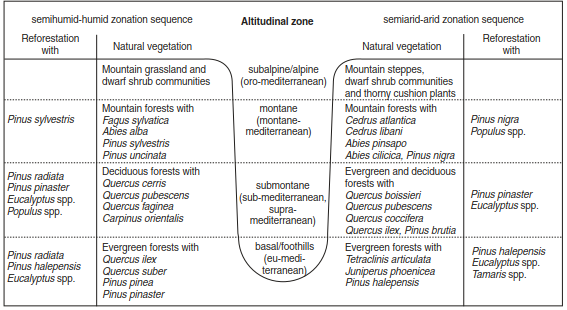
Fig. 17.19. Altitudinal belts of dominant tree species of natural vegetation and the most important exotic tree species used in reforestation in Mediterranean region. (Müller-Hohenstein 1991)
Typical Mediterranean shrub communities (macchie, garrigues), developed. Inland areas remained untouched for a long time, disregarding the first transhumance, for example, shepherds moving in the hot, dry summers from the plain into the mountains near the coast, and establishing a “vertical migratory pattern” of grazing management. The farms on the coastal plain, with favourable soils and availability of water, for example, the Spanish huertas, were the first areas with intensive agricultural crops. Evidence of crop plants introduced from the Mediterranean into North Africa demonstrates the development of an increasingly richer flora in agriculturally managed landscapes. In the Palaeolithic period, barley (Hordeum vulgare) was evident, whereas in the Neolithic period, wheat (Triticum spp.) emerged as well as fruit trees (Phoenix dacty- lifera, Ziziphus spp., Lawsonia inermis) and Fabaceae (Lens culinaris, Pisum sativum, Vicia faba).
The Phoenicians cultivated olives, vine, pomegranates and figs, while the Romans added garlic, onions, apples and pears. During the Arab period, species from Central and Eastern Asia arrived, for example, citrus, mulberry and carob trees, hemp and sugar cane. Species from the New World followed after the discovery of the Americas. Only at that time did some plant species often regarded as characteristic of the region reach the Mediterranean basin: agave, opuntia and maize, tobacco and tomato. In the nineteenth century many ornamental plants were added for economic reasons, and Acacia and Eucalyptus species were introduced. Today, about 200 exotic species are naturalised in North Africa, corresponding to 4% of the total regional flora (Le Floch et al. 1990). Some species were introduced unintentionally and, along with crop plants, became established. The number of those species originating from the New World is considerable, among them so-called aggressive invaders that became established particularly on ruderal sites (species of the genera Amaranthus, Cuscuta and Conyza). Currently, rapid expansion of Heliotropium curassavicum, Solanum eleagnifo- lium and Xanthium spinosum are occurring, as well as of some shrub species (Ricinus communis and Nicotiana glauca) into North Africa.
In the segetal flora, on the other hand, indigenous species found new niches. The approx. 50 species found within fields and fallow land include Ammi majus, Ammi visnaga, Anagallis arvensis and Anagallis foemina, Ridolfia segetum, Sinapis arvensis and Carduncellus, Convolvulus, Cyperus and Diplotaxis species. The number of sometimes thorny weeds on pastures is just as high (Astragalus armatus, Calycotome villosa, Scolymus hispanicus and S. grandiflorum) and also partly poisonous or at least non-edible (div. Asphodelus spec., Peganum harmala, Solanum nigrum, Stipagrostis pungens and Stipagrostis capensis). The nutrient indicators (nitrophils) include Aizoon and Mesembryanthemum species, Chenopodium murale, Hyoscyamus albus and Hyoscyamus niger and Withania somnifera.
As for the Mediterranean regions, the same applies as for Central Europe: Naturalisation, expansion and disappearance of individual species are closely connected to the agricultural practices performed in those regions. Deil (1997) showed for the areas bordering the Strait of Gibraltar that vegetated landscapes can be read as a history book. Further, they can show how historic and actual forms of use demonstrate religious regulation as well as subsistence-orientated management of the indigenous population, or the market-orientated management of colonial times. Even today, it is possible to identify from the spectrum of different species an Islamic cemetery from the time before the reconquista. Similarly, it is possible to show the different uses of herbicides and the mechanical control of weeds in the fields of southern Spain or northern Morocco.
The recent history of forests in the Mediterranean regions is completely determined by human activities. During the Greek colonisation of Dalmatia around 3000 years BP, forests were intensively cleared. The Italian peninsula was largely deforested during Roman times, and the Iberian Peninsula mostly from the sixth century BC onwards. Severe consequences for vegetation and site quality have often been documented (Muller-Hohenstein 1973). Forest degradation starts with structural changes (age structure, density of stand and closure of canopy); livestock grazing in a forest leads to the invasion of ruderal species and the eventual decline of the forest, which causes a thinning of the stand. Forests on more favourable sites were cleared first, while arable fields extended on land with not very productive rain-fed agriculture. Clearing was also often supported by fires to take over grazing areas. Mediterranean dwarf shrub communities (macchie with various regionally different terms such as garrigue, tomillares, phrygana, matorral) and pastures differing in their floristic compositions are quite often determined by human activities.
Clearing was not just an intervention with irreversible consequences for vegetation; soil erosion down to the bed rock and sedimentation in valleys generally followed. The negative effects of soil degradation also has serious economic consequences, and a growing lack of wood has been an issue in the past 50 years. Reforestation efforts have increased in many southern European regions and North African countries, but so far such efforts have borne no discernible results. Exotic, fast-growing types of trees are chosen for reforestation, in particular some pine species (Pinus radiata), but a variety of Eucalyptus species are favoured for their fast growth rates (Fig. 17.19).
Where the reforestation has been successful, “forest” areas increased, but a uniformity also arose. The expected economic yields have not always materialised. The negative side effects on fauna and soil organic matter, attacks by pests and fires, for example, known from monocultures, increased. With the high diversity of Mediterranean woody species, the preferential use of exotic species would not have been necessary. The choice of fast-growing exotic species stemmed mainly from economic considerations, while ecological considerations were ignored. One could have limited those species to in areas where urgent protection from further erosion was required. In southern European countries, the pressure to harvest wood from forests is presently declining; the recovery of sclerophyllic and deciduous species can be observed. In North African countries, however, the pressure on the last near-natural remnants of forests is growing.
Also, in the European/North African- Mediterranean region, it is obvious that subsistence-oriented land management in small family farming systems coincides with a greater diversity of vegetation. Modern market-oriented management is always linked to a loss of diversity at all levels. Typical forms of Mediterranean land use are shown in Fig. 17.10.
Date added: 2026-04-26; views: 239;