
Agriculture and Forestry in Industrial Times
Since the onset of the Industrial Revolution and continued urban sprawl, significant changes have occurred in plant communities, where even the smallest of areas have now been affected (Sukopp and Wittig 1998). In the past, localised ploughing, watering and draining had an effect that was only apparent at a specific scale; however, as the influence of supplying and managing resources and their waste products increases, so does the effect on living systems. Pollutants and the effects of fertilisation have undoubtably influenced vegetation.
For example, atmospheric deposition of nitrogen currently exceeds natural background levels by three orders of magnitude in some regions, leading to a steadily increasing eutrophication of terrestrial ecosystems (Galloway et al. 2004).
The beginning of the industrial period is linked with new anthropogenic influences on plant cover. At the onset of industrialisation, most of the remaining forests of Central Europe had already been degraded and the soils were much eroded or depleted of nutrients, which left the upper layers acidified. Although the conditions of the forest were maintained, the change in dominant energy source (coal) led to a significant makeover in terms of people thought about forest management. As the use of coal began to increase, many traditional forestry practices were no longer used; however, the demand for timber, paper and energy grew with the onset of the steam engine and railway.
Attempts of reforestation occurred as early as the fourteenth century. However, it was only in the year 1713, when von Carlowitz put forth the “principle of forest sustainability”, that large- scale afforestation projects were undertaken (Pretzsch 2005). It was at this time that the transition from deciduous forests to coniferous tree plantations commenced. Only some mixed forests were retained until the nineteenth century; however, they were considered to have become degraded. The so-called new forest management started with the intensive plantation of conifers on degraded lands and within abandoned fields, where this practice was used to meet the increasing requirements for construction-grade lumber. In Fig. 17.16, characteristic forms of forest management are shown. On the other hand, there are also individual steps of degradation from a natural forest to wasteland (Fig. 17.13). Experiments with trees, such as the Douglas fir (Pseudotsuga menziesii), were successful, and spruce (Picea), pine (Abies) and larch (Larix) were planted beyond their natural ranges. Coppiced forests slowly transitioned to high forests (mature). Various forms of forest management practices were used, for example, clear-cutting, shelterwood-compartment systems and shelterwood-selection systems. The aim was to produce commercial timber as quickly as possible while maintaining a sustainable production yield (harvesting < regrowth).
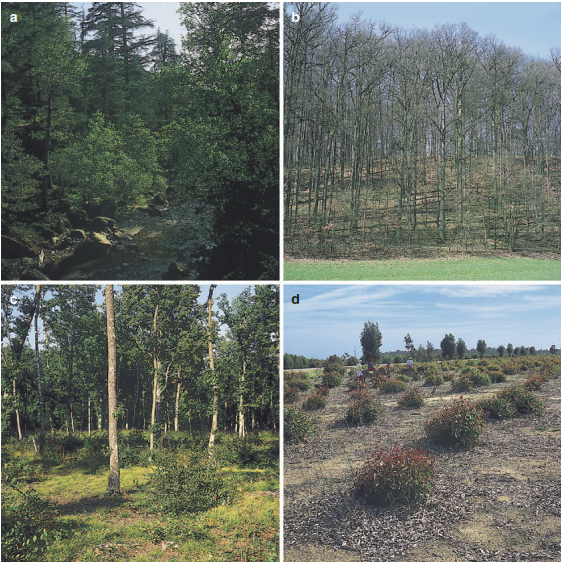
Fig. 17.16. Important human-made forest types in Central Europe and North Africa. a Almost naturally mixed forests (Quercus faginea, Q. rotundifolia, Cedrus atlantica) with trees of all age classes in central Atlas Mountains (Morocco). b Beech forest close to Bayreuth (Bavaria). Trees are clear felled or the largest trees are selectively removed. c Oak forest (Quercus robur, Q. pubescens) in Burgundy. The best stems for timber are only felled after 100 or more years, the rest for firewood every 30 years. d A Eucalyptus coppice in northern Morocco, cut 2 years before with new shoots forming that will be harvested after 12–15 years. (Photos: K. Müller-Hohenstein)
Managing the forest using these strategies was successful for many reasons: forests were no longer used for livestock grazing, pruning or sodcutting, and the use of leaf litter was significantly reduced, which in turn returned substantial amounts of nutrients back to the system. The most important change in these forests was the change from the once dominant deciduous trees to conifers, which triggered a change in vegetation dynamics. All coniferous species, particularly pine and spruce, are relatively undemanding in terms of regeneration and can be sown without major drawbacks. Furthermore, conifers tend to grow quite rapidly, resulting in much shorter rotational periods (80 years) than those of oak, which can be twice as long. The extent of this change from predominantly deciduous forests to coniferous forests is considerable, as depicted on maps of German forests over the last few centuries (Fig. 17.9).
Reforestation with only conifers can cause significant problems for forest communities. Soil erosion and acidification are higher in spruce plantations than in mixed deciduous forests. Bird diversity is also significantly reduced, where the number of species and their abundance is half as much in conifer stands as in deciduous forests (Goudie 1994). These findings were reinforced in the Chilean deciduous forest, where differences were more abrupt compared with exotic pine plantations (Finckh 1995). It is well known that coniferous plantations typically have much less food resources for birds and also lack the multitiered structures found in deciduous-dominated stands.
The separation of forest use and grazing was also important for the development of vegetation in open spaces. To protect forests and arable land from animals, fences were put around grazing areas. In early summer with a surplus of food, animals tend to favour the most palatable species. Areas of eutrophication due to the excrement deposits of livestock and grazing areas gave rise to a characteristic pattern. Particularly noticeable was the damage caused by trampling and erosion by too many animals. This can be counteracted to some extent through the use of mineral fertilisers, and changing the variety of crops can improve yields. Soils of low fertility were fertilised and sown with grass (Vergrtinlandung). Meadows were mowed, often several times per year, to provide enough fodder for animals that were kept in stables during the winter months. Cereal fields were also used for grazing after harvests, which affected segetal flora. Nutrient-poor meadows were invaded by scrub, and sites for thermophilic and xerophilic species became rarer. These examples show how new agricultural techniques and trade patterns affected the composition of plant communities.
In agriculture, the improved three-field crop rotation was increasingly used. The fallow was abandoned and replaced by root crops, in particular potato. A significant agricultural advancement occurred in the middle of the nineteenth century, when N and P mineral fertilisers became available. As a result, the diversity of site conditions decreased, and flora diversity was reduced with fewer fallow fields occurring owing to the increased use of fertilisers and herbicides, where many perennial species of segetal flora disappeared. Marshes, bogs and river forests were drained and converted to meadows or pastures. Edges of fields, hedges, terraces and marginal biotopes, all with important interconnecting functions for non-crop plant and animal species, were drastically reduced. Schreiber (1995) demonstrated how various central European grassland communities, which had developed up to the middle of the nineteenth century, were converted into intensive grassland by new agricultural practices (Fig. 17.17). Currently, intensive land use has led to drastic losses of diversity in the landscape and plant communities in all regions of Europe. The colourful mosaic of a rural landscape developed for extensive use since the Middle Ages has only been sustained in some remote areas.
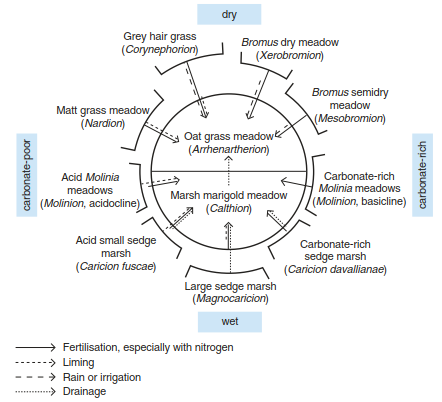
Fig. 17.17. Characteristic grassland communities in Central Europe according to water and carbonate availability. (modified from Schreiber (1995))
Already 20 years ago, Vitousek et al. (1997) estimated that between one-third and a half of all terrestrial ecosystems had been transformed by human activities, more than half of the total surface of freshwater resources is used by humans, and one-quarter of the bird species on Earth have already gone extinct as a result of anthropogenic influences. More recently, Ellis et al. (2010) characterised the artificial changes in the terrestrial biosphere since the Industrial Revolution on the basis of gridded global data for human population density and land use. According to their evaluation of the past three centuries, the terrestrial biosphere passed from mainly “wild” to mainly “anthropogenic”. With fewer small subsistence farms it is no longer necessary to combine arable crops with animal husbandry. The former “balance” of forest, grazing land and arable land once required in the rural landscape for reasons of greater self-sufficiency has now been lost. The impacts of human transformation of ecosystems over such a short time span during the last few decades has no parallel in the past with respect to intensity and consequences. Nowadays, even more drastic and irreversible shifts of global ecosystems are being discussed, potentially threatening Earth’s ability to sustain humans and other species in the near future (Barnosky et al. 2012).
Date added: 2026-04-26; views: 238;