
Changes in Vegetation Owing to Human Influence
Human activities have always affected vegetation because humans are directly or indirectly dependent on plants for raw materials, food and feed for agricultural livestock. The influence of humans historically was fairly small and restricted to simple consumption for themselves and their livestock. However, over time, with the rapid growth in population sizes, coupled with advances in technology and our use and the distribution of plants across the world, that influence has changed dramatically. The mosaic of anthropogenic plant communities became more diversified, corresponding to the type, duration, intensity and extent of human influence. Gathering beneficial wild plants for food and medicine, wood cutting, grazing and especially hunting and clearing, assisted by fire, led to specific “substitute communities”. Soon, coppiced forests, managed meadows and other previously unknown plant communities arose. An important contribution to the diversification of human-made vegetation types brought the lessons learnt from hunting and gathering to all agricultural activities to improve plant cultivation and animal husbandry.
The present-day global distribution of vegetation can only be understood in light of human- induced influence and its associated effects on the plant community for the past few millennia. Nowadays, in Central Europe, no plant communities exist that have not been influenced by humans. In the absence of humans, it would be easy to have a vast closed cover forest across the entire European continent, for the exception of the area above the tree lines in the high mountains. At least in Europe and East Asia, the present vegetation is the result of interactions between the requirements of humans in different cultural situations and resources that offered natural landscapes. Most of these interventions are linked to the development of sedentary agricultural societies in Central America and—especially important for Europe—in East Asia.
Early Land-Use Influences.The area surrounding the Bay of Bengal, the northern Savanna landscapes of India, the Yangtze region of China and the highlands of Mexico are some of the oldest centres of agriculture (von Wissmann 1957). There is now proof that these agricultural centres had access to a number of different agricultural techniques since at least 14,000 years (Bar-Yosef 1998). Agriculturalists are thought to have come from the Levant about a thousand years later, where they arrived via Iran in Mesopotamia and essentially replaced the hunter-gatherers already located there (Hillman et al. 2001). The first technical advance was irrigation.
From this region of the Fertile Crescent agriculture and animal husbandry (cultivation) reached Central Europe via the Mediterranean region. The important steps in the shift away from a culture based on pure hunting-gathering to one that developed through the use of many techniques to improve crop growth had already taken place outside Europe. Neolithic agriculture in southern-central Europe has been found to have started about 7000 years ago, while the northern region began roughly 5500 years ago, generally limited to areas with the best climatic and edaphic conditions (dry, warm, but often nutrient-poor sites) as present in sparse mixed oak forests.
Land-Use Influences from Neolithic to Middle Ages.For a long time the effect of prehistoric man on the cover of vegetation was severely underestimated. Today, it is possible to prove the effect of these human activities for the periods in which, during postglacial times, the edges of the ice sheet retreated and woodland species immigrated. Agricultural activities (clearing and burning) contributed already during late-Neolithic times to the excessive release of greenhouse gases (GHGs) in the atmosphere and leading to human-induced climate warming. Furthermore, the intensified rice cultivation in Asia has consistently contributed to GHG emissions, where significant levels of methane are a primary by-product (Kerr 2013). Deforestation, soil erosion, nutrient depletion of soils, and land-use changes have led to often irreversible impacts worldwide, especially since the industrialisation of many larger countries over the past 300 years.
In the Neolithic Age, “unregulated forest- field management” was the most important type of land use in Central Europe. After clearing, agriculture was practised for a few years. Then the area was left fallow for a long period. Regulated rotation with sowing, grazing and use of wood in certain restricted periods in an area was only developed in the Bronze and Iron Ages (about 3700 BP), when sickles and iron ploughs replaced the wooden hook plough. The major crops grown during this period were primarily wheat, emmer and spelt. At the regional level, buckwheat was important, as were barley and rye later. The primary livestock of cattle and pigs were used to graze in forests, where the canopy trees provided wood for housing and firewood.
The first coppiced forests were developed in the Bronze Age. Wood was used for charcoal kilns and the smelting of iron ore. Hedges grew along species-rich edges of forests and nutrient- poor meadows, and dwarf shrub heathland expanded, leaving the regeneration of grazed forest areas endangered. Many deciduous trees were harvested for their branches (lopping) to provide livestock food for the winter. Thus, natural vegetation was not only considerably changed on arable fields and replaced by crop plants and their accompanying vegetation, but also in structure and species composition. In addition, large areas around settlements were influenced by grazing, trampling and tree felling and the use of other non-timber forest products, such as leaf litter.
For the last 2000 years, the youngest history of climate and vegetation development has been the focus of IGBP’s “Past Global Change” (PAGES 2k) project (Kaufman et al. 2013). A continued cooling event has been confirmed with modest fluctuations (Little Ice Age between 1550 and 1850, with three warmer intervals) until the beginning of the industrial period (circa 1700 AD). During this period, on average, global temperature was still 0.3 K lower than that found over the last millennium. These findings should be taken with a grain of salt, as considerable variability and a combination of anthropogenic and natural drivers skew the effects at the local scale.
In Central Europe, until the beginning of modern times, human activity focused on clearing areas for agricultural purposes and settlements. Forests were degraded by grazing animals and by the increasing demand for wood, which was the sole energy source for cooking and heat prior to the use of coal. The ratio of forest to open land at the end of the first clearing period was approximately 70:30, despite Neolithic and Roman settlements. In the thirteenth century this ratio flipped to 30:70. Natural forests were restricted to areas unfavourable for agriculture. Not only was the vegetation cover changed drastically, but considerable soil erosion also occurred, outlined by the alluvial deposits in most European valleys (Dotterweich 2008). Towards the end of the Middle Ages, considerable breakdowns within the social system would lead to slight increases in forested areas. At the dawn of the sixteenth century, some of the first forest regulations were enacted as a means of protecting and limiting the use of forests. As early as the twelfth century, in some regions, the grazing of goats in forests was already forbidden.
The remaining forests were structurally and flo- ristically changed. To maintain the energy requirements and to consciously save areas of forests for grazing, coppiced forests were managed. Oak and hornbeam were particularly suited to this kind of forest management because they regenerate easily through coppicing. The fruits of oak, beech and hazel were not only important feed for livestock but were also consumed by humans. These species were thus cultivated in open forests so shadedemanding woody species decreased. Oaks were grown not only for acorns (animal feed) but also for their bark, which was used for tanning. Large, emergent trees were retained as standards in the coppice system for timber, which was required for construction.
Forest management strategies like that of the “thinned coppice” allows several light-demanding herbaceous and woody plants to become established. However, losses of species can occur owing to heavy grazing from livestock, in addition to the use of leaf litter and humus-rich topsoil for barns. The excessive collection of humus and leaf litter contributed significantly to the loss of nutrients in the system and led to large differences in fertility between forests and arable land. Excessive use of forests on sandy soils caused the formation of heathland in Northern Europe. Chronicles describe the scarcity of wood, which led to the use of peat from bogs.
Today grazing and browsing in forests occur worldwide and are regarded as the anthropogenic factor that has had the most significant influence on vegetation (Ellenberg 2009) (Fig. 17.13). The increasing level of grazing had two consequences. First, depending on the original forest type and the number and type of grazing animals, many different plant communities, dominated by herbs and grasses, developed. Moist meadows, nutrient- deficient meadows, hay meadows and pastures with grasses able to regenerate rapidly expanded and excluded woody species.
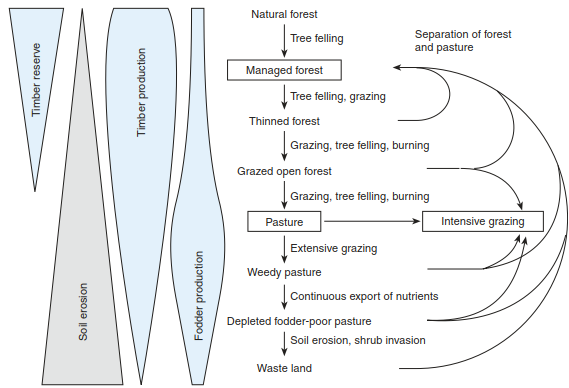
Fig. 17.13. Human influences on the vegetation of Central Europe. Including harvested timber and fodder yields, as well as estimates of timber reserves and soil erosion. (after Ellenberg 2009)
Occasional burning stimulated some herbaceous species, while others disappeared. More animals led to an increase of weeds in pastures, and plants sensitive to trampling disappeared. Poisonous species and those possessing protection (i.e. thorns) flourished and became dominant in the system. Animals contributed to the expansion of shrubs, dwarf shrubs and herbaceous species. To control the species composition within their fields, farmers would regulate the frequency of mowing, periods of grazing and the number of animals allowed to graze. A particular feature of this vegetation type is the large number of nitrophilic species in areas where many animals were kept (“Lagerflur”, Sect. 20.3).
Previously unknown plant communities also developed with agriculture. During the Middle Ages, the permanent cultivation of rye without crop rotation, together with the growth of other cereals and buckwheat, led to so-called three-field crop rotation. The succession was winter cereals, summer cereals and usually a compulsory grazing fallow period that would regenerate the balance of nutrients through the input of manure as fertiliser. The first communities of weeds on arable land still contained many perennial species because of the fallow period and the relatively rare disruption from ploughing the soil. The highest species diversity in Central Europe occurred at the end of the Middle Ages as a result of human activities, which also led to a higher diversity of plant communities and habitat. In valley landscapes of Central Europe, a number of different important processes occurred that led to a number of different communities (Fig. 17.14).
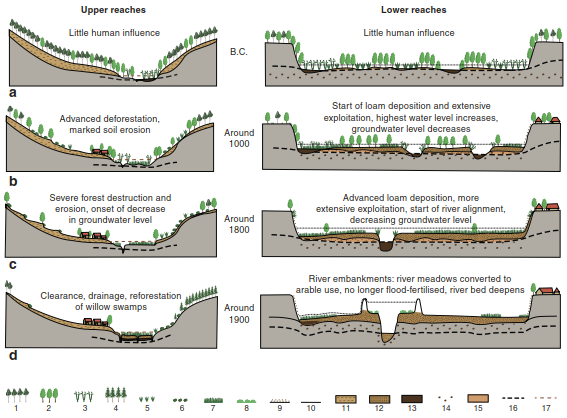
Fig. 17.14. Development of a central European river valley landscape. Increasing deforestation, drainage, erosion and deposition of loam in flood meadows in upper and lower reaches of river. 1 Beech forest; 2 oaks and other mixed deciduous forests; 3 alder swamp; 4 conifer reforestation; 5 willow scrub; 6 other scrub; 7 wet grassland; 8 moist grassland; 9 dry grassland; 10 arable fields; 11 loess soils; 12 meadow loam; 13 moorland; 14 gravel; 15 other soil types; 16 mean groundwater level; 17 highest water level. (after Ellenberg 2009)
The valleys were important not only for the expansion of economic innovations but also for the dispersal of plants because of their small-scale differentiation of site conditions. The increase in the richness of the flora was only possible because of the disturbance of natural sites and resulted in the creation of new sites. The plant communities within the valleys were much different from those occurring within a forest or open fields because the depletion and accumulation of nutrients, irrigation and drainage were controlled by many different microclimatic processes.
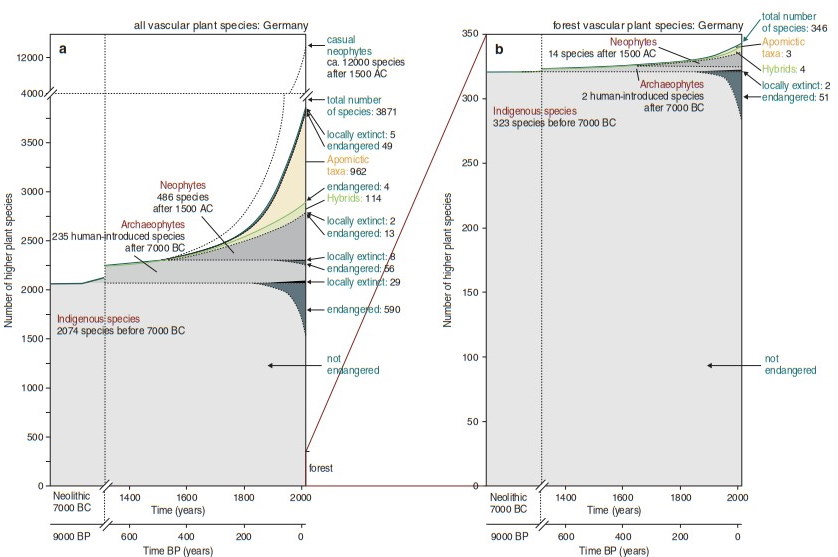
Fig. 17.15. Increase and decrease in plant species in Central Europe since Neolithic times. (after Scherer-Lorenzen et al. 2000; Schulze et al. 2016)
The agricultural landscape of the Middle Ages was driven primarily by two developments. The first one was the introduction of crops from the Americas (e.g. potatoes, maize, quinoa). The second one concerns an extremely varied mosaic of plant communities, resulting in high compositional and structural diversity, which became very much endangered as a result of subsequent mechanisation in agriculture. The temporal development of species that have become naturalised (archaeophytes and neophytes), as well as those that have become extinct, have been summarised for Central Europe (Fig. 17.15). Despite the fact that species extinctions occurred mainly after the nineteenth century, the total number of plant species is still increasing owing to the continued emergence of more neophytes.
Date added: 2026-04-26; views: 231;