
Typical Methods of Forest and Agricultural Management
A. Forestry Coppice system (“Niederwald”): In the Middle Ages, such forests were used to obtain oak bark for tanning and firewood (Fig. 17.9d). The entire forest was used in 30-or-so-year cycles and regenerated from coppiced trees (regrowth from stump or roots). Thus, species that could regenerate were selected for (e.g. hazel, oak, hornbeam). Today, in many developing countries, afforestation efforts (e.g. with Eucalyptus species) are also used as coppiced forest.
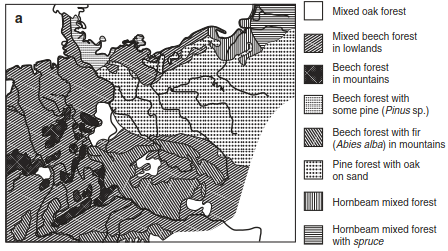
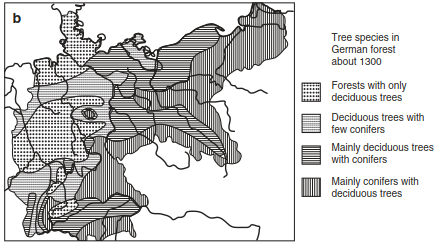
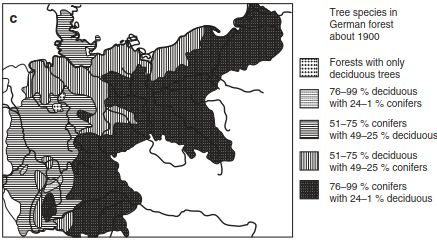
Fig. 17.9. Development of forests in Central Europe. From a after the warm period about 2000 BP (Firbas 1952) through b the Middle Ages until c the nineteenth century. (after Kreeb 1983)
Coppice with standard system (“Mittelwald”): This is a form of forest management applied in the Middle Ages (Fig. 17.9c) in combination with agriculture. The best individual trees (primarily oak) were harvested to supply timber for construction (“standards”), while the remaining trees were selected via coppicing. This technique is still used today to harvest valuable oak for veneers. Thus, an open canopy of uneven aged trees was consistently maintained to provide a sustainable supply of timber for use in construction.
High forest system (“Hochwald”): This consists of trees that grew from seeds (in contrast to regrowth from coppiced trees) (Fig. 17.9b). High forest systems are the dominant forest management strategy today. There are different varieties of this system: (1) clear- felling (clear-cut), where all trees within a cutting block are cut at the same time; (2) shelter-wood felling, where a portion of the canopy trees are harvested, while the remaining portion provides canopy protection for the understorey and seed production and are typically distributed uniformly over the harvesting block.
This management strategy leads to uneven aged stands, where successful regeneration in the European systems consists of beech, coming through the understorey, while pine and oak are harvested in the overstorey. As a result, canopy trees can be twice as old as the mean stand age. For example, oak becomes most valuable for timber beyond 300 years, where the space between individual trunks is filled with some younger tree generations in order to minimise the growth of shoots from dormant buds; (3) selective cutting and gap felling, whose tree harvests result in stands that are not of uniform age; only some of the trees are removed according to their size and usefulness. Regeneration in selectively thinned forests takes place where the individual trees have been removed. Because of variations of light and size in the regeneration area, a species-rich and multi-storey forest results.
ARD: Afforestation, reforestation and deforestation attained particular significance in the onset of the Kyoto Protocol (Chap. 21). Deforestation refers to harvesting an entire forest and converting the area into other uses (e.g. roads, agriculture), reforestation is reestablishing areas of forest that had previously been forested but changed to another land use (e.g. planting of forests in valley meadows), and afforestation means the establishment of forests on land that had not been forested earlier (e.g. forests on moorlands). Revegetation is the re-establishment of forests on areas that had been free of vegetation (e.g. slag heaps). Degradation is the result of harvesting of wood in excess of its natural growth, self-thinning and the density it would reach had the stand attained maximal growth. The current definition of a forest (10-30% cover, 2-4 m high) allows degradation of these limiting values before conversion (e.g. from primary to secondary forest or to plantations).
B. Agriculture. Managed grasslands: This term refers to meadows and swards that used in the production of hay or silage or for grazing. In Central Europe, these grasslands occur mainly on heavier (clay) soils, which are difficult to plough in spring, or in areas where the growing period is too short for cereals (mountain meadows). The species richness of this strategy depends on the intensity with which they are used (e.g. frequency of cutting, fertilisation).
Arable farming: Distinctions based on the following criteria are made (Swift and Anderson 1993):
Type of soil manipulation: ploughing, disc-harrowing. With the latter, a breakdown of organic matter in the soil is reduced and seed is sown in the furrows made by the disc harrow. This method decreases the compaction of soils and leads to deeper rooting, which may increase yields in semi-arid regions. There is no soil manipulation with zero tillage.
Type of crop: root crops (potatoes, beet) and cereals. Earlier agriculture employed intensive soil manipulation and thinning after sowing as a means of controlling weeds and crop density. Today, hoeing is less essential as weeds are controlled chemically and the number of crop plants is technically regulated by sowing density. In cereal cultivation, a distinction is made between winter cereals, sown in the autumn months, and spring cereals, sown in spring. Spring cereals have smaller yields, but they avoid the risk of frost damage in winter. Particular types of crops are those grown for oil seed (rape: sown in autumn; sunflower: sown in spring) and maize, which is sown in late spring after frost (typically in May) because it requires warm temperatures for growth. Cultivation of oil seeds and maize in Central Europe has increased considerably in recent decades. Also, crops for bioenergy have growing importance (e.g. straw from cereals).
Rain-fed agriculture occurs in dry areas (Fig. 17.10b): In the first year, fields are ploughed but not sown (fallow land). Precipitation is stored in the soil following rainfall, and the soil surface is harrowed in order to decrease evaporation, and the capillary action causes water to rise from deep in the soil to the surface. In the second year (or even later), the field is sown, so the crop can often benefit from 2 years of stored rainfall.
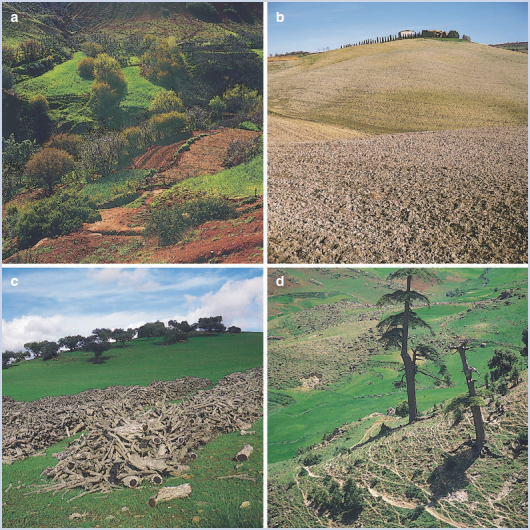
Fig. 17.10. Typical types of agricultural land use in countries around the Mediterranean. a Subsistence farming in a small area with mixed crops and many cultivated plant species (Central Atlas, Morocco). b Grain crops and fodder plants for national market on large-scale farms with high input of agrochemicals and machinery (Tuscan Hills, Italy). c Mixed agroforestry with grain crops for grower consumption and cork (Quercus suber) for national market (Extremadura, Spain). d Unregulated, excessive grazing with severely degraded forests and soil erosion (Central Atlas, Morocco). (Photos: K. Müller-Hohenstein)
Shifting cultivation: This type of agriculture is dominant in tropical regions (Fig. 17.11a-c): smaller areas of forest are cleared and burnt in order to make nutrients available for cultivation, for example, of rice, manioc, banana, for a number of years. After some time, the nutrient availability is exhausted by the continuous harvesting and leads to the abandonment of the agricultural area and the clearing of a new area. Depending on the duration of this cycle, secondary forests can become established in abandoned areas. However, following very rapid or multiple rotations, degradation occurs because the fallow period is too short for the accumulation of nutrients in soils and vegetation. Grass species (e.g. Imperata cylindrica) invade; they are not preferred by animals because of their high Si content and must be controlled by fire. Consequently, there is a transition from species-rich forest to monotonous grassland.
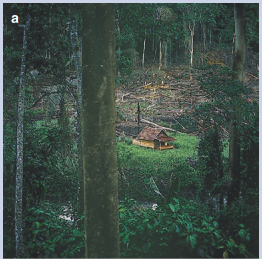
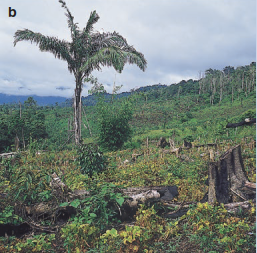
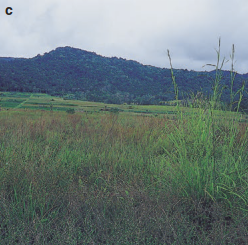
Fig. 17.11. Typical processes and sequences in exploitation of tropical rainforest. Examples from Central Sulawesi, Indonesia. a Uncontrolled clearing (slash and burn) of primary forest, done often by groups of people without knowledge of methods appropriate for the environment. b Agricultural use of the cleared forests for only a few years (without fertiliser application) until the fertility of the land is exhausted by the cultivated plants grown to fulfil people’s needs. c The unproductive area is abandoned and quickly invaded by alang-alang grass (Imperata cylindrica) and bracken (Pteridium aquilinum). (Photos: K. Muller-Hohenstein)
Agroforestry (predominantly in the tropics) describes management systems in which forest regeneration and timber production (for fodder and fire wood respectively) are linked to field crop production in space and time. The overstorey is used for timber production, while field crops are grown in the understorey. Species of both strata are deliberately selected to optimise resource complementarity, which results in higher yields.
Multiple cropping (mainly in the humid tropics and oases of the Sahara): In this case (Fig. 17.12b), there is a permanent layer of fruit trees (mango, coconut) above useful shrubs (also herbs, banana), which in turn cover herbaceous crops (ginger, taro, manioc).
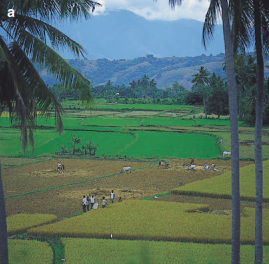
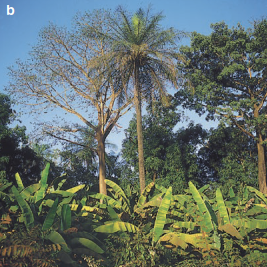
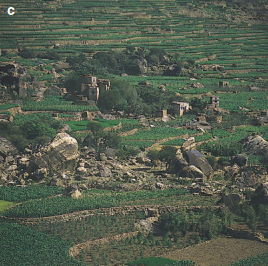
Fig. 17.12. Types of sustainable agricultural land use in the humid as well as in seasonally moist tropical regions, across all continents. a “Continuous” rice cultivation in South-East Asia often combined with cultivation of different palm trees (Sulawesi, Indonesia). b In almost all tropical regions, small home gardens are multi-storied with different layers of cultivated plants, which “copies” the species-rich tropical forests, for example, trees such as oil palm (Elaeis guineensis), cashew nut (Anacardium occidentale) and banana (Musa paradisiaca) and annual vegetables below (Guinea-Bissau). c Sophisticated irrigation schemes on widespread terrace complexes have been in use for many centuries for cultivation of annual crops such as sorghum (Sorghum bicolor) and perennial shrubs such as coffee (Coffea arabica) and qat (Catha edulis) in the Yemen Arab Republic. (Photos: K. Muller-Hohenstein)
Date added: 2026-04-26; views: 238;