
Classification of Anthropogenic Influences and Their Consequences for Vegetation
The overall human impact on plant cover and the increase and decrease of plant species and communities have also led to further development of the classification system of plant communities in Europe. Jager (1977) classified anthropogenic effects on vegetation into three main categories:
- Original (natural) vegetation (in sub-Atlantic period).
- Actual (recent) vegetation under present-day conditions of site and use.
- Potential natural vegetation (pnV), a term introduced by Tuxen (1956) describing the vegetation that would occur under present conditions at a site (without further changes in these site conditions).
Natural vegetation no longer exists in Central Europe. The pnV is important for some aspects of nature conservation and spatial planning. Recently, the pnV concept has been well criticised (Chiarucci et al. 2010; Loidi et al. 2012). In particular, non-predictable vegetation dynamics due to natural environmental changes, biological invasions and multiple human interventions have been ignored. We therefore concentrate on the actual vegetation and its environmental conditions here. Evaluating anthropogenic influences is essentially based on the balance between gain (introduction, immigration, naturalisation) and losses (displacement, extinction) of species. Compared with natural vegetation, gains as well as losses represent a change of the “natural” state. Therefore, a rather popular approach is to characterise and typify anthropogenic vegetation by defining the so-called level of naturalness. Several proposals have been made to scale naturalness.
One subdivision of anthropochors (non- indigenous species with expansion dependent on humans) was given by Sukopp (1972), using the following three criteria:
1. Based on the time of immigration: archaeo- phytes (old adventives) immigrating in prehistoric times are separated from neophytes (new adventives), which only immigrated in historical times after 1492 (Columbus’ arrival in the Americas);
2. According to the method of immigration, i.e. the type of human interaction in immigration: ergasiophytes (intentionally introduced species, for example, crop plants and their forms that grow wild, ornamental plants) as well as xenophytes (unintentionally introduced species, e.g. weeds accompanying imported seeds, plants from bird food);
3. According to the degree of naturalisation: how well they become established permanently at a new site (for example, agriophytes, i, e. new indigenous species that are competitive without human intervention; ephemero- phytes, i.e. non-persistent, ephemeral species, which disappear quickly).
To be classified as a neophyte, a species must be introduced or imported, become established after reaching new sites, be naturalised permanently without direct help from humans, and finally expand. The hypothetical number of species that are successful in this sequence decreases with each new step. Plants must possess some of the characteristics listed in Table 17.3 in order to be successful.
What are the consequences of a gain and loss of species for the indigenous vegetation? The loss of distribution barriers leads to a mixing of the flora and fauna from various biomes. Already Elton (1958) regarded this as a decisive, recent change in the biosphere. Two marked historical epochs must be distinguished: the time after the discovery of America until the sixteenth century, where increasing travel occurred between continents. Another important period also existed where, since the beginning of the nineteenth century, new anthropogenic sites opened up for the establishment of plants.
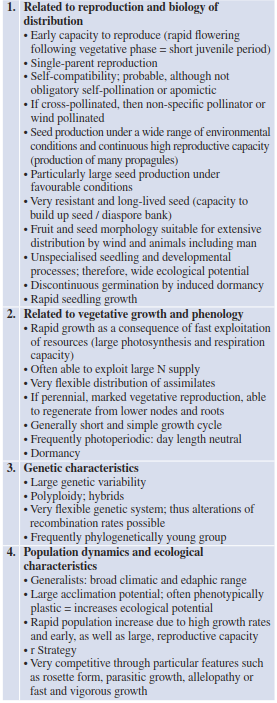
Table 17.3. Characteristics of successful neophytes. Compiled from different sources by Sukopp and Wittig (1998)
Lohmeier and Sukopp (1992) analysed the consequences of introduced foreign plants on the native vegetation present in the ecosystems of Europe. It was typically found that within industrial countries approximately 100 species per 100 000 km2 were naturalised; however, variability exists in the system, whereas in Japan as many as 800 species were found where three floral regions meet. The proportion of synan- thropic species is constantly increasing (Fig. 17.15); Sukopp (1972) assumed less than 1% of introduced plants, but this was modified by Lovei (1997) to 6%, coupled with 54% of total species in Germany originating from Europe and western Asia, 30% from moderate climates in North America, and 9% from Central and East Asia.
Because a cultivated landscape possesses a mosaic of different site conditions, the probability of species meeting and hybridising is greater. Thus, several families developed quickly and became species-rich, for example, the Oenothera species, following their introduction into Central Europe. Among the anthropochors, agriophytes are of special importance. These plants have been introduced for economic reasons in natural habitats (e.g. Robinia pseudoacacia, Junglans regia, Prunus serotina, Castanea sativa, Helianthus tuberosus), as ornamental plants (Centranthus ruber, Heracleum mantegazzianum, Impatiens glandulifera, Tulipa sylvestris, Reynoutria japon- ica), as species originating from botanical gardens (Impatiens parviflora, Elodea canadensis), and as species that were deliberately planted in natural areas (Lupinus spp.).
Agriophytes were not able to become established everywhere. They are particularly numerous on sites disturbed by humans, in towns and industrial areas. Only a few species became established in woodland regions. An example in forests is the wild cherry (Prunus serotina), which was originally introduced to accelerate the accumulation of humus, but it impedes natural regeneration. The spread of nitrogen-fixing species such as Robinia pseudoacacia leads to nitrogen accumulation in the soil and, consequently, to an increase of nitrophilic species. Along the coasts the cord grass (Spartina anglica), planted to take over land, has widely replaced glasswort (Salicornia europaea) and has thus become an unwanted invader. This applies also to the Canadian pond weed (Elodea canadensis), but in many waters it has decreased again owing to increasing eutrophication of waterways. Areas around river banks provide particularly favourable conditions for the immigration and expansion of agriophytes, as new open spaces always develop, due to the natural dynamics of water flow, and because there are few competitors to immigrants.
Are neophytes a danger to nature? The number of alien species in Central Europe exceeds the extinct species (Fig. 17.15). At present, about 5-25% of the flora in Central Europe may be anthropochor; in towns it reaches about 50%. There is much evidence for the decrease in indigenous species because of the advance of neophytes. Two species with a particularly high invasion potential, Solidago canadensis in Berlin and Tribulus terrestris in the east African savannas, were analysed using a key-lock model to explain their invasion of niches (Cornelius 1991). It was found that resource demand, tolerance to climate stress and strategies of adaptation to competition and regeneration (key traits) coincide with climatic conditions, disturbance and succession. Invasion is possible and endangers the existing mosaic of species and communities, where neophytes may become pests because they migrate at such a fast rate that their primary competitors and other negative influences, such as pathogens, stay behind.
Some important traits of neophytes are that they have a high potential of propagation and are highly efficient dispersal vectors. They are strong competitors who require no special climatic conditions while also showing the ability to efficiently exploit soil (for more traits, Table 17.3). Thus, they are often able to outcompete or suppress native species, especially in agricultural and forest communities, as they may produce high quantitative losses. At present, neophytes are not regarded as very dangerous for native species diversity in Europe; however, concern does arise on oceanic islands or other isolated habitats where more than 40% of the actual flora may be neophytes. The same is true of densely inhabited areas, as Lovei (1997) called this ongoing dynamic the “MacDonaldization” of the biosphere.
Date added: 2026-04-26; views: 245;