
Desertification on the Border of the Sahara
The term desertification has been used to describe environmental problems in arid areas, at least since the many years of drought in the Sahel in the late 1970s. Today it is obvious that this term describes not only climatic stress in long- lasting drought periods but also the complex interactions that include in particular human impacts on vegetation and landscapes. In the context of ecosystems in arid areas, and of the often- cited man-made deserts, it should be underlined that extended dry periods are a characteristic feature of arid areas. It is not only the small amount of available water after a precipitation event coupled with high temperatures but also the highly variable temporal, episodic and spatial distribution of this precipitation that cannot be anticipated.
In the Sahara region, it is not uncommon for prolonged periods of dryness to last for several years, as depicted historically through the interpretation of lake sediments (Nicholson 1978). The recent dry period in the 1970s in the Sahel had catastrophic consequences as it preceded a relatively moist period. During the moist period the human population grew considerably, but it found itself maladapted when the dry period arrived. Improved medical supplies and technical innovations (deep wells to tap fossil water) have improved grazing conditions and increased the number of animals being farmed in this area (Muller-Hohenstein 1993). However, it is not correct to regard ecosystems of arid areas as particularly labile systems. These ecosystems are adapted to extreme climatic variability. Autochthonous plants and animals are able to adapt in many ways, and thus are able to survive under such conditions. The human population in these areas has also adapted to maintain supplies and is prepared for variations in crop yield. A “desertification scheme” (Fig. 17.20) indicates the most important causes and consequences of land degradation in arid regions.
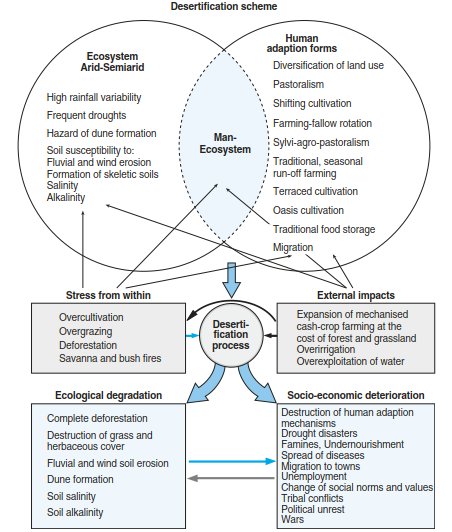
Fig. 17.20. Scheme of process of desertification. (after Ibrahim 1988)
It is important to consider the discrepancy between population growth and—despite all the technological progress—the limited availability of renewable resources, in addition, as well as the substitution of traditional forms of management (nomadic life style) by modern forms of grazing and rain-fed agriculture. Up until the end of the twentieth century, the human population around the Sahara has grown five-fold (Goudie 1994). Today, owing to these increases in population, many examples of poor agricultural practices can be found in all areas near deserts, for example, agriculture in north-eastern Syria or eastern Jordan, which receives less than 200 mm of precipitation annually, or growing animal fodder through the use of fossil water from depths more than 1 km under the Algerian oases, all of which can further contribute to the degradation of vegetation in the area.
Human influence on the vegetation in arid areas is particularly linked to the disturbance of sites and original plant cover. As a result, many of the woody plants previously present in arid regions disappear as the requirements for energy are not met. The naturally sparse contracted vegetation, growing in areas with an above-average water supply, is damaged by overgrazing. While vegetation in drier areas with a high fodder quality typically becomes locally extinct, toxic or thorny plants can strongly expand. Local changes resulting from the increased loss of vegetation are seen in the remobilisation of dunes and increased number of dust storms. Also, water relations of areas are affected by modern irrigation installations, which result in the salinisation of soils and a rise in halophytes (Fig. 17.21).
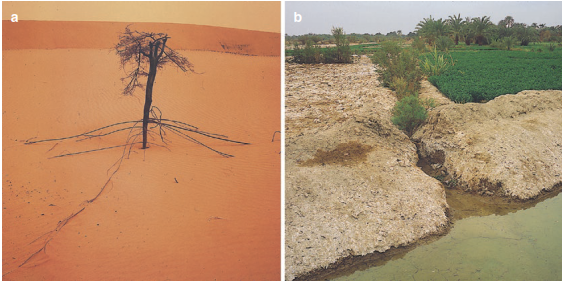
Fig. 17.21. Desertification in areas where people apply inappropriate forms of land use. a A single tree (Commiphora africana) in the southern Sahel of Mauretania is witness to former removal of dry forests, which disappeared because of excessive grazing and movement of sand dunes. b Incorrect irrigation with water of high salt content and inadequate drainage has caused salinisation in oases that had functioned for centuries with traditional cultivation (Dakhla Oasis, New Valley, Egypt). (Photos: K. Müller-Hohenstein)
The Sahara Desert area has probably grown by 15% in the last 100 years; indeed, it is believed that, just between the years 1958 and 1975, the Sahara extended 100 km to the north and to the south. However, such rates of desert growth are also questioned. Hellden (1991) found on the basis of satellite photos a close relationship between precipitation and vegetation, but no evidence for expansion of desert areas. It is still not exactly known whether the observed changes are permanent or whether regeneration is possible.
The latter is understood as the sum of processes in an ecosystem by which lost elements may be regained and thus re-establish themselves to the point where they achieve a status equivalent to their original status. There are many positive and negative interactions between climatic events, the development of vegetation and abiotic site factors and human influences, all of which remain poorly understood. However, in all dry areas of the Old World, there have been examples of a rather rapid recovery of vegetation following a precipitation event. Obviously, the ability of species to regenerate in arid regions depends on the lower and upper variability of precipitation a plant can tolerate; however, this still remains largely unknown. Nevertheless, the existing alterations in the albedo, increasing dust load in the atmosphere and changes in soil moisture in arid regions also contribute to global climate changes and influence the regeneration of desert vegetation.
Date added: 2026-04-26; views: 233;