
Methods in Phenology Research
Phenological studies focus on the appearance of plants during their temporal development throughout the year. The characteristics include floral development (reproduction) and leaves (vegetative growth). In spring, observations are usually made weekly and later at longer intervals. The numbers of flowers, shoots, leaves and fruits, as well as the degree of cover, are typically counted or measured.
Dierschke (1994) provides an example of such analysis for deciduous trees in nemoral forests and reproductive stages in phenology.
Vegetative phenological stages
0. Buds completely closed
1. Buds with green tips
2. Green leaf emergence
3. Leaves 25% unfolded
4. Leaves 50% unfolded
5. Leaves 75% unfolded
6. Leaves fully expanded
7. First leaves yellowing
8. Leaves 50% turned colour
9. Leaves 75% turned colour
10. Leaves 75% turned colour
11. Bare
Reproductive phenological stages
0. Without flower buds
1. Flower buds recognizable
2. Flower buds swollen
3. Shortly before flowering
4. Start of flowering
5. Up to 25% flowers mature
6. Up to 50% flowers mature
7. Full flowering
8. Flowering decreasing
9. Flowering ceased
10. Fruiting
11. Fruit abscission
Comparable categories have been developed for herbs, grasses and cryptogams. For general phenological examination, in which the whole plant community is considered, permanent areas are marked and regularly monitored. This may include all or only selected species in vegetative and reproductive stages of development (phenophases). In addition, environmental data are recorded, particularly those related to weather conditions (temperature, precipitation). For the visualisation of these data sets, species are sorted by the start of flowering or the length of the flowering period.
Development during the year is often subdivided into phenophases that are based on phenological plant types. They have the same developmental rhythm, which appears in comparable leaf characteristics, time of flowering and duration of the vegetative period. The applicability of these types is limited to particular regions because individual species may behave differently in different communities. Phenophases are initiated by the start of flowering, leaf unfolding, leaf colouration and leaf abscission of particular plant species.
In so-called phenophase diagrams, representatives of important phenological plant types are used to describe phenology over the course of the year (Fig. 17.24). These quantitative-synthetic phenological spectra provide a precise understanding of the floristic structural features of vegetation and elucidate connections between flowering, reproduction and dispersal, thereby providing the basis for the study of biocoenotic relationships. Phenological maps are widely used to show spatial differentiation, for example, of the start of spring (often based on flowering initiation of apple or lilac in Central Europe).
The selected plant species used for this must fulfil two conditions: (1) they must occur in high numbers and be widely distributed and (2) they must show clearly distinguishable and easily assessable phenologi- cal characteristics. In mesoclimatic regions, trees are generally selected, while herbs are used to characterise the climatic conditions of the understorey. Phenological maps, which now are made with the help of aerial photographs and permanently installed automatic cameras (so-called phenocams), show differences within small areas such as towns and their suburbs. In agriculture, phenological characteristics are used to establish maps of growth climates and temperature ranges to assess the potential use or the probability of damage to particular types of crops.
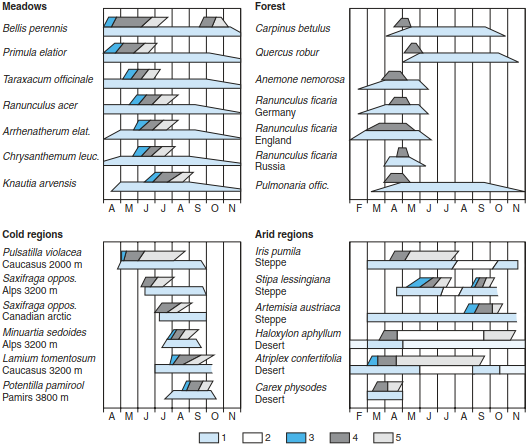
Fig. 17.24. Phenological phases in growing season. Examples of an oat grass-Arrhenatherum-grassland in Poland, for trees and herbs in a mixed oak forest in northern Germany (with comparison of Ranunculus ficaria to those in Russia and England) and for plant species from cold regions (high mountains, arctic regions) and from semi-arid and arid regions (steppe, deserts). 1 Time required for complete leaf cover; 2 death due to drought; 3 flower buds visible; 4 flowering period; 5 fruit ripening and seed dispersal. (after Larcher 2003)
Date added: 2026-04-26; views: 233;