
Primary and Secondary Succession in Vegetation Dynamics
Succession Types.Succession may be considered over large or small areas, with fast or slow changes. It may be directed or cyclical and may be affected by endogenous or exogenous processes, which may differ by type, intensity, duration or extent. It is important to consider the geographical location within different climatic zones and whether development occurs on newly formed soils or on those previously colonised. Finally, participating plant species will differ in their ability to disperse and compete and in their life history strategies and resource demands/strategies. Dynamic processes are triggered if net production and mineralisation in an ecosystem are not balanced. In such cases it is possible, for example, to accumulate organic matter (formation of bogs, autotrophic succession) or for organic matter to be consumed (use of humus by agricultural systems, heterotrophic succession).
Considering all these aspects, many succession types on different spatial and temporal scales have been described. Spatial and temporal relations and how these aspects are related and differ are shown in Table 17.4. In Fig. 17.29, the suc- cessional types are schematically arranged. These are the most important examples of progressive and regressive, directed as well as cyclical vegetation dynamics.
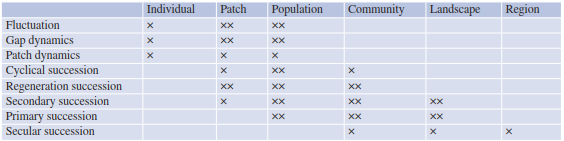
Table 17.4. Relationships between spatial and temporal dimensions in changes in vegetation. The terms in the table headers refer to spatial dimensions. A patch is a small homogeneous area (ecotope), a gap a small open space in the forest (after van der Maarel 1988)
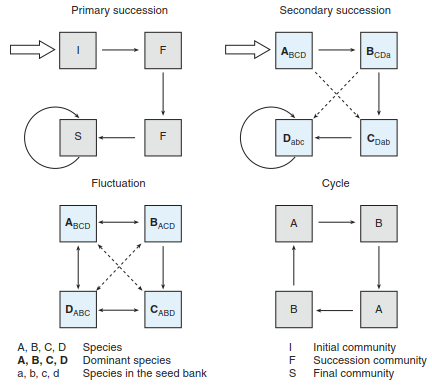
Fig. 17.29. Types of directed and cyclical vegetation dynamics. (after Jochimsen 1993)
Primary Successions. Primary successions are important for understanding processes of vegetation dynamics, but in reality they are rarely observed because they typically occur over long time periods where an uninhabited abiotic substrate needs to be present. Knowledge of individual stages of the sequence of primary successions derives mainly from newly formed sites, for example, following a volcanic eruption (Fig. 17.30) or in newly developed coastal regions or at the receding edge of a melting glacier (Fig. 17.31). Also anthropogenic sites, such as rubble heaps, quarries, road cuts and so forth, may be regarded as starting points of primary succession. Despite the differences in sites, similar trends and basic patterns may be discerned in such situations.
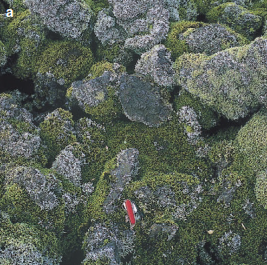
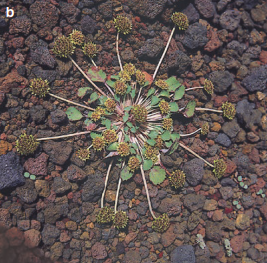
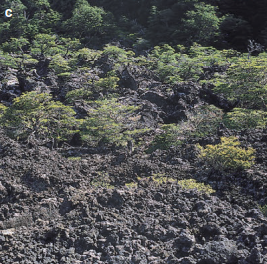
Fig. 17.30. Different stages of primary succession. a On fresh volcanic lava dense moss and lichen communities have developed after 8 years. b Only specialists among the vascular plants (e.g. Pozoa volcanica) become established quickly on almost unweathered rocks without soil. c Only after several decades do the first trees (Nothofagus obliqua, N. dombeyi) form open woodland vegetation. Photos were taken on sites on Llaima Volcano in southern Chile. (Photos: K. Müller-Hohenstein)
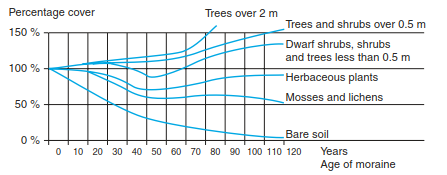
Fig. 17.31. Succession on moraines of Aletsch Glacier (Switzerland) (after Klötzli 1993)
Very few plants are able to cope with the hostile conditions of a site during the initial phases. On rocks, cryptogamic communities develop first, perhaps lithophilic lichens, then fruticose lichens, mosses and ferns. In unfavourable exposed positions, for example on steep rock walls or on mobile debris, development rarely goes beyond this phase (permanent pioneer communities). Usually, the pioneer communities, which themselves depend on the input of propa- gules from the surrounding areas, change the site over the course of time, which allows for the formation of a soil substrate. Many Leguminosae are herbaceous pioneers that facilitate the accumulation of nitrogen in this new substrate. Upon the establishment of later pioneer plants, these will help change the local microclimate. If flowering plants have not become established during the first phase of succession, they will now follow. These are predominantly heliophilic, epi- gaeically germinating annuals or, where climatic conditions do not allow such establishment, undemanding (i.e. able to grow on a nutrient- deficient substrate) herbaceous hemicryptophytes and chamaephytes.
As succession progresses, the pioneer species are excluded more and more with each step by more demanding species. When this change takes place solely because of the changes in the vegetation itself, it is called autogenic succession. If other causes are more important— for example, natural climate change or a lower groundwater table caused by human extraction of water—this is called allogenic succession. If successions proceed under steady external conditions, there are further stages, after the pioneer stage where competing species occur, that are superior to the pioneer species in vegetative and reproductive growth. These species grow taller, despite lower rates of growth, because of their longer life span (occurrence and increase of shrubs and trees), and they are more shade tolerant but often have less effective mechanisms for distribution, despite their more effective occupation of space in the long-term. Trees are superior to shrubs, forming polycormones, which enable them to dominate for a certain time. In the final phase of such development, trees dominate. This type of primary succession is understood to be progressive because the diversity increases at the level of the species as well as with regard to structure.
Common dynamic trends, despite the apparent individuality of responses, are summarised in Fig. 17.32. At the beginning of primary succession, chaotic interactions dominate, which cannot be predicted, because input and the establishment of propagules are, to a high degree, stochastic; widely distributed annuals dominate. Between the development of vegetation and changes in the site, feedback mechanisms trigger (Table 17.5). This means that plants themselves contribute, to a considerable degree, to creating environmental conditions that favour conspecific species. The dominance of exogenous factors is only slowly substituted by endogenous factors and is accompanied by a change in species and life forms. In the labile pioneer stages, intra- and interspecific competition is not very important, but in the later stages competition plays a decisive role in the development of communities that become increasingly resistant to external disturbances.
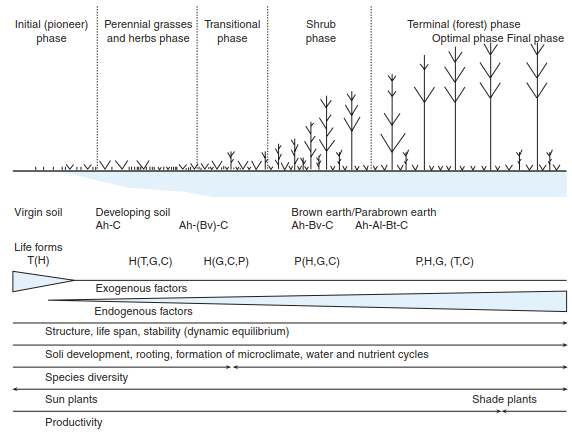
Fig. 17.32. Main characteristics of progress of primary succession. Exemplified for silicate rock and under sub-Atlantic climatic conditions. T: Therophytes; H: Hemicryptophytes; G: Geophytes; C: Chamaephytes; P: Phanerophytes. (after Dierschke 1994)
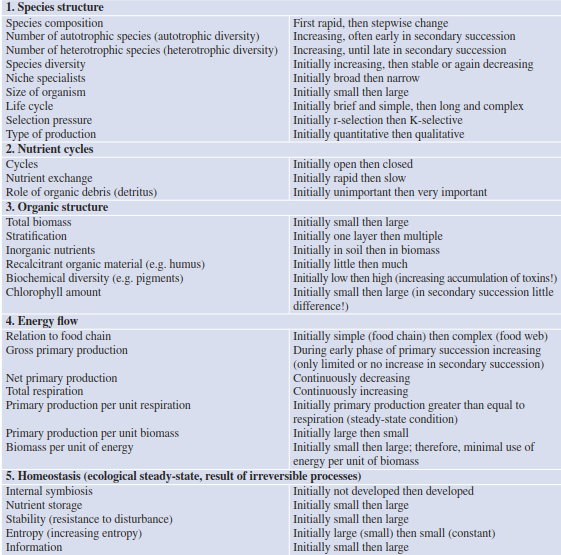
Table 17.5. Environmental changes during succession (after Klötzli 1993)
Disturbances and Secondary Successions. Primary successions occur faster under warm, humid climatic conditions than under cold or dry conditions. However, it is most important that development of these successions are not affected by disturbances, which can only be rarely excluded. Thus, primary successions are particularly important for a better understanding of the processes of secondary successions, which dominate the actual vegetation dynamics in our environment.
Disturbances are the main causes of spatial heterogeneity and also affect environmental conditions and plant competition. They may disturb but at the same time also maintain biodiversity. For instance, grazing by large herbivores is an important disturbance because it can control vegetative dynamics, structure and diversity. All successional concepts, from patch dynamics to mosaic cycles, are based on disturbance regimes. Disturbances can have a profound influence on the species composition, changes and vegetative matter fluxes at a site, which can regulate habitat fragmentation. These factors concern plant communities as well as entire ecosystems, and the loss, gain and turnover of organic matter and disturbances may be the result of natural events or human interventions (Fig. 17.33).
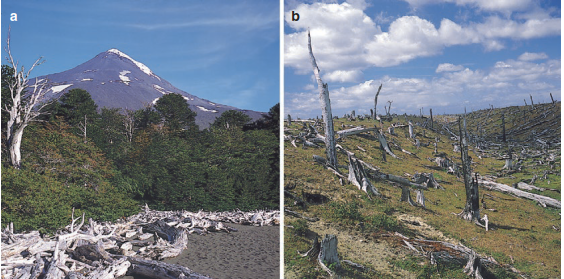
Fig. 17.33. Secondary successions develop after disturbances, which may be natural, for example, a when dead wood accumulates after volcanic activity and subsequent fire in a forest community on the Lanin Volcano in southern Chile. However, b the disturbances can also be human-made, for example, forests cleared by fire for range lands, not for timber, in southern Chile near Aisen. (Photos: K. Müller-Hohenstein)
There are several definitions and a multitude of different types of disturbances (Box 17.4). Secondary succession sequences may be classified according to the responses to disturbance (regarding the material balance of an ecosystem):
- Disturbances may interrupt the dynamics and the vegetation but leave the ecosystem at a certain stage (permanent communities).
- Changes occur without clear direction within vegetation, for example, because of long-term fluctuations in the water level.
Influences mentioned can lead to faster or slower, as well as irreversible, alterations. A response that reverses the process or sets it back to a previous step or direction of change is known as regressive succession. These include successions that occur as a consequence of overexploitation or selective use of forests and pastures.
Most often secondary succession leads to reestablishment of the state that preeceded the disturbance. Here, too, the changes in direction lead to a more complex form of organisation in the plant community. However, secondary successions have different initial stages. Their dynamic changes start from an already settled substrate and may build on an existing seed bank. This means that secondary successions progress faster than primary successions; right from the start there is competition for space and resources, and only species that can compete are able to invade.
In Central Europe, numerous studies investigate secondary succession on fallow land and meadows. Schmidt (1993) describes succession over 25 years on (previously sterilised) fallow fields and found that after only 2 years of occupation by annuals, the persistence of herbaceous plants allowed them to become established by the eighth year, after which dwarf shrubs and shrubs occurred up to the twentieth year. Finally, successions continued with pioneer forests, or a preforest stage. These phases were initially limited by nutrients. Even if individual phases develop relatively regularly, it is difficult to analyse this development and to define the decisive factors determining the succession because of the many factors influencing and feeding back into the process (Fig. 17.35). 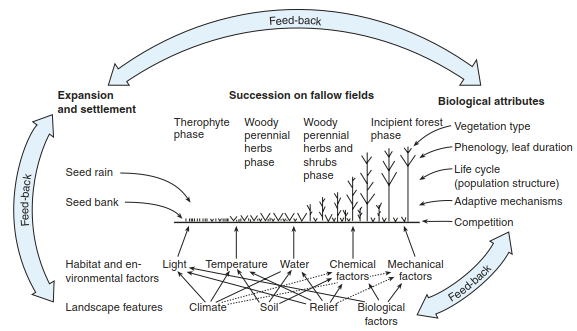
Fig. 17.35. Successions on fallowed agricultural fields: influencing factors and interrelations. (after Schmidt 1993)
Secondary succession in fallow pastures is delayed because of the dense grass layer. Schreiber (1995) shows from observations over 20 years that the establishment of woody plants can occur in several ways. Occasionally, well-known basic processes in the succession of different functional types of plants from annuals to woody species occur. However, pastures, initially relatively homogeneous, often show the formation of dominance patterns with few species that cover the area well after just a few years. With good nutrient supply, herbs dominate because biomass is not removed (auto-eutrophication), but with poor nutrient supply grasses dominate. The temporal sequence of individual stages differs considerably. In some areas, 10-15 m high pre-forest vegetation occurs, while on other potential forest sites neither trees nor shrubs grow. The difference in the establishment of woody plants does not fit any succession model so far described; a prediction about changes in life forms and species is not yet possible, even if occasionally such phases in vegetation dynamics may be clearly seen.
A special case of secondary succession is polycormophyte succession. Vegetative lateral shoots of plants form colonies that are able to expand in closely covered herbaceous plant communities even faster than via seeds. This type of succession usually starts with a pioneer woody species possessing a superior defence against herbivores, for example, Prunus spinosa. Such plants are able to expand over large areas for decades. Finally, taller, unprotected shrubs and trees become established in centres of such areas, so that forest islands and, ultimately, closed forest areas may result. This development can be interpreted as an autogenous succession, regulated by the vegetation itself. The study of this form of succession allows strategies of competition in woody species to be recognised (Fig. 17.36).
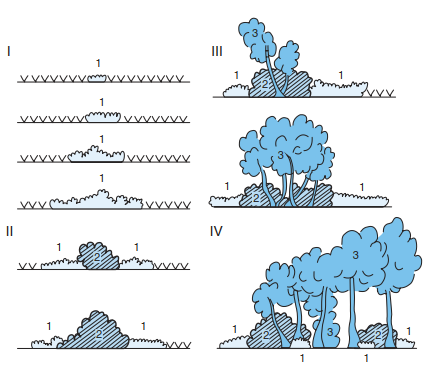
Fig. 17.36. Polycormophyte succession of woody species in grassland. 1 With establishment of low-growing woody species; 2 followed by tall-growing woody species; 3 with woody, tall trees. (after Dierschke 1994)
The concept of succession as a directed, more or less deterministic, although predictable, process must therefore be corrected according to empirical results obtained in recent decades. These changes over time are very complex, with many variables influencing development, for example, site, biological reproduction, space and time. Particularly important are the type, intensity and duration of disturbance. All these factors make it difficult to regulate and predict successions.
Date added: 2026-04-26; views: 220;