
Disturbances: Definitions and Properties
A disturbance is a relatively discrete event in time that concerns an ecosystem, community or population structure (of vegetation) and changes the resources, substrate availability or physical environment (Pickett and White 1985). Because this is an absolute definition, all changes must be measured and accounted for. In contrast, by some relative definitions, disturbances are regarded as events leading to deviations from the normal dynamics in an ecosystem or plant community, based on the assumption that a “normal” state is known. Furthermore, severe disturbances can range from having very far- reaching consequences, up to a complete floris- tically and structurally different plant community, to very small ones, for example, affecting the ability of a single plant to resprout.
Richter (1997) distinguishes between endogenous and exogenous disturbances. The former occur regularly; they are a feature of a system, so organisms in the community adapt.
This is the case for seasonal changes and for changes such as frequent, regular flooding of meadows. Most disturbances that then lead to secondary successions are exogenous and are typically natural in origin (e.g. catastrophic storms or landslides and avalanches); however, they can also be caused by human activity.
To overcome the high complexity of disturbance regimes, Buhk et al. (2007) established a classification scheme that takes into account the disturbance type (e.g. felling, flooding), disturbance space, form and distribution (spatial dimensions) and disturbance frequency, seasonality and duration (time dimensions).
The intermediate disturbance hypothesis (IDH) puts forth an often discussed theoretical background to evaluate the effects of a given disturbance (Sect. 13.5 and Sect. 20.3). This hypothesis describes the relations between the type and force of the disturbance and the species diversity in the area concerned (Huston 1979). It states that at intermediate levels of disturbance, species diversity is at its highest.
No species will be lost by being overly disturbed, and the competitive exclusion of a species is not very likely. Field tests of the IDH showed mixed support for and against this hypothesis (Mackey and Currie 2001).
In our managed landscapes, anthropogenic disturbance dominates because it begins with processes that immediately affect individual plants or that alter the environment and affect the whole community. It is therefore useful to differentiate between natural and anthropogenic disturbances, such as unusual weather conditions, flooding and landslides versus logging, mowing and trampling. However, some disturbances may be a combination of both, for example, fire (Fig. 17.33). There are spatial and temporal patterns in disturbances that help to understand the patterns of succession. Richter (1997) attempted to characterise disturbances in different climate zones (Fig. 17.34).
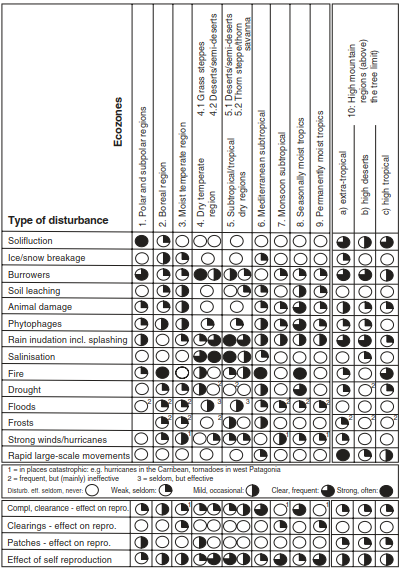
Fig. 17.34. Type and occurrence of disturbances in different ecozones. (after Böhmer and Richter 1996)
Date added: 2026-04-26; views: 233;