
Cyclical Vegetation Dynamics
Secondary successions not only develop on fallow or abandoned land but also in plant communities affected by all kinds of disturbances. Here processes directed towards a re-establishment of the original status may occur and fit into a cyclical regeneration scheme. Examples originate from managed forests where humans are the driving force, ensuring that the cycle is maintained. Pignatti and Pignatti (1984) analysed such regeneration cycles for Mediterranean forests (Fig. 17.37) and showed two variants—one for regeneration after clearing and one, more regressive, succession after several fires. After clearing, various weeds become established that are later on outcompeted by oaks. Reoccurring fires will lead to a permanent stage where regeneration takes place—if at all—only after a long period.
The final phase of secondary succession can be understood as a kind of self-preservation cycle. In a cyclical succession, plants of different ages enter and replace each other in the same vegetation community. Structural changes with the same or different species at one site are important. Further concepts about cyclical vegetation dynamics originated from Watt (1947), who introduced the “gap” into the discussion, that is, sites where these processes take place. Remmert (1991) coined the term mosaic-cycle concept to describe such cyclical dynamics. An important observation was that the climax stage (mature stage) does not extend over enormous areas in natural forests, but that various phases of development are spread out like a mosaic. All stages co-occur adjacent to each other in small patches. For Central European forest areas three phases are distinguished:
- A rejuvenating and juvenile phase, with young plants of the same or different tree species, with the previous phases occurring again. Often light-demanding trees invade first, followed by shade-tolerant trees.
- An optimal phase corresponding to a forest of uniform age with few species, a closed stand with little undergrowth.
- Ageing and decaying phases when the tree layer is disrupted over large areas and species requiring light are able to invade.
These phases may be regarded as a continuous process of self-thinning.
Figure 17.38 shows schematically the cyclical vegetation dynamics for a tropical rain forest. The size of the pieces of the mosaic differs, depending on the diversity of species. In nemoral
| Phases: 1. Destruction 2. Regrowth 3. Competition 4. Death of pioneer species 5. Homeostasis |
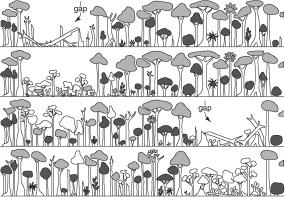
deciduous forests an average size of 1-2 ha is assumed; in boreal forests the pieces of the mosaic cover several square kilometres because of the influence of fires. In contrast, in tropical rain forests they are hardly ever larger than 100 m2 (treefall gaps). The duration of cycles also differs. For the well-analysed forests of the boreal zone several centuries are assumed; in the North American sequoia forests cycles last several thousand years. Processes of vegetation dynamics similar to mosaic cycles also exist in North Atlantic heath and bog complexes.
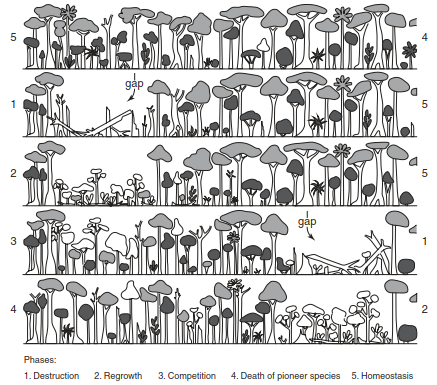
Fig. 17.38. Mosaic cycle in tropical rainforest. Open tree crown pioneer species; thick tree crown canopy species; medium tree crown shade-tolerant species. (after Richter 1997)
Disturbance is again seen as the driving force for cyclic vegetation dynamics. The life span of “key organisms” is important, and competition following their death is centred on obtaining light and nutrients. The same is true for mechanical influences (wind breakage, fire). Constant conditions are not to be expected in a pristine forest, which is also a mosaic of asynchronous phases of cyclical vegetation dynamics. During the individual phases, the structural characteristics of forests and their species diversity change.
Today, additional types of cyclical vegetation dynamics are distinguished based on questions of scale and preferential occurrence in different biomes. The formation of mosaics over large areas in Hawaii is known as a consequence of the “death of cohorts” (Muller-Dombois 1995). Demographically unfavourable situations caused and maintained by fire and storm damage are the driving force. In this context, the mass die-off of bamboo-like grasses in all tropical regions should also be included. However, it is still not clear whether only endogenous (age) or also exogenous (climate) influences are responsible; it is likely that a combination of both is responsible.
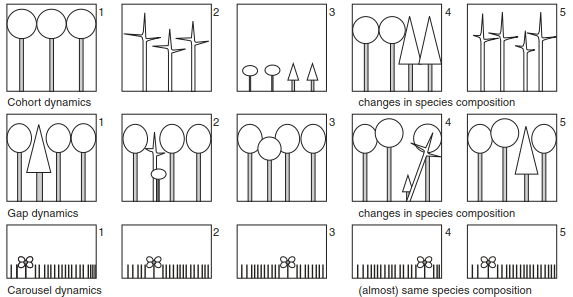
Fig. 17.39. Developmental phases of different types of plants during changes in vegetation. (after Richter 1997)
In cohort dynamics, as in the mosaic cycle, the species composition may change. However, in so-called carousel dynamics, the pattern formation in grasslands occurring over small areas is not included according to van der Maarel and Sykes (1993). The basic idea of this change over time is that species are able to recycle in a very short time period on the smallest of scales. A regeneration gap is a sufficient free space for seeds to germinate and become established. These spaces become available through the death of individual plants and are conquered in a sort of “guerrilla strategy” or even according to the lottery principle of species in the community in which all have occupied the same regeneration niche, or a first-come, first-served approach. Because these species are short lived, the carousel model describes vegetation dynamics in the smallest space and of the shortest duration. Populations of a species are always available, but they are very mobile, and the species composition remains constant. Figure 17.39 compares different spatial and temporal scales of cohort, gap and carousel dynamics schematically.
Aspects of Applied Succession Research. The dynamic nature of plant communities has often been identified via bio-indicators. It is assumed that the response of a plant community to disturbances is specific, and perhaps quantifiable. The vitality of species of the plant community and shifts in the species spectrum are measured. Knowledge about the formation of plant communities and their regulation is gained by empirical findings of many succession studies. For instance, pioneer plants with uniform seeds are selected for the greening of open spaces or to stabilise open slopes after road building (Fig. 17.40).
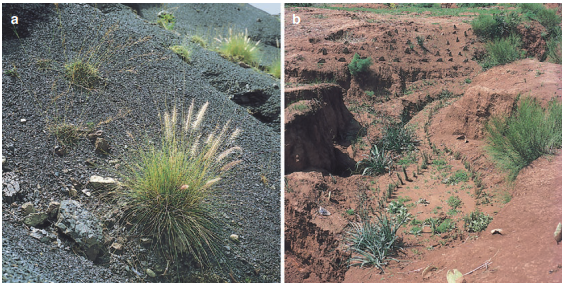
Fig. 17.40. Pioneer plant species are able to start the succession in areas requiring protection, such as those subject to erosion. Pennisetum setaceum a is a tussock grass with extensive roots that is suitable for the stabilisation of steep slopes (mountains in Yemen Arab Republic). b As part of a project to protect against severe degradation of vegetation and soils in the Central Atlas Mountains (Morocco), a mixture of suitable plant species, such as dwarf and brush-wood scrubs, dwarf palms and Opuntia cactus was used to achieve the initial stages in regeneration of area. (Photos: K. Müller-Hohenstein)
Today, we know about asynchronous vegetation cycles and therefore understand the limits to the practical application of current knowledge of vegetation dynamics. Management recommendations for the maintenance of certain ecosystems also need to be revisited, as do the minimum spatial dimensions of protected areas. Current knowledge of vegetation dynamics helps in the selection of “replacement areas”, where disturbed or lost communities may develop again.
Biomonitoring was developed in order to understand syndynamic processes, to identify damaging influences so that they could be quickly counteracted or minimised. Examples are the indication of air pollution and the eutrophication of water. Vegetation changes resulting from interventions at certain sites can also be recorded by continuous biomonitoring. Multiple scales on the hemeroby (level of naturalness) of spaces for vegetation have been devised. Red List species, loss of species, proportion of annuals and neophytes are important values for structuring vegetation units according to the degree of human intervention. Ultimately, knowledge about vegetation dynamics is applied in attempts to improve areas to be used for agriculture or forestry and to control such attempts. Thus, for example, the application of Ca-containing fertilisers in order to combat the acidification of soils in forests and the effects of herbicide application in vineyards, leading to the loss of endangered species, were assessed in this way.
Date added: 2026-04-26; views: 241;