
Change of Climate and Vegetation in Pleistocene
The change from warm to cold periods is very important for the development of the vegetation in Central Europe. Temperatures continued to decrease in the Pleistocene for about two million years, which periodically would change to brief cold (“ice ages”) and warm periods. Average annual temperatures decreased here by at least 8 °C and as much as 12 °C below present-day temperatures. These climatic variations in the early Holocene are mainly explained by periodic changes of solar radiation caused by alterations in the orbit of the rotational axis of the Earth.
Direct and indirect consequences of Quaternary climate variations may be summarised as follows: On both hemispheres, starting from the polar regions, enormous inland ice masses up to 3000 m thick developed. Massive alpine glaciers also were present in the higher mountainous ranges. During the glacial maximum, few peaks rose beyond the alpine ice cover (nunataks). The glaciers extended far north into the foothills of mountainous regions, where a mere 300 km of ice-free area between alpine and polar ice caps in Europe remained. At the same time, sea level sank to about 200 m below the present level (eustatic changes) so that movement of plants in the cold period became easier between landmasses currently separated by shelf oceans (e.g. land connection between England and the European continent).
For Europe six cold periods are recognised with intermittent warm periods and short-term thermic oscillations. Glacial advances are typically named by the furthest northern-reaching point of the ice edge in Germany (alpine glacial periods):
- Biber and Danube ice age in the early Pleistocene about one million years ago; Gunz and Mindel ice age in the middle Pleistocene, about 250,000 years ago;
- Riss ice age about 230,000-120,000 years before the present (BP);
- Wurm glaciation (about 90,000-12,000 years BP) in the late Pleistocene.
The extinction of warmth-requiring tropical and subtropical species became more extensive, as did the alternating dominance of woody species during the warm periods and herbaceous species and grasses during cold ones. Trees in particular disappeared locally or survived unfavourable periods in refuges of eastern and southern latitudes. Because herbaceous plants, grasses and low-growing dwarf shrubs expand at much faster rates owing to their shorter regeneration times, this also resulted in far fewer losses of such species. Some thermophilic species were able to occupy refuges and survived, but their original continuous distribution was eventually separated into several disjunct areas. One of these disjunct distributions has cedars, with some species in the North African mountains (Cedrus atlantica), in the Near East (Cedrus libani) and in the Himalayas (Cedrus deodora).
During cold periods, very few species (mainly mosses, lichens and high alpine flowering plants) successfully inhabited mountainous regions surrounded by glaciers on the nunataks. The southern range expansion of some species has also been attributed to the changing climate during cold periods. There are several migratory paths, for example, the East African Rift Valley, the American mountain ranges and the bridge in South-East Asia-New Guinea-Australia, where these plants found places to grow and even today occur in bipolar distribution regions. Examples are the genera Carex, Erica, Epilobium and Empetrum.
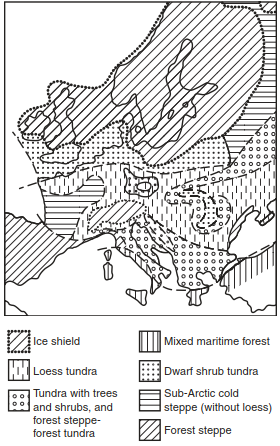
Fig. 17.4. Distribution of vegetation types in Europe during time of maximal glaciation in Würm glacial period. (after Kreeb 1983)
A map of the vegetation in Europe during the peak of the Wurm glaciation (Fig. 17.4) shows, compared to the present day, the shift of vegetation zones towards the south. Almost no trees could grow in the regions of Central Europe between the edges of the ice sheet. The vegetation of tundras and cold grasslands of that time were reconstructed using plant remains found in sedimentary lake cores, and it was found that the indicator species was the arctic alpine plant Dryas octopetala. During the warm periods, separated by cold periods, an interglacial vegetation developed, similar to the development steps of the postglacial vegetation.
Date added: 2026-04-26; views: 220;