
Development of Plants during Life History on Earth
Recent ecological interactions between plants and their environments are the basis of the present structure and spatial distribution of vegetation. However, the occurrence of species and communities may only be explained historically on the basis of knowledge of evolution and distribution. Three important geological events have contributed significantly to the formation of present-day patterns of distribution:
- Continuous migration of the continents in relation to the poles. According to measurements of palaeomagnetism, the magnetic North Pole in the Cambrian was in the Pacific, not far from the current location of the Japanese island group, whereas it was in north-eastern Asia in the Triassic (Fig. 17.1).
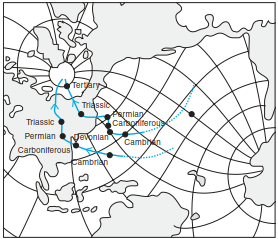
Fig. 17.1. Changes in position of magnetic North Pole during geological time, determined from palaeomagnetic measurements of North American (upper curve) and British rocks (lower curve). (after Kreeb 1983)
- The formation of continents arising from the permanent changes in the position of parts of the Earth’s crust (continental shift and plate tectonics) (Fig. 17.2).
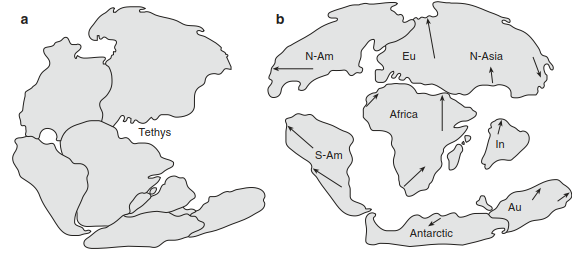
Fig. 17.2 Stages in development of present distribution of continents. a Joined landmass of Pangaea in Triassic. b Distribution of continents at end of Cretaceous. (after Bick 1993)
- Solar effects (different radiation conditions) arising from the composition of the atmosphere, coupled with changes in the Earth’s eccentricity (orbit) around the Sun.
These events are linked to two influences directly affecting plants and their evolution. Firstly, climatic conditions have changed drastically and, secondly, the possibility for area expansion of plants and animals by the opening or closing of land bridges or by the rise of mountain barriers was either limited or enhanced. Furthermore, catastrophic asteroid impacts as well as changes in the CO2 levels (Sun et al. 2012) that greatly reduced biodiversity at the end of the Permian and the Mesozoic should be mentioned.
More recently, the development of the patterns and distributions of vegetation has changed worldwide more rapidly and to a much greater extent by the continuously growing influence of human settlement and changes of land use. This shows clearly that palaeo-ecological links and historical development must be known to acquire a better understanding of present-day vegetation and its structure, composition and spatial distribution.
In the following section, periods of the history of life on Earth, including selected aspects of the phylogeny and coevolution of organisms (eophyticum, palaeophyticum, mesophyticum), will be outlined. The Neophyticum will be discussed in more detail, with special emphasis on late and postglacial development of vegetation, as well as direct and indirect influences of humans on plant cover. Problems of global change will be discussed more comprehensively in Chap. 21.
Date added: 2026-04-26; views: 219;