
Destruction of Tropical Forests
The destruction of tropical forests has been a topic of public discussion even more than the problem of desertification. Not so much climatic but edaphic preconditions, particularly the availability of nutrients, are the limiting factors in this biome. It has long been known that soils weather intensively and nutrients are leached under conditions of high temperatures and continuous moisture, two prominent features of tropical forest biomes. Although litter production is high, fast decomposition impedes the build-up of nutrient reserves, for example, in the form of humus. Even fertilisation is not sustainable in tropical soils with two-layered clay minerals, which have only weak ion-exchange capacities.
The system can remain functional only if the short-cut nutrient cycle is maintained, with the help of mycorrhizae or fine roots present in the soil. The exportation of organic substances by harvesting has far-reaching consequences for the stability of soils and plant growth. Exceptions exist only where primary cations are released because of the mineralogical conditions, for example, in some regions of Java and Sulawesi, relatively young, nutrient-rich volcanic soils favour the establishment of permanent rice crops.
Clearing and changes in land use have taken place in tropical rain forests for thousands of years. However, the consequences of these early influences are considered to be much smaller than those occurring today. Intervention over large areas began with colonial times. Of the approximate 1.5 million described animal and plant species of the perhumid tropics—globally 10-11 million (Mora et al. 2011)—many thousands probably went extinct before they could be scientifically classified. In contrast to the forest management strategies used in temperate forests, these strategies have had negative effects in the tropics, as perhaps only one single tree trunk is used per hectare and many neighbouring trees are destroyed. Even the mangrove stands in tropical coastlands were intensively used for wood extraction, despite their protective functions against normal floods and tsunamis. Sites of these unique plant communities are used in East Asia, as well as Ecuador, for the breeding of shrimp.
Not only has the management of forests led to losses of species. The settlement that followed forest harvesting limited the development of secondary forests. Governments of several rain forest states saw the forests as a “valve” for the growing population pressure. Thus, many states subsidised their populations to help clear large patches of forest for agricultural purposes, more specifically ranching livestock. Grass seed was even sown from planes, but subsequent grazing was mostly given up after a few years as substitute communities with sclerophyllic grasses (e.g. Imperata cylindrica) developed, which were not suitable species for animal fodder. The practice of shifting cultivation with slash and burn was commonly used in all moist, tropical areas and was initially thought to be less damaging. Today this form of land clearing is regarded as less damaging, particularly if the periods of fallow last long enough, and the effect of fire is less harmful to the soil mycorrhizae, which is well known to help stabilise tropical forests and promote species biodiversity (Kottke et al. 2013). However, regeneration requires rather long fallow periods, which were often shortened because of the growing pressure from the human populations. Bruenig (1991) compared the consequences of “mild” intervention with “modern” intervention and assessed the consequences using two transects (Fig. 17.22). There are typical phases of the development of land use from the natural forest to unproductive fallow areas (Fig. 17.11).
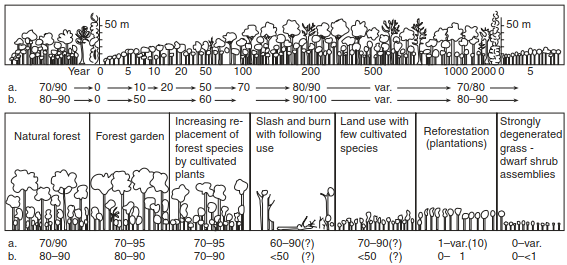
Fig. 17.22. Diversity of trees in undisturbed and disturbed tropical rainforests. Top: natural succession; bottom: following increasing intensity of land use. a Species richness as percentage of maximum attainable species number and b evenness as percentage of maximum attainable species number. (after Bruenig 1991)
Growing evidence supports significant losses of tropical moist forests, where in the period 2000-2012 it was found using Landsat satellite imagery a total of 2.3 million km2 or 32% of the total biome was lost (Hansen et al. 2013). The tropical zone not only experienced the greatest total losses, it also suffered an estimated annual forest loss of 2101 km2. Land-use changes are considered to have the highest impact on the decline of species richness and are still considered a major driver of change in ecosystem functions (Murphy and Romanuk 2014; Hooper et al. 2012).
If one starts with the assumption of a relatively low p-diversity (differences of diversity between different sites, Box 20.1), these habitat losses affect whole plant communities with highly endemic species, and particularly the specialists among plants and animals. Considerable losses in genetic material for breeding, species for medicinal purposes, food and various commodities have occurred (WBGU 2000). Cleared forest results in increases in soil erosion, which in turn leads to changes in water relations. These deleterious effects are expected to intensify with increases in atmospheric CO2 concentrations associated with global climate change, which is expected to increase mean temperatures and the variability in precipitation (IPCC 2013) (Chap. 21).
In the wake of the destruction of tropical rain forests, various social movements have become involved in demanding increasing efforts to establish larger protected areas. It has been difficult to convince the many millions of native people in these areas to change their way of life. It is often overlooked that concepts for sustainable management already exist in some areas. Earlier hunters-gatherers and the first settled farmers developed well-adapted forms of land use in most tropical regions. Low population densities allowed long fallow periods, which had a minimal effect on the land. The population was less mobile, stimulating a closed cover of several “storeys” from different crop plants. The original land use simulated (intuitively?) the structure and biodiversity of a natural rainforest with useful plants for daily life. Today, few examples exist of sustainable land use in permanent and seasonally moist rain forests of the tropics (Fig. 17.12).
Sustainable forest harvesting is extremely difficult to maintain owing to the imbalance of nutrient content in the soil post-harvest. New integrated approaches that take advantage of local crops that are adapted to current conditions (e.g. supply with nutrients), while limiting the effect of the site (e.g. creation of particular microclimatic conditions), must be developed to educate the local indigenous populations to improve management in the area. However, in doing this, the expectations of higher yields often linked to land use in the tropics must be revised. Sustainability must be thought of more than just as a rate of production or bottom line and more in terms of the maintenance of cultural and natural heritages in a particular environment or region. Some elements of sustainable use are generally valid. These are, for example, agroforestry, mixed cropping, mulching and biological pest control.
Many questions remain open about the scientific basis for nature protection in the tropics. It is assumed that a suitable number of plant individuals, able to reproduce, must be available to maintain a species. Assuming this9 number to be only 500, this could require, in the rain forest ecosystem, probably several hundred hectares for some species. This concerns the protection not only of species but of plant communities as a whole.
Little is known about the protection of complete communities, about the minimum size of such areas and the bordering buffer zones required to ensure the persistence of a species. The borders of national parks and biosphere reserves are usually roughly estimated, even if not determined according to political and economic criteria. To define these borders is an important task for applied ecology, which is concerned with the protection of tropical ecosystems.
Date added: 2026-04-26; views: 229;