
Recent Developments in Forests, Arable Fields and Settlements
Intensifying production in agriculture continues apace. Machines in agriculture are becoming increasingly heavier and cause increasing concerns regarding soil compaction. As a result, soil organisms suffer, particularly the macrofauna with Lumbricides. However, yields are still increasing, because modern plant-breeding programmes continuously provide new varieties (strains) with higher yield potential. Varieties must be continuously improved as they become resistant towards xenobiotica, which also require continuous changes. An unwanted “co-evolution” takes place, and the WBGU risk assessment (2000) points to the dangers posed by genetically modified crops that are resistant to herbicides and viruses if such transgenic crop plants become wild or cross with indigenous species.
Intensive agricultural practices also result in fewer species in the associated flora, which are often resistant to pesticides and herbicides. Therefore, measures for the protection of segetal flora are required. Various attempts have been made in this regarding, including mixed cropping, intercropping and managing strips at the edges of fields. However, the present-day agricultural landscape is characterised not only by mechanisation, specialisation and high production but also by homogenisation and contamination.
The use of land for settlement and industrial sites has grown enormously. Habitats and communities, which are without parallel in the natural landscape, are investigated in urban ecology. Changes are especially apparent for flora and fauna within an urban setting (Fig. 17.18). These areas are basically warm islands where warmth- and light-demanding species find refuge, but they need to be relatively insensitive to mechanical disturbance and pollutants.
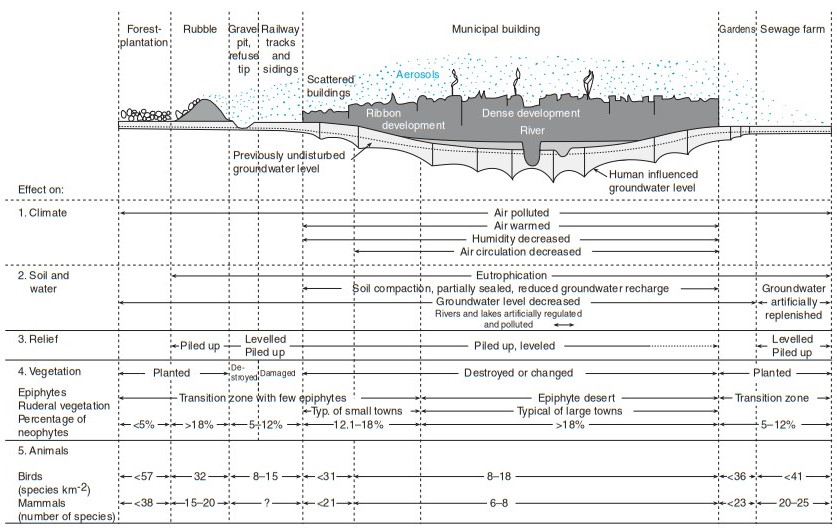
Fig. 17.18. Ecological characteristics of a large town, stressing interactions between human influences and abiotic and biotic conditions in this ecosystem. (after Sukopp and Wittig 1998)
Urban flora is fairly diverse and develops many rather constant plant communities owing to new non-natural sites being colonised mainly by ruderal species. Lichen flora is particularly well represented in towns. Especially epiphytic lichens are often taken as the standard for assessment of SO2 pollution and evaluated regarding their toxic tolerance. New characteristic plant communities are also found in villages. Wittkamp et al. (1995) compared the vegetation of northern Bavarian and southern Thuringian villages on both sides of the former border between the western and eastern parts of Germany and found that variation in land use was closely linked to variation in vegetation.
The comparison also showed that social structure and economic activity were important for this variability. Quite often, differences in vegetation caused by site conditions are of secondary importance compared with differences due to land use. The marked differences in the actual vegetation cover of landscapes north and south of the Strait of Gibraltar are strongly determined by different agro-political measures, culture-specific characteristics and economic activities. With almost identical natural initial conditions, a completely different inventory of communities developed with the intensive, market-orientated land use of Spain compared with the subsistence-orientated land use of Morocco (Deil 1995).
Recent human influences on vegetation in Central Europe is also well illustrated by the introduction of a new type of forest decline. Damage to trees and complete forest areas by smoke and other pollutants from industry has been reported since the beginning of the industrial age. It is also known that rejuvenation of forests in Central Europe has become more difficult, for several reasons, including damage by pests, attacks by fungi or other pathogens, climatic abnormalities and above all from acidification of the upper soil layer. It is now certain that the soils of many semi-natural woodlands and managed forests were depleted of nutrients because of litter removal, erosion and monoculture practices over the centuries.
The “new forest decline” affecting complete forest ecosystems has only been observed for the past 50 years. Significant damage has been attributed to the influx of acid from the atmosphere via long-distance transport in the form of acid rain and complex interactions with other drivers of environmental change (Sect. 16.4). However, analysis of the recent history of vegetation gives much evidence that the key to understanding present-day vegetation is a thorough recognition of past management methods and their effects. This is relevant not only for highly modified ecosystems such as agricultural fields, managed grasslands and heathlands but also for more natural vegetation types such as forests or bogs (Ellenberg 2009).
According to the results of the PAGES 2k project, the twentieth century was the warmest in the last 1400 years. The increase in temperature between the nineteenth and twentieth centuries was the highest ever, and the long-term cooling trend was reversed as a result. Cooling in preindustrial times was certainly mainly due to natural forces. Because these factors did not change, the actual warming, which has exceeded the known dimension until now, can only be explained by new anthropogenic influences, leading to actual global change (Chap. 21), and there will also be more changes in vegetation cover in the future.
Date added: 2026-04-26; views: 221;