
Ants: Evolution, Ecology, and Role as Bioindicators
Ants are social insects of the order Hymenoptera and the family Formicidae. They evolved from a wasp-like ancestor during the mid-Cretaceous period (110-130 million years ago), achieving ecological dominance after an adaptive radiation coinciding with flowering plants in the early Tertiary (around 60 million years ago). A key fossil discovery in 1966, Sphecomyrma freyi preserved in amber from over 80 million years ago, exhibits transitional features between wasps and ants, confirming this ancient lineage. While this early species was likely a ground forager, evidence from primitive extant groups like Leptanillinae suggests the first ants were probably subterranean predators.
Ants are often mistakenly called white ants, but true termites belong to a different order (Isoptera) and are more closely related to cockroaches. Although both groups exhibit complex eusocial societies, this similarity is a product of convergent evolution rather than close kinship. Today, over 12,500 ant species are described, representing an estimated 15-25% of terrestrial animal biomass. They are virtually ubiquitous, absent only from Antarctica, Greenland, Iceland, and some isolated islands, occupying a vast array of ecological niches (Fig. XV.I).
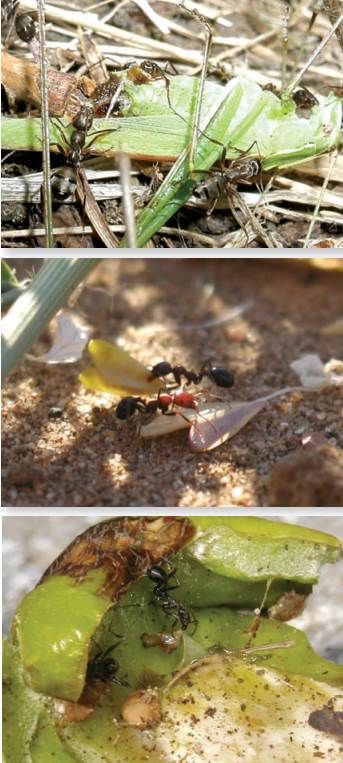
Fig. XV.I: Ants are highly social organisms and as such it is relatively rare to see lone individuals far from the nest. This ‘teamwork’ is apparent in the above three images which show: (top left) Foragers of Formica cunicularia cutting pieces from a dead grasshopper that will be carried back to the nest as food for the colony; (left) Messor minor workers carrying seeds; (above) Workers of Aphaenogaster campana foraging on a fruit. These granivorous ants are abundant in dry areas of Central Southern Italy
Ant morphology is defined by three body regions: the head, mesosoma (thorax), and gaster (abdomen) (Fig. XV.II). Size ranges from 0.75 to 53 mm, with coloration typically red or black. Three key features distinguish ants: elbowed antennae, metapleural glands on the mesosoma, and a narrow, node-like petiole connecting the mesosoma and gaster. Their social structure is famously complex, based on eusociality, characterized by cooperative brood care, overlapping generations, and a reproductive division of labor.
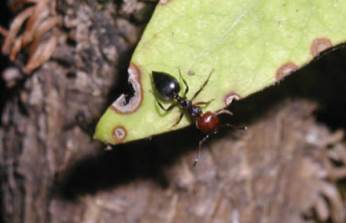
Fig. XV.II: All insects have three body sections and six legs, as shown by individual above, but the elbowed antennae are ant specific. This photo shows a worker of the species Crematogaster scutellaris.\
Ant colonies operate as highly integrated units, often described as superorganisms. They range from small cavity-dwelling groups (Fig. XV.III) to vast territorial networks of millions. Society is structured into castes: fertile queens, short-lived drones (males), and sterile, wingless female workers (Fig. XV.V). Polyethism (division of labor) among workers is often linked to polymorphism, where individuals exhibit different sizes or morphologies—such as minor, median, and major workers—specialized for specific tasks like defense, foraging, or brood care.
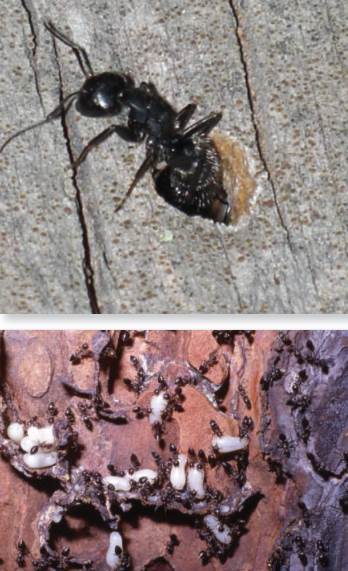
Fig. XV.III: Ants live in most of the terrestrial environments and nest in many different habitats and form colonies in a variety of substrate such as these Camponotus sp. ants living in a dead tree. Above shows an ant leaving through the nest entrance and below shows the internal portion of a Crematogaster sp. colony within a dead tree

Fig. XV.IV: Different species of ants can have very different heads (below). From left to right the species are: Cyphomyrmex laevigatus, Camponotus sp., Acanthognathus brevicornis, Thaumatomyrmex mutilatus, Basiceros convexiceps, Pheidole sp., Solenopsis germinate, Pachycondyla striata, Eciton burchellii, Cephalotes angustus
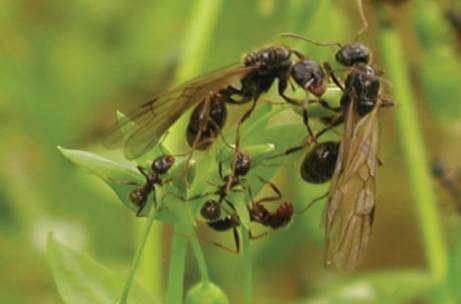
Fig. XV.V: Winged queens of Messor structor assisted by workers on grass blades before leaving for their nuptial flight
Ants engage in sophisticated ecological interactions. Many species form mutualistic relationships with sap-feeding homopterans like aphids, protecting them in exchange for carbohydrate-rich honeydew (Fig. XV.VII). Similar associations occur with myrmecophilous butterflies. Conversely, some arthropods infiltrate nests via mimicry to prey on ants. Notable ecological strategies include the nomadic raids of army ants (e.g., Dorylus, Eciton), the fungal agriculture of leafcutter ants (Attini tribe), and seed dispersal (myrmecochory) by harvester ants (Messor, Pogonomyrmex).
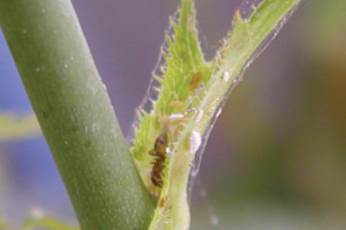
Fig. XV.VII: Linepitema humile worker tending a colony of mealybugs
Their ecological impact makes ants valuable in applied contexts. They serve as biological control agents, such as Formica ants against pine processionary moth larvae. However, invasive species like the red imported fire ant (Solenopsis invicta) and the Argentine ant (Linepithema humile) become major pests, disrupting native ecosystems. Their complex social algorithms even inspire computational models like the Ant Colony Optimization algorithm for problem-solving.
Ants as Bioindicators. Ants are increasingly recognized as powerful bioindicators for ecosystem monitoring. Their high diversity, numerical abundance, and biomass dominance across habitats provide a robust framework for assessment. Sampling is generally efficient and cost-effective (Fig. XV.VIII), and their stationary, perennial nests allow for reliable, repeated monitoring at specific sites. Occupying multiple trophic levels—as predators, scavengers, herbivores, and mutualists—ants integrally reflect ecosystem health.
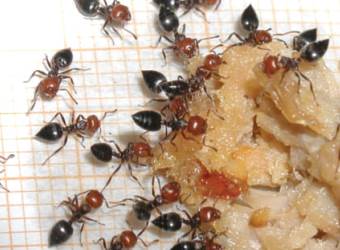
Fig. XV.VIII: Workers of the species Crematogaster scutellaris. An example of a very simple food bait trap filled with tuna. Food baits and pitfall traps are commonly used to monitor ant biodiversity
Functionally, ants are profound ecological engineers. They physically and chemically modify soil (Fig. XV.IX), influence nutrient cycling and energy fluxes, and affect vegetation patterns. Certain species act as keystone species; for example, harvester ants disproportionately influence plant community dynamics through seed predation and dispersal (Fig. XV.X). The disruptive impact of introduced ants starkly demonstrates their pivotal role in maintaining ecological balance.
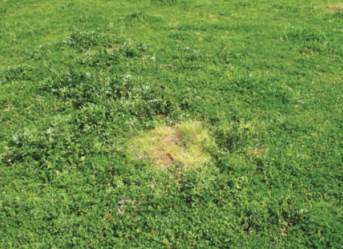
Fig. XV.IX: The External aspect of Messor minor’s nest showing evidence of the soil modification due to ant activities
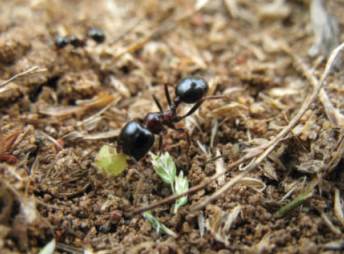
Fig. XV.X: Worker of the species Messor wasmanni. The worker is a forager collecting plant fragments
Their sensitivity to environmental change further enhances their indicator value. Many species have narrow microclimatic tolerances, particularly to temperature and humidity, making them responsive to climatic shifts and habitat disturbance. Monitoring assemblages containing both long-lived and short-lived species allows scientists to track both chronic stress and acute changes. Consequently, ants are excellent tools for multi-temporal scale environmental monitoring, with promising applications in Europe’s temperate regions warranting further study.
Date added: 2025-12-15; views: 688;