
Earthworm Ecology: Roles, Ecological Groups, and Impact on Soil Fertility
Earthworms are nearly ubiquitous terrestrial organisms, found in soils across all continents including Antarctica, and are fundamentally important for maintaining soil fertility. They consume vast amounts of soil organic matter, yet lack the endogenous enzymes to fully decompose plant cellular structures. Consequently, they rely on microbial preconditioning within the soil biota to initiate the digestion process. To meet their substantial energy requirements, earthworms typically ingest between 10 and 30 times their own body weight in soil daily. This processed material is excreted as casts; for species like Lumbricus terrestris, these are deposited on the surface. This activity promotes continuous soil mixing and bioturbation, with earthworms capable of bringing up to 5 mm of fresh subsurface material to the surface annually.
Earthworm species are classified into three distinct ecological groups based on their vertical distribution and feeding behavior within the soil profile, a key concept illustrated in Fig. XIII.I. These functional categories—epigeic, anecic, and endogeic—describe their habitat preferences, diet, and resultant impacts on soil structure and nutrient cycling.
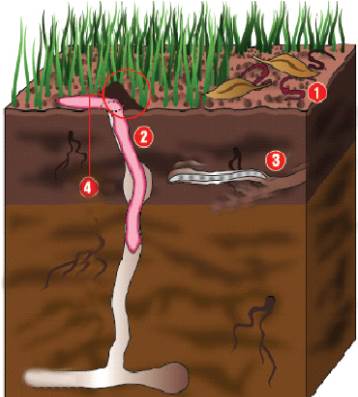
Fig. XIII.I: Spatial distribution of the three earthworm ecological groups. 1 = epigeic specis, 2 = anecic species, 3 = endogeic specis and 4 = cast deposition on the soil surface
Epigeic Earthworms: Surface Litter Decomposers. Epigeic species, or litter-dwelling earthworms, reside primarily at the soil surface within the leaf litter, humus, compost, and the uppermost few centimeters of soil (Fig. XIII.II). They are generally small (1-5 cm), darkly pigmented, and do not form permanent burrows. These worms are crucial agents in the initial fragmentation and turnover of coarse organic matter. Their life history strategy is characterized by a short lifespan, rapid maturation (around 45 days), and high reproductive output, producing up to 100 cocoons per year. They endure unfavorable conditions like drought in the cocoon stage and face significant predation pressure from birds, mammals, and arthropods. Common examples include Dendrobaena octaedra, Lumbricus castaneus, and the widely cultured Eisenia fetida.
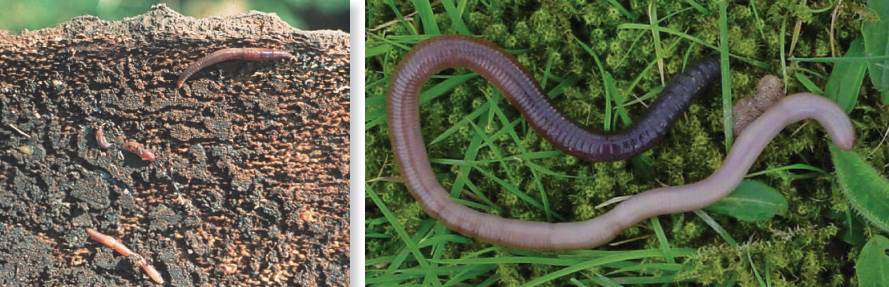
Fig. XIII.II: The photo to the left shows Allolobophoridella eiseni, an epigeic species which lives in the leaf litter and mulch layer and only sometimes moves down into the top few centimetres of the soil. The photo on the right shows Aporrectodea giardi, an anecic earthworm of a different genus. Photos: left (MBo) and right
Anecic Earthworms: Deep-Burrowing Ecosystem Engineers. Anecic species are the deep-dwelling ecosystem engineers, inhabiting permanent, vertical burrows that can extend 5-6 meters deep and open to the surface. They are typically the largest earthworms, ranging from 10 to 110 cm in length, and exhibit variable coloration from red to dark grey. These worms emerge nocturnally to drag surface litter into their burrows, consuming it mixed with soil. They deposit characteristic casts on the surface, which can amount to 30 tons per hectare annually and often form organic-rich middens. This activity is vital for incorporating surface organic matter into the subsoil. Anecic earthworms have longer lifespans but lower reproduction (about 12 cocoons/year) and longer generation times (approximately 9 months). They are vulnerable to predation during surface foraging and are severely impacted by soil tillage. Representative species are Aporrectodea giardi, Lumbricus terrestris (the common nightcrawler), and Lumbricus rubellus rubellus.
Endogeic Earthworms: Subsoil Geophagous Feeders. Endogeic earthworms live and feed entirely within the mineral soil horizons, rarely venturing to the surface (Fig. XIII.III). They are geophagous, deriving nutrition from humified organic matter already incorporated into the soil matrix. Generally medium-sized (1-20 cm) and lightly pigmented (pink to grey), they create extensive but temporary, horizontally oriented burrow networks. These tunnels are backfilled with their casts—an immense amount estimated at 190 tons per hectare yearly—which creates a stable, granular soil structure. Their life history traits are intermediate, with moderate longevity and generation time. Predation is lower, primarily from soil-dwelling predators. Their work occurs entirely belowground, enhancing aeration, water infiltration, and nutrient distribution in the subsoil. Species in this group include Allolobophora icterica, Octolasium cyaneum, and Aporrectodea caliginosus.

Fig. XIII.III: Above are three different species of endogeic earthworms (Left – Aporrectodea icterica; middle – Octalasium cyaneum; and right – Allolobophora c. chlorotica albanica. While all three species fall into the same ecological group, clear morphological differences can be seen in both the pigmentation, size, shape and position of the clitellum (saddle)
Collectively, the activities of these three ecological groups facilitate profound improvements in soil physical properties, nutrient cycling, and organic matter dynamics. Their combined bioturbation, casting, and burrowing actions are integral to creating and maintaining fertile, well-structured, and healthy soils in ecosystems worldwide.
Date added: 2025-12-15; views: 604;