
Myriapods: Millipedes and Centipedes as Integral Soil Macrofauna
Myriapods are a distinct group of arthropods characterized by an elongated, multi-segmented body. Most segments bear one or two pairs of legs, resulting in adults possessing far more than the six legs typical of insects. Within this subphylum, the classes Pauropoda and Symphyla consist of minute, primarily soil-dwelling (euedaphic) microarthropods, categorized as mesofauna. The two remaining classes, Diplopoda (millipedes) and Chilopoda (centipedes), are larger, widely distributed across ecosystems, and formally classified as soil macrofauna due to their significant ecological roles.
Millipedes (Diplopoda) are arthropods ranging from 2 to 280 mm in length. A key diagnostic feature is the presence of two pairs of legs on most body segments (Fig. XIII.III), except for the first legless segment and a few subsequent segments bearing only a single pair. This morphology distinguishes them from other terrestrial arthropods. Millipedes are evolutionarily ancient, with fossil evidence placing Pneumodesmus newmani, a 1 cm long species from approximately 428 million years ago, among the oldest known land animals. Their bodies are typically elongated and cylindrical, though many species exhibit flattened forms.
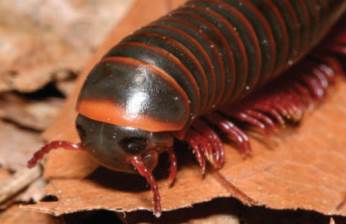
Fig. XIV.III: The head of a North American Millipede (Narceus americanus) on which two eyes are clearly visible
Beyond morphological diversity, millipedes possess robust defense mechanisms. Many have a well-sclerotized cuticle, often reinforced with calcareous salts, explaining their prevalence in calcareous soils. Behavioral defenses include conglobation—the ability to roll into a spiral or a tight ball. Chemically, they secrete repugnant substances from lateral glands. Diplopoda are primarily slow-moving detritivores, consuming decaying plant matter and crucially fragmenting organic material during initial decomposition stages. This activity accelerates nutrient cycling and their excreta contributes to coprogenic humus formation.
While most are detritivores, some millipede species are omnivorous or carnivorous, preying on small arthropods or earthworms. Others possess piercing mouthparts for feeding on plant juices. Numerous species exhibit adaptations for life in deeper soil horizons or caves, displaying traits like reduced size, eye loss, and specialized sensory receptors. Reproduction typically involves copulation, though parthenogenesis occurs. With around 10,000 described species, their population density varies widely (15-800 ind./m²), but their substantial biomass (up to 4-8 g/m²) underscores their ecological importance.
Centipedes (Chilopoda) are ubiquitous terrestrial predators within soil and litter habitats. Their size spectrum is broad, from a few millimeters to about 30 cm (Fig. XIV.V - VII). They share an ancient terrestrial ancestry with millipedes, dating back roughly 430 million years to the late Silurian period. The centipede body is elongated, with each segment bearing a single pair of legs. The first trunk segment is modified into a pair of venom-injecting forcipules (modified maxillipedes), which are primary tools for subduing prey.
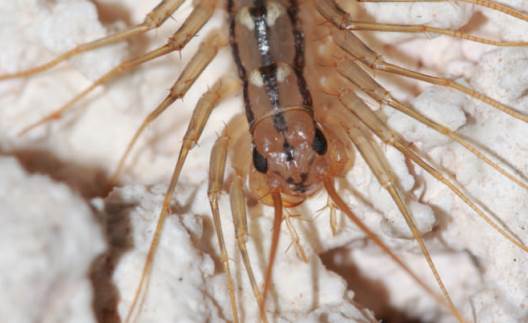
Fig. XIV.V: A centipede of the species Scutigera coleoptrata, one of several species of chilopoda commonly known as house centipedes. They feed on spiders, termites, cockroaches and ants, and other small insects
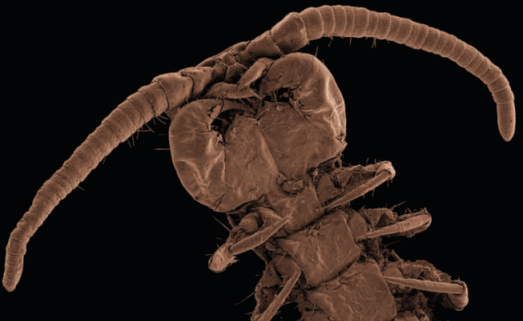
Fig. XIV.VI: A scanning electron micrograph showing the underside of a centipedes head and first four body segments. Clearly visible are the forcipules, a feature unique to centipedes. These are modified front legs which form a pincer like appendage just behind the head. These are used for capturing prey and are capable of injecting venom

Fig. XIV.VII: The species in the photograph above give some impression of the high levels of morphological and colour variation found in this group. Surface dwelling species as Orya barbarica (bottom right) and Eupolybothrus tridentinus (above left) are usually well pigmented, larger and more flattened. Above ground living house centipedes (as Scutigerella coleoptrata, above middle) have very long body appendages. Species living in deeper soil layers (as Clinopodes flavidus, bottom left or Henia illyrica, above right) are usually narrow, pale, with a relatively narrow body, high number of segments and short, minute legs
Two principal body forms reflect ecological specialization. Larger, surface-dwelling species (e.g., orders Lithobiomorpha and Scolopendromorpha) possess a dorsoventrally flattened body with fewer segments and long, powerful legs for rapid pursuit. In contrast, soil-specialized Geophilomorpha exhibit an elongated, almost cylindrical body with a high segment count and short, delicate legs, an ideal morphology for navigating soil pores. These euedaphic species often have pale or depigmented cuticles.
As generalist predators, centipedes hunt a wide variety of prey, including insects, collembolans, mites, spiders, nematodes, and earthworms. The largest species can tackle small vertebrates. While primarily carnivorous, they may consume detritus under starvation conditions. Reproduction involves an indirect sperm transfer where the male produces a spermatophore, often accompanied by a courtship dance to guide the female.
Centipedes inhabit diverse biomes, from forests to deserts, occupying microhabitats like rotting wood, rock crevices, and under bark. Of an estimated 8,000 species worldwide, about 3,000 have been formally described. Their abundance typically ranges from 20 to 300 individuals per square meter. As voracious predators, they regulate prey populations and are, in turn, preyed upon by beetles, snakes, and birds. Some large species possess notably painful, though rarely life-threatening, venomous stings of medical significance to humans.
Date added: 2025-12-15; views: 540;