
Termites: Social Insects as Ecosystem Engineers and Global Decomposers
Termites, often called "white ants," are scientifically classified under the order Isoptera, a name derived from Greek meaning "equal wing" for the two pairs of similar wings on reproductive adults. These small, typically pale insects (5-15 mm) are hemimetabolous, developing through nymphal stages without a pupal phase. Contrary to popular belief, they are not ants but are phylogenetically closely related to cockroaches, with a shared evolutionary history extending over 180 million years. With more than 2,600 species globally, their diversity peaks in Africa, and they constitute a staggering 15-33% of Earth's terrestrial animal biomass, especially in tropical and subtropical regions.
Termite success is built upon two pillars: complex eusocial organization and a supremely efficient digestive system. They are among the few animals capable of digesting lignocellulose, the primary component of wood. This ability stems from a mutualistic relationship with gut-dwelling symbiotic microorganisms (protists and bacteria) that break down this recalcitrant compound. This system functions as nature's most efficient bioreactor, converting up to 95% of cellulose into usable energy within 24 hours.
Termite society is uniquely comprised of both male and female members in all castes. A new colony begins when winged reproductive adults, called alates or swarmers (Fig. XVI.III), embark on a nuptial flight. After shedding their wings, they pair, mate, and become the primary king and queen. Colonies can grow to millions of individuals, organized into a strict division of labor among distinct castes (Fig. XVI.II). These include sterile workers and soldiers, alongside the reproductives.
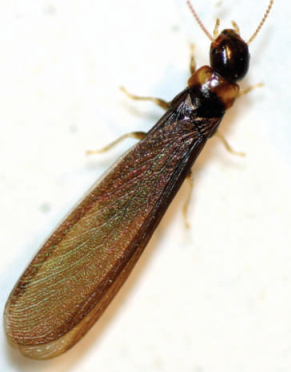
Fig. XVI.III: An alate (adult reproductive with wings) of the species Kalotermes flavicollis. In alate form this species has a dark-brown body and head, a yellowish pronotum (neck) and transparent long brownish wings and are usually 10-12 mm long, (with wings). In this species usually alates perform swarming flights during late summer
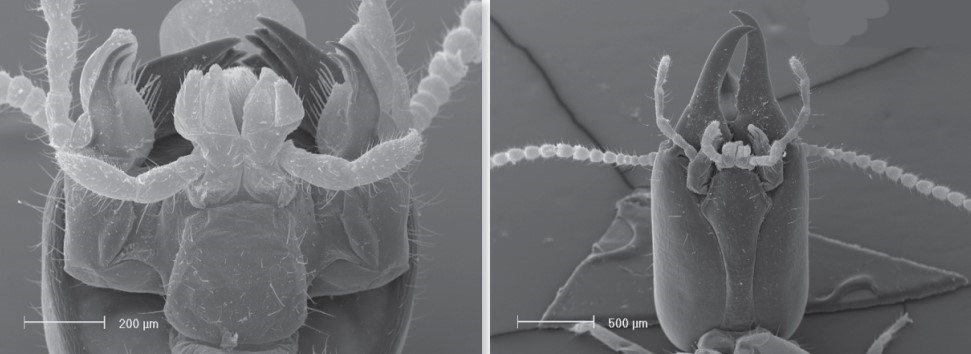
Fig. XVI.II: Two scanning electron micrographs showing a comparison of the head regions of a worker (left) and a soldier (right) of termites of the species R. lucifugus. The worker has a rounded head capsule and short, strong, toothlike mandibles (darkest elements) which are used for chewing wood and for nest construction/repair In contrast, the soldier has an elongated-rectangular shaped head capsule and the long slender sickle-shaped mandibles with sharp cutting edges, used for mechanical defence against enemies (e.g. ants). Soldiers are whitish with dark brown mandibles and are usually 4-5 mm long
Workers, the most numerous caste, are responsible for foraging, nest construction, and feeding all other colony members through a process called trophallaxis (Fig. XVI.I, Fig. XVI.V). Soldiers are morphologically specialized for defense, using enlarged mandibles or chemical sprays (Fig. XVI.II, Fig. XVI.IV), but are dependent on workers for sustenance. The primary queen, after an initial period, undergoes physogastry (extreme abdominal enlargement), becoming an egg-laying machine capable of producing thousands of eggs daily.
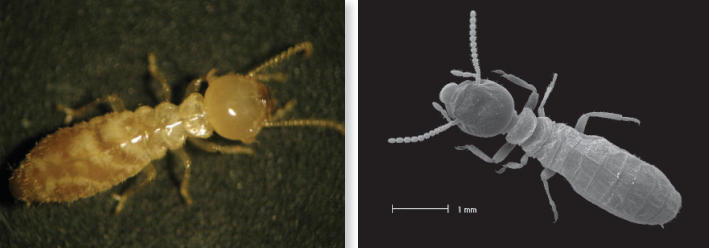
Fig. XVI.I: A photo (left) and a scanning electron micrograph (right) showing workers (about 5 mm in length) of the species Reticulitermes lucifugus. This is a subterranean termite species commonly found in Italy that can be a serious pest of wooden/paper materials in urban areas. Images: left (LMa); right (EC)
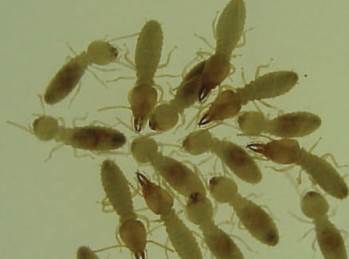
Fig. XVI.V: A group of workers and soldiers of Coptotermes formosanus. Workers are whitish with rounded heads and short dark mandibles. Soldiers (5-7 mm length) are white-yellowish with orangebrown, tear-drop shaped heads and have dark brown, sickle-shaped mandibles. Beside biting, they exude a white, glue-like secretion from the top of their head during fights or when disturbed. This subterranean species is native of China but has been introduced by man activities in almost all continents (except Europe) and is considered the most destructive pest termite in the world
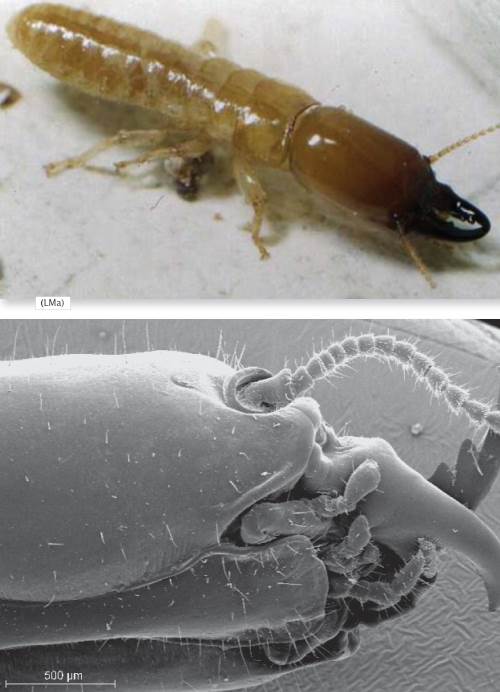
Fig. XVI.IV. A soldier of K. flavicollis (top left). Soldiers are 6-8 mm long, with grey-yellowish body, ochre-yellow pronotum and head and dark brown mandibles. The head capsule is rectangular and as long as half of the body. (LMa) The image on the left is a scanning electron micrograph showing the detail of the head of a soldier of K. flavicollis. Notice the long tough mandibles with internal toothed edges, used for mechanical defence against enemies (e.g. ants)
Ecologically, termites are categorized into four main groups based on nesting and feeding habits: dampwood, drywood, subterranean, and mound builders. Subterranean species, like those in the genus Reticulitermes (Fig. XVI.I), construct elaborate underground galleries and are significant pests in urban areas. Mound-building termites in the tropics create colossal, architecturally complex nests reaching up to 8 meters in height.
In their ecosystems, termites are pivotal soil ecosystem engineers and global decomposers. Their tunneling aerates soil, improves drainage, and increases organic matter content. It is estimated they consume one-third of all annually produced plant material, driving nutrient cycling. Conversely, their appetite for cellulose brings them into conflict with human interests. Species like Coptotermes formosanus and Reticulitermes sp. cause billions in annual damage to structures and crops (Fig. XVI.VI, Fig. XVI.VII).
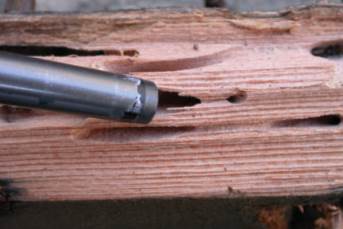
Fig. XVI.VI: Some of the damage that termites can do to wood. The above image shows wood which has been eaten by drywood termites
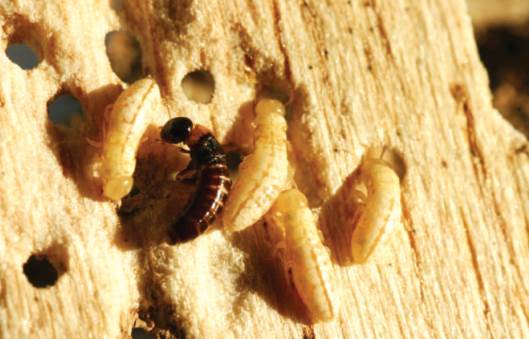
Fig. XVI.VII: A group of four pseudergates (= false workers, functionally acting as workers) of K. flavicollis, together with a queen (female reproductive). Pseudergates are faded yellow-whitish with short robust dark chewing mandibles, the queen is dark-brown with a yellowish neck and is usually 6-8 mm long. This drywood termite species is commonly found in coastal regions of the Mediterranean basin, nesting and feeding inside dead wood, but can attack also living plants, becoming an occasional pest of fruit and ornamental trees
Research into the termite gut symbiont community offers promising biotechnological applications, particularly for biofuel production, mimicking their efficient conversion of plant biomass to sugar. Furthermore, their role in soil reclamation, especially in arid regions, highlights their environmental importance. As both essential ecological agents and formidable economic pests, termites represent a powerful force shaping landscapes and human economies worldwide.
Date added: 2025-12-15; views: 665;