
Carabid Beetles: Ecology, Morphology, and Role as Bioindicators
Carabid beetles, commonly known as ground beetles, constitute a highly species-rich family within the order Coleoptera. They belong to the suborder Adephaga, a primarily predatory group that also includes families like Dytiscidae and Gyrinidae. The name "carabid" is thought to derive historically from "Caribbean cannibals," a reference to their predominantly predatory feeding habits. Their global distribution is extensive, encompassing all continents except Antarctica, with approximately 40,000 described species across 1,500 genera, about 3,000 of which are present in Europe.
These beetles occupy nearly every terrestrial habitat, from mountain peaks to coastal shores, with most species being typical soil dwellers exhibiting epigeic (surface-running) activity. While preimaginal stages (larvae) typically live concealed within soil or leaf litter, many species, especially in tropical regions, are arboreal. Specialized subgroups, such as the tribes Trechini, Anillini, and Platynini, have adapted to life in caves or deep soil fissures in mountainous areas.

Ground beetle populations often reach high abundance and density in diverse ecosystems, including forests, pastures, wetlands, and riverine habitats. They are also found in anthropogenic landscapes like cropland and urban areas, though species diversity is usually lower there. Due to their sensitivity to environmental changes, carabid beetle communities—analyzed through species-abundance distributions—are widely employed as bioindicators. They are used to monitor ecological successions, forest management practices, habitat and soil quality, conservation efficacy, agricultural impacts, pesticide effects, landscape planning, and the consequences of global change.
Most carabid species are univoltine, producing one brood per year. Their life cycle timing is closely tied to climate and habitat. Eggs are typically laid in spring, resulting in summer larvae, or in autumn, leading to overwintering larvae (Fig. XVIII.II). In the latter case, larval development requires 5-8 months, with pupation occurring the following spring (Fig. XVIII.III). In wet or hydromorphic soils, species with summer larvae tend to predominate.

Fig. XVIII.II: Carabid larvae are, in most cases, less pigmented than adults, and are subject to predation in the leaf litter or in the humus layer of the soil. The preimaginal development passes through three larval phases. This image shows, here the third “instar” stage of a forest species, Pterostichus burmeisteri.
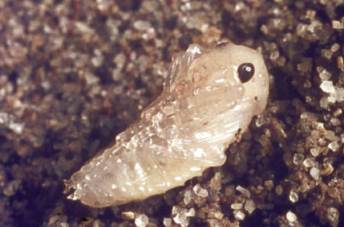
Fig. XVIII.III: The pupal stage lasts two or three weeks and is protected in a subterranean hole that the larva digs out before metamorphosis. Despite its harmless look, the pupa is strongly protected against predators and fungal attacks by manifold chemical substances, including ketones, aldehydes, alcohols, esters and carboxylic acids secreted by lateral exocrine glands
Significant morphological adaptations in adults are often linked to specialized feeding modes. Most detect prey via olfactory or tactile cues and are polyphagous, consuming various food sources. Some, however, are highly specialized, such as snail-feeding species in the genus Cychrus or the "snail crusher" Licinines. Genera like Scarites and Thermophilum possess robust heads and powerful mandibles for crushing hard prey. Visual hunters, such as Cicindela and Elaphrus, have enlarged eyes with numerous ommatidia. The visual hunter Notiophilus selectively preys on Collembola (springtails), a preference shared by beetles like Leistus and Loricera, which have specially adapted mouthparts and antennal setae. In tribes like Amarini and Harpalini, predatory habits are reduced or replaced by granivory (seed-eating); some Ditomines even store seeds in soil as a larval food supply.
Habitat selection in carabids is strictly connected to soil characteristics, particularly subsurface moisture and texture. Ecologists assess ground beetle assemblages using life history traits, which reflect fundamental species adaptations independent of taxonomic kinship. These traits define how species react to habitat alterations. In unstable, ephemeral habitats, taxa with high dispersal power, recognizable by their fully developed hind wings, are common. In stable environments like forests, brachypterous (short-winged or wingless) species typically dominate the community.
Human impact on ecosystems is often reflected in carabid assemblages. Opportunistic and omnivorous species become numerous in disturbed areas like cropland and cities, while specialized predators are more vulnerable. Species with restricted endemic chorotypes often exhibit low dispersal power and reproduction rates, dominating in pristine forest or mountain soils. As a key predatory guild, carabids are vital from the tropics to high latitudes, including alpine zones, glacial margins, and barren stone fields. They help transfer minute animal biomass into larger prey for birds, hedgehogs, shrews, moles, bats, and amphibians.
Their role in biological pest control within agroecosystems is increasingly recognized. As generalist predators in cultivated fields, they contribute significantly to natural regulation. International research and EU pesticide registration authorities now acknowledge this; for instance, environmental risk assessments for new agrochemicals may require testing on species like Poecilus cupreus as a representative of beneficial arthropods.
Chemical Defense Mechanisms. Chemical defense is a primary anti-predator strategy for adult carabid beetles. Nearly all species produce defensive secretions from abdominal glands. In the remarkable "bombardier beetles," these secretions are particularly potent, involving hydroquinones expelled at high temperature through an explosive reaction chamber. The image on the right shows an Australian Bombardier Beetle (Pheropsophus verticalis).
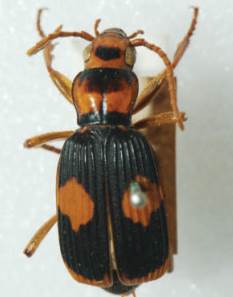
When threatened, a bombardier beetle rotates its abdomen and discharges hot, noxious gases heated to 100°C from twin combustion tubes toward the attacker. This rapid ejection, accompanied by a distinctive popping sound, serves as an effective deterrent. The gland openings of some African bombardier beetles can swivel through 270 degrees, allowing accurate directional discharge, even between the insect's own legs, ensuring comprehensive defense.
Date added: 2025-12-15; views: 515;