
Collembola (Springtails): Ecology, Adaptations, and Roles as Ecosystem Engineers
Collembola, commonly known as springtails, are small, globally distributed soil arthropods named for a unique escape mechanism. Many species possess a forked, lever-like appendage called a furcula tucked beneath their abdomen. When threatened, this structure is released, propelling the organism through the air—hence the name "springtail." They are classified within the group Hexapoda, which includes all six-legged arthropods, but despite having six legs, springtails (along with Protura and Diplura) are no longer formally classified as insects. They are, however, considered the most abundant hexapods on Earth, with over 6,000 described species.
These organisms are ubiquitous in terrestrial ecosystems, inhabiting soil, leaf litter, decaying wood, and even shorelines from the tropics to polar regions (Fig. IX.I, Fig. IX.II). Population densities are immense, with hundreds to thousands of individuals, representing numerous species, found in a single handful of grassland soil. As primarily detritivores and microbivores, their diet consists of fungal hyphae, bacteria, and decomposing organic matter. Through this grazing, they act as major biocontrol agents of microbial populations and are crucial drivers of nutrient mineralization and decomposition processes within the soil food web.
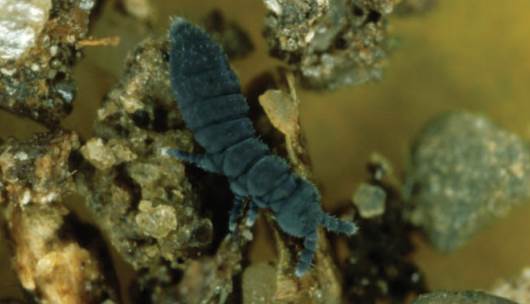
Fig. IX.I: Hypogastrura concolor. This collembolan is widespread in the high Arctic and probably has a circumpolar distribution. During a research expedition to the Canadian Arctic, Nunavut, this species was found to be highly abundant. Although its size is only about 1 mm it has managed to disperse over the Artic region since the last glaciation. However, how it acheived this long range dispersal through such as harsh environment as the Arctic is not known, although it has been found that some collembolans have managed to disperse over 700 km across oceans in the Arctic
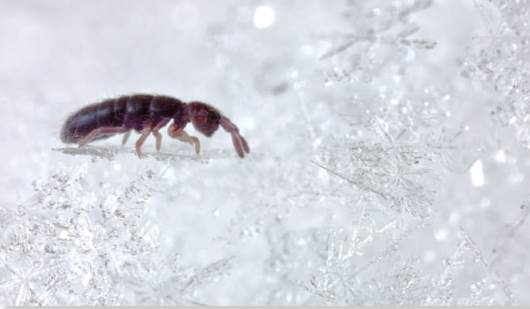
Fig. IX.II: Desoria sp. Some species of Collembola, particularly Hypogastrura harveyi and Hypogastrura nivicola are often referred to as ‘Snow fleas’. This is because they can sometimes be seen jumping around on the surface of snow on warm days, as in the case of Desoria sp., shown on the right. Actually, they are collembola and not fleas at all, but the fact that they can survive and are mobile on snow, as well as being distributed around the Arctic (as the species shown above) highlights the amazing adaptability of collembola which has allowed them to colonise virtually every terrestrial ecosystem on Earth
The soil community of Collembola exhibits distinct vertical stratification and horizontal variability. Species living in surface leaf litter (Fig. IX.III) often possess pigmentation, longer limbs, and protective scales or hairs to resist desiccation. In contrast, species adapted to deeper soil horizons typically lack pigmentation, have reduced eyes and limbs, and are generally more sensitive to drying. This morphological specialization reflects niche partitioning and evolutionary adaptation to different microhabitats, a topic explored further in specialized literature.
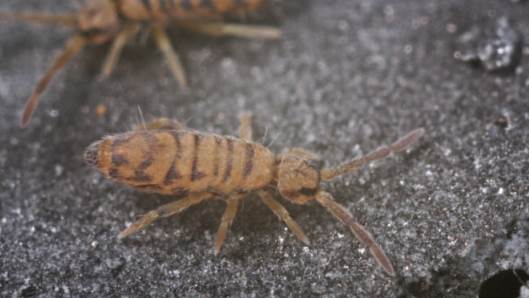
Fig. IX.III: Entomobrya nivalis is an epigeic collembolan living on the soil surface. They are usually approximately 1-2 mm in length, are very common and have a very wide distribution throughout the world. They can often be found on branches and flowers and are relatively resistant to desiccation
Springtail sensitivity to moisture is a key ecological determinant. Their role in nutrient cycling is directly linked to their feeding activity, which regulates fungal and bacterial decomposition rates. While most species are beneficial, a few can become pests; for example, Sminthurus viridis (the lucerne flea) causes significant agricultural damage in Australia. Research into extreme environments reveals remarkable adaptations. Arctic species, often darkly pigmented to withstand high UV radiation, survive harsh winters through inactivity and the production of cryoprotectant sugars. Genetic studies suggest glacial refugia in the Canadian Arctic acted as sources for post-glacial recolonization.
Collembola as Vectors for Moss Fertilization.A fascinating and evolutionarily significant role of Collembola is their newly discovered function in bryophyte reproduction. Unlike flowering plants, which use pollen, mosses require water for their sperm to swim between male and female plants. Scientists long believed this process was solely water-mediated. However, experimental evidence now confirms that Collembola and mites act as accidental vectors for moss sperm, analogous to insect pollinators for flowers.
In controlled experiments, fertile moss shoots attracted springtails. When the arthropods moved between separated patches of male and female mosses, they physically carried sperm cells, significantly enhancing fertilization rates. Fertilization only occurred at a distance when Collembola were present, confirming their active role. This animal-mediated fertilization mechanism is considered a very ancient symbiotic interaction. Given that mosses and Collembola are ancient lineages dating back 440-470 million years to early land colonization, this relationship likely predates the evolution of pollination in vascular plants by a significant margin.
In summary, Collembola are far more than simple soil dwellers. They are exceptionally abundant, ecologically stratified detritivores essential for soil health and nutrient dynamics. Their physiological adaptations allow them to thrive from polar deserts to forest floors, and they participate in ancient, mutualistic relationships that facilitate plant reproduction. As key ecosystem engineers, their activities fundamentally shape the microbial community and biogeochemical cycles upon which terrestrial ecosystems depend.
Date added: 2025-12-15; views: 621;