
Tidal Inlets: Formation, Dynamics, and Role in Coastal Barrier Systems
Tidal inlets are vital conduits within barrier island systems, providing a critical connection between the high-energy open ocean and the protected, low-energy back-barrier environments such as bays, lagoons, and tidal marshes. These dynamic passages facilitate the exchange of water, nutrients, and organisms, while also serving as essential navigation routes for maritime traffic. Consequently, many inlets are heavily modified with stabilization structures like jetties, breakwaters, and dredged channels to maintain safe, predictable passage. Their presence fundamentally shapes the ecology and sedimentology of the entire coastal zone.
The hydraulic engine of a tidal inlet is driven by the rhythmic rise and fall of the tides, which generate powerful, reversing currents. As the ocean tide rises outside the barrier, water initially rises faster than in the confined back-barrier area, creating a hydraulic gradient. This difference forces a rapid inflow through the inlet known as the flood-tidal current. When the external tide falls, the process reverses, generating a strong ebb-tidal current as water drains from the back-barrier basin. These currents are so potent that swimming in a tidal inlet is extremely hazardous, and the timing of high and low tides can differ significantly on opposite sides of the barrier due to this lag in water exchange.
Sediment transport is dominated by these tidal currents, which scour the inlet channel and carry large volumes of sand. The zone of maximum current velocity and deepest water is termed the inlet throat. As flow expands and slows after passing through this constriction, it deposits sand in distinctive lobes called tidal deltas. The flood-tidal delta accumulates on the landward side from flood-current deposition, while the ebb-tidal delta forms seaward from ebb-current deposition. The sides of inlets often feature curved recurved spits, built by wave refraction pushing sand into ridges along the channel margins.
Geomorphologically, tidal inlets form through several mechanisms. A common origin is storm breaching, where elevated waves and surge during a hurricane or nor'easter overtop and erode a barrier island, carving a new channel. As floodwaters recede, a rapid outflow scours the initial cut, which may be maintained by subsequent tidal exchange if it achieves equilibrium. Many inlets along the Outer Banks of North Carolina formed this way. Alternatively, inlets can evolve when a longshore current builds a sand spit across a bay mouth, gradually constricting the opening until focused tidal flows establish a stable channel.
Inlet stability represents a delicate balance between sediment supply from longshore drift and sediment removal by tidal currents and waves. Human interventions like jetty construction often disrupt this natural equilibrium, leading to downdrift erosion and requiring ongoing dredging. Understanding inlet dynamics is crucial for coastal management, as these features control sediment budgets, habitat connectivity, and navigational safety. Their behavior is also intrinsically linked to relative sea-level rise, which can alter hydraulic gradients and increase the frequency of storm-driven breaching events.
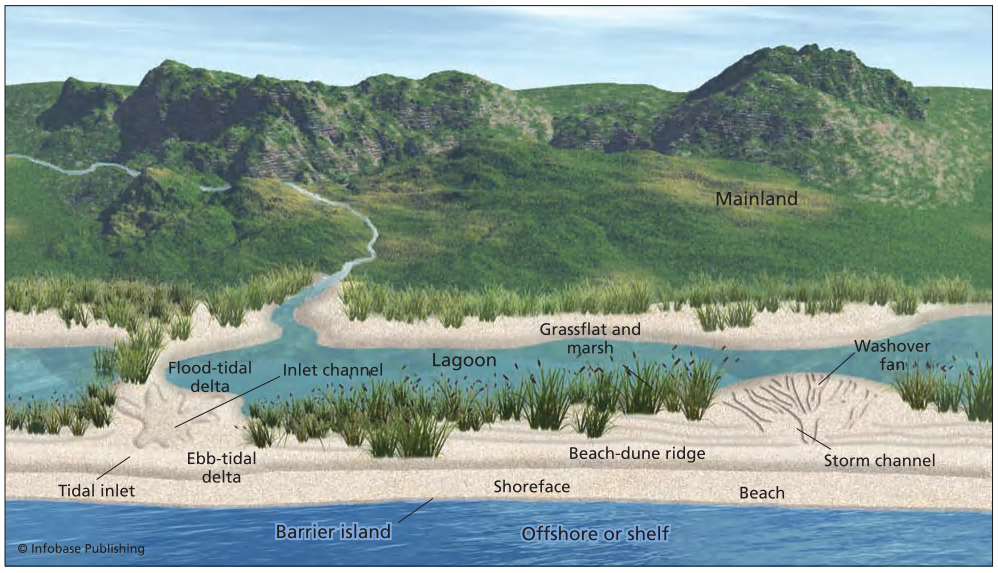
Sketch showing features of a barrier island, tidal inlet, and lagoon coastal system. Note the positions of the small deltas on either side of the tidal inlet, the coastal marsh, and beach-dune ridge. (modeled after R. Davis and D. Fitzgerald).
The accompanying illustration synthesizes the key components of this complex system, highlighting the barrier island, tidal inlet, adjacent tidal deltas, and back-barrier lagoon or marsh. This model visually encapsulates the interaction of processes that govern inlet morphology and longevity. As vulnerable and dynamic features, tidal inlets require integrated scientific understanding to manage their profound influence on coastal resilience, economics, and ecology in an era of environmental change.
Date added: 2026-07-14; views: 118;