
The Benthic Zone: Ecosystems, Sediments, and Life on the Ocean Floor
The benthic environment encompasses the entire ocean floor, and its inhabitants, known as the benthos, include all organisms dwelling on or near the seabed. This community ranges from large plants in shallow waters to diverse animal life across all depths. The nature of the seafloor itself is shaped by various sediments, many of which originate from continental erosion and are transported by turbidity currents, wind, or floating ice. These materials form the foundational substrate for benthic ecosystems, creating habitats that vary from soft muds to hard rocky outcrops.
A significant portion of deep-sea sediments consists of deep-sea oozes, which are pelagic sediments derived from marine organic activity. Calcareous ooze forms from the accumulated shells of carbonate-secreting organisms at low to middle latitudes, but it is absent below depths of 2.5-3 miles (4-5 km). This limit, known as the calcium carbonate compensation depth, is where high pressure and dissolved CO2 dissolve carbonate materials. In contrast, siliceous ooze originates from organisms like diatoms that construct shells from silicon.
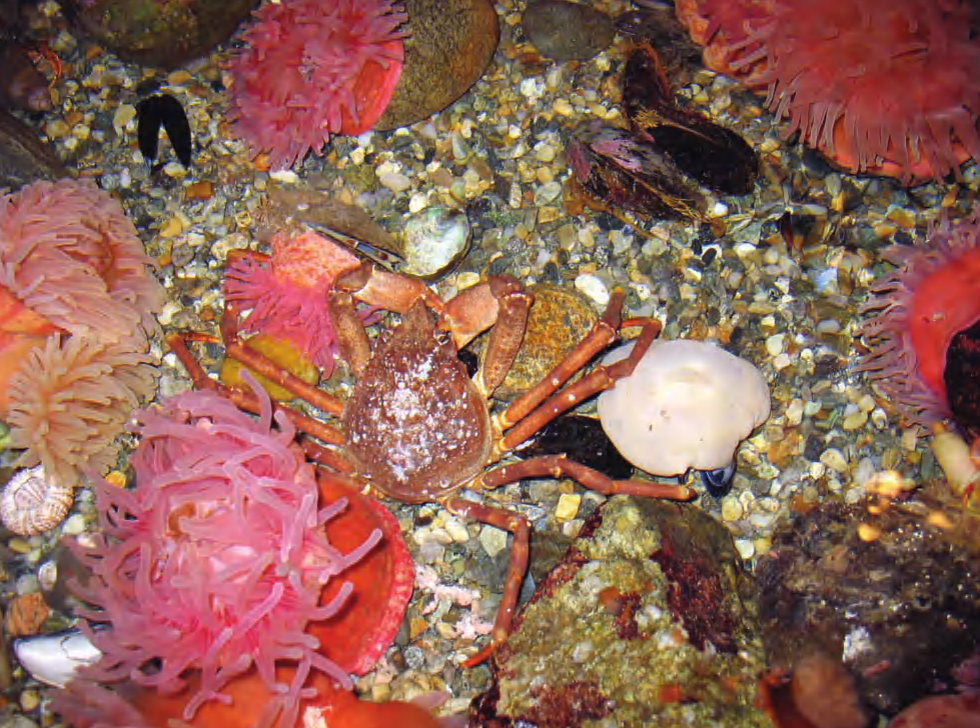
Benthic organisms including crabs, anemones, clams, and mussels on ocean floor
Benthic organisms employ one of three primary survival strategies in this vast, underexplored realm. Sessile organisms permanently attach to surfaces and filter food from the water column. Mobile organisms roam the seafloor actively hunting prey. Infaunal species burrow into sediments, extracting nutrients from the substrate itself. Competition for space and food is intense, with factors like light, temperature, salinity, and bottom composition controlling distribution. Species diversification correlates strongly with environmental stability; fluctuating conditions support few species in high abundance, while stable environments foster high biodiversity with numerous species.
Distinct benthic environments host specialized communities. Rocky shore environments in the intertidal zone exhibit clear biological zonation due to varying exposure to air and wave agitation. Barnacles dominate high-energy zones, while algae, snails, starfish, and crabs thrive nearer the low-tide mark. Tide pools create micro-habitats for crustaceans and worms. Below the tides, the subtidal environment supports lobsters, mollusks, and extensive forests of kelp, a brown benthic algae that can grow to depths of 130 feet (40 m).
Sandy and muddy bottom environments, common near deltas and estuaries, host epifauna on the surface and infauna buried within. Deposit-feeding bivalves like clams and filter-feeders such as oysters and shrimp are typical inhabitants. Coral reefs represent a unique, biologically constructed benthic environment requiring warm waters above 64.4°F (18°C). Built by colonial animals and cemented by calcareous algae, reefs like the Great Barrier Reef provide immense biodiversity and shelter for countless symbiotic organisms.
Extremophiles thrive in unique deep-sea benthic settings. At hot vents along mid-ocean ridge systems, ecosystems based on chemosynthesis rather than photosynthesis flourish. Giant tube worms, heat-tolerant thermophyllic bacteria, and unique clams derive energy from hydrothermal sulfides. Similar cold vent communities exist near subduction zones and hydrocarbon seeps. The general deep seafloor away from these vents, though sparsely populated with smaller organisms, still hosts representatives of most major animal groups, demonstrating the remarkable adaptability of benthic life across the planet's most expansive habitat.
Date added: 2026-07-14; views: 111;