
Mermaids: Global Myths and Modern Interpretations
Described as a mythical sea creature that is half woman to the waist and adorned with a fish tail in place of legs, a mermaid is one of the most popular folklore mysteries of the ocean. Its existence is not definitively proved or disproved, despite scientific and technological advancements. And, with 95 percent of the ocean being relatively unexplored, little is known about life forms that may or may not exist in its depths. Thus, it is no wonder that present-day sightings of mermaids continue to be reported throughout the world, keeping the myth alive and bringing into question their very existence.
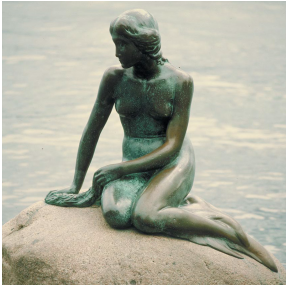
Famous statue of a mermaid in Denmark’s Copenhagen Harbor. One of the most popular folklore mysteries of the ocean, mermaid is described as a mythical sea creature that is half woman to the waist and adorned with a fish tail in place of legs. The statue was inspired by children’s author Hans Christian Andersen’s fairy tale about a mermaid who gives up her life at sea to be united with a young prince on land (Corel).
Sightings date back to ancient Greek mythology when it was believed that Nereus, referred to as “the Old Man in the Sea,” had fifty daughters known as sea nymphs called nereids. They were described as being exceptionally beautiful, with long, flowing hair and fishlike tails. They lived in the Aegean Sea and helped protect sailors from treacherous storms by calming the sea and guiding ships to safety. In Mesopotamia, around the same time as the ancient Greeks, the early Arabs reported seeing mermaids. They believed Atargatis, a fertility goddess, became a mermaid by choice due to tragic circumstances. In Ireland, Celtic folklore calls mermaids and mermen merrows. They were thought to be the souls of those who drowned. Australian Aborigines have their own version of mermaids called yawkyawks, which they believe are girls who have the power to transform themselves into mermaids. In Japan, they called mermaids kappa and believed they were child-sized water spirits.
There is one experience that is worth mentioning, and that is the mermaid of Amboina. It was reported that not only was a mermaid spotted but it was captured on an island in Indonesia in the eighteenth century. It is said that she only lived for four days because she refused to eat. Years later, however, this was explained by abnormalities found in local fish caused by hot gas vents in the Indonesian Ocean; hence, with creative imagination, the creature evolved into the mermaid. Also in Indonesia, many Japanese soldiers reported seeing several mermaids near the Kei Islands. Sadly, there is no evidence to support these claims.
Even Christopher Columbus, the legendary explorer, once told a story about an encounter he had with three mermaids while anchored in the Caribbean, stating that they were not as pretty as previously suggested. Later on, this encounter became known as the first sighting of the graceful, swimming manatees. There is no doubt that manatees and the aquatic mammal dugongs could be mistaken for mermaids from a distance. They have the ability to turn their heads and have flat tails and tapered bodies with stubby, fingerlike flippers. From afar, within the ocean waves, these mammals even fooled Christopher Columbus.
For centuries, people have created stories of goddesses, monsters, and mermaids, all coming from the unexplored depths of the vast ocean. However, at one point in time, science went one step further as it unearthed a theory of evolution called the aquatic ape hypothesis. This theory suggested some apes became aquatic in their search for food and, over time, adapted to full-time life in the water and did not move to the savannah with the majority of apes. It further asked, if, given that as a land-based animal, humans can swim, dive underwater, and hold their breath, these apes did become mermaids? This theory was short-lived as there was no credible evidence. Nowadays, explanations for the presence or sightings of merfolk are misidentified aquatic animals or human hoaxes.
Nowadays, many people view mermaids on the silver screen depicted in films. The Hans Christian Andersen story entitled “The Little Mermaid” boosted the mythical creature’s popularity and brought it into mainstream TV and film. It has become one of the most popular folklore characters. In 2009, mermaid fever hit Kiryat Yam, Israel, with a $1-million reward for verification of a mermaid that had been reported by many people; the authorities have yet to set the record straight on whether it was a publicity stunt or not.
The National Oceanic and Atmospheric Administration (NOAA) is yet to categorically state that mermaids do not exist. That said, they can state that to date, no substantial evidence has been produced to support the existence of mermaids. Being wary that an immense 95 percent of the ocean remains undiscovered, NOAA is willing to say that mermaids “may” not exist. The National Ocean Service concurred by stating that no evidence has ever been found of aquatic humanoids.
FURTHER READING: Alexander, Antonio. 2015. A New Mermaid Guide That Has It All—177 Success Facts. Seattle, WA: History Ink Books.
Alexander, Skye. 2012. Mermaids: The Myths, Legends and Lore. New York: Adams Media.
Rose, Francine. 2006. The Secret World of Mermaids. Seattle, WA: Silver Dolphin Books.
Ventura, Varla. 2013. Among the Mermaids: Facts, Myths, and Enchantments from the Sirens of the Sea. Seattle, WA: Weiser Books.
Virtue, Doreen. 2012. Mermaids 101. Seattle, WA: Hay House.
Date added: 2026-02-14; views: 388;