
The History of Aviation: From the Wright Flyer to Global Air Transportation Networks
The conquest of the air represents a transformative achievement within modern industrial civilization, emerging alongside the parallel development of coal-fired power generation and extensive terrestrial transportation networks. While the eighteenth-century invention of the hot-air balloon in France demonstrated preliminary aerial mobility, its application remained largely recreational or militarily limited. The foundational breakthrough for sustained powered flight arrived only with the late 19th-century maturation of compact, lightweight thermal engines, predominantly the internal-combustion engine. This critical innovation provided the necessary power-to-weight ratio, turning the ancient dream of human flight into an imminent engineering reality and setting the stage for a revolution in global connectivity.
On December 17, 1903, Orville and Wilbur Wright achieved the first powered, controlled, and sustained flight in a heavier-than-air machine at Kitty Hawk, North Carolina. Their pioneering aircraft, a wood-and-fabric construct leveraging recent advances in gasoline engines and bicycle manufacturing techniques, flew 120 feet in twelve seconds. Despite the Wright brothers' initial prediction that airplanes would find use solely in warfare, aviation technology evolved with extraordinary rapidity. By World War I, aircraft were deployed as weapon platforms, and the subsequent development of the radial engine enabled milestones like Charles Lindbergh's 1927 transatlantic flight. The 1930s witnessed the dawn of commercial passenger airlines, epitomized by the iconic, aluminum-skinned DC-3 with its pressurized cabin. Within half a century, the primitive Wright flyer evolved into complex commercial airliners synthesizing hundreds of novel techniques and materials.
The social and economic consequences of aviation have been profound, revolutionizing global tourism, trade, and geopolitical dynamics. Regions previously isolated by the limitations of land and sea travel were integrated into the global mainstream. Furthermore, the industry necessitated deep governmental involvement alongside private enterprise, from constructing passenger terminals and establishing universal safety standards to operating military aircraft fleets and regulating what became a global industry. Commercial aviation is inherently international, with nearly every nation operating a government-owned or regulated airline, and modern aircraft are assembled from components manufactured across multiple countries, operated by multinational crews.
Technological progression accelerated dramatically after World War II, leading to the sophisticated global air transportation system in operation today. The 1970 introduction of the Boeing 747, the first "jumbo jet," marked a pivotal scale increase, while advanced electronic guidance and control systems became standard. Although the Anglo-French Concorde introduced SST (supersonic transport) technology in 1976, its operational costs and environmental impact limited widespread adoption. The current pinnacle of passenger capacity is the European Airbus A380, a double-deck, four-aisle aircraft capable of carrying 555 to 800 passengers. This evolution, from 120 feet to global reach, underscores aviation's role as an essential component of modern infrastructure.
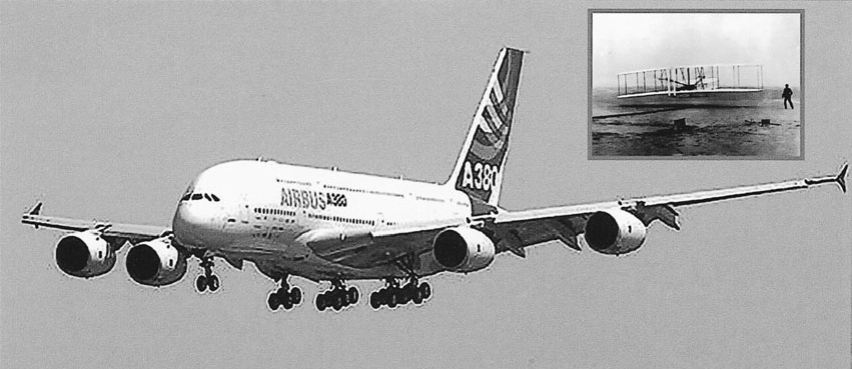
Fig. 17.2. A century of flight. The world’s largest passenger plane, the Airbus A380, on its maiden flight, April 27, 2005. Inset (to scale): The Wright brothers’ first flight at Kitty Hawk, North Carolina, on December 17, 1903. The A380 has a wingspan six times that of the Wright brothers’ flyer and, fully loaded, weighs over two thousand times more.
The scale of modern aviation is staggering, with thousands of aircraft in the sky simultaneously, enabling intercontinental travel within a single day. This network is managed by complex radar and air traffic control systems that ensure safety and efficiency from takeoff to landing. The system's reach extends globally through regional airports and secondary carriers. In 2002 alone, U.S. airports processed 714 million passengers, with global hubs like Atlanta Hartsfield-Jackson, Chicago O’Hare, London Heathrow, and Tokyo Haneda handling tens of millions each. The system operates continuously, having effectively shrunk the world by making rapid, reliable long-distance travel commonplace and relatively accessible.
Parallel to civilian progress, military air transportation has fundamentally rewritten the doctrines of warfare and logistics. Additionally, the specialized air cargo sector, exemplified by integrated carriers like United Parcel Service (UPS) and Federal Express (FedEx), constitutes a highly sophisticated pillar of global commerce. From its humble beginnings at Kitty Hawk, aviation has grown into an indispensable, intricate technological system, a testament to a century of relentless innovation that continues to shape economic and social patterns worldwide.
Date added: 2026-02-14; views: 406;