
The Technological Transformation of the Household: Domestic Systems and Social Change in Industrial Civilization
A profound metamorphosis of the family household has unfolded as a direct consequence of the Industrial Revolution and the maturation of industrial civilization. This technological revolution of the household, impacting billions in daily life, particularly women, has reconstituted the home and transformed the kitchen into a domain of machinery. The shift within the heart of the family unit must be ranked alongside other foundational technological systems essential for understanding contemporary industrial society. This domestic evolution signifies a fundamental reordering of private life and labor.
At the dawn of the twentieth century, even in industrializing nations, domestic work relied on traditional tools: the washboard, hand-operated wringer, broom, mechanical carpet sweeper, and dish towel. While cast-iron stoves had largely replaced the open hearth for cooking and heating, they still required tending with coal or wood, and the iceman's delivery was essential for refrigeration. Upper-class households depended on servants for chores, but by the year 2000, circumstances were radically altered. An army of power-hungry machines displaced simple appliances, including the washing machine (1910), dryer, refrigerator, vacuum cleaner (1901), dishwasher, microwave oven, and countless countertop gadgets. The proliferation of frozen and prepared foods further revolutionized meal preparation, resulting in the servant-less modern middle-class home.
This domestic revolution did more than alleviate drudgery; it played a significant role in socio-political movements, including women’s liberation. In the United States, alongside growing educational access and activism, it contributed to the cultural shifts culminating in the Nineteenth Amendment (1920) granting women suffrage. World War II further cemented this change as women entered the workforce en masse, demonstrating how technological innovation drives social transformation. However, critics argue that these laborsaving devices paradoxically created "more work for mother," imposing new standards of cleanliness and generating endless domestic "needs". Despite this, the modern lifestyle, both at home and beyond, is fundamentally underpinned by this technological armamentarium of the home.
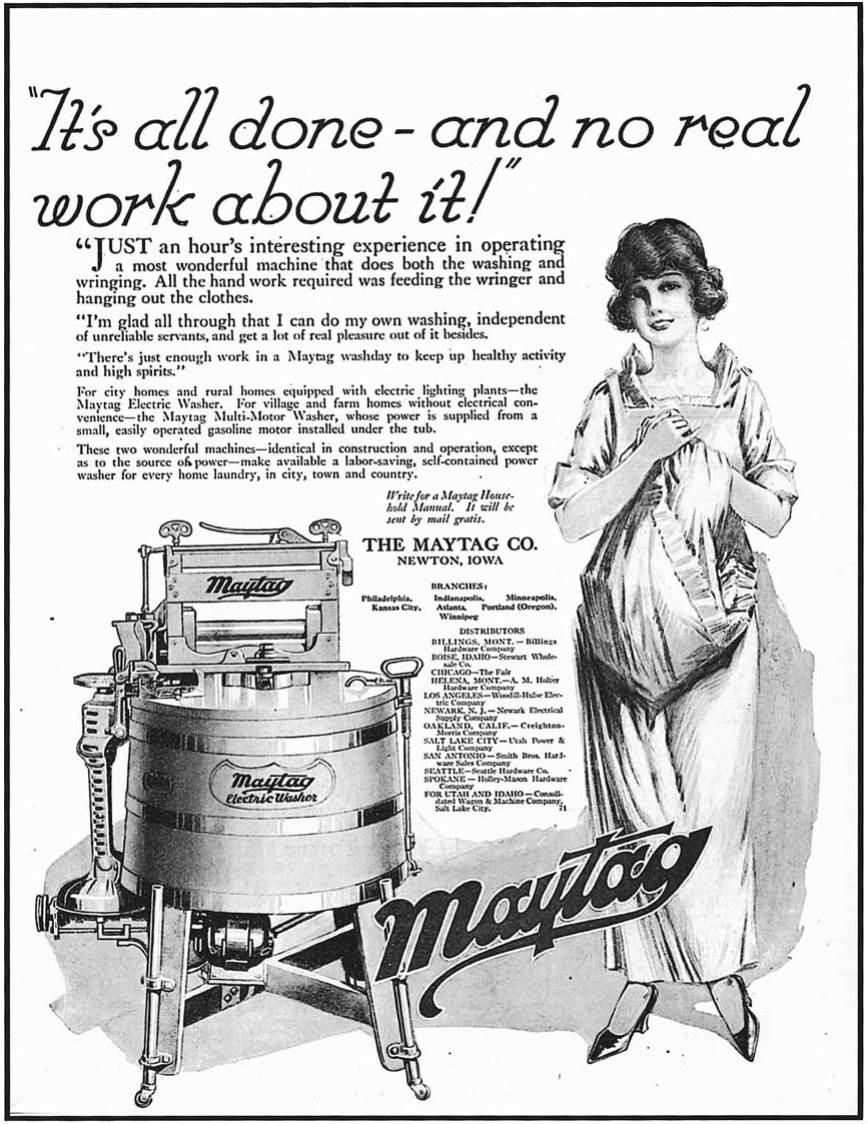
Fig. 17.3. More work for Mother? A 1919 advertisement for the Maytag Electric Washer and Wringer touting “an hour’s interesting experience . . . independent of unreliable servants.” New appliances eased the burden of housework for women, yet arguably enslaved them with more chores and higher standards for the modern home.
The transformation of homes into technological showcases was propelled by relentless advertising and consumer demand, saturating households with specialized cleaning fluids, antibacterial wipes, and personal care technologies. The revolution extended to child-rearing with industrially processed baby foods, disposable diapers, and complex paraphernalia, all heavily marketed. Furthermore, the dwelling itself became a refined technological system, integrating running potable water, indoor plumbing, central heating, air conditioning, electric lighting, and digital connections for communications and power. The elevator enabled high-rise living, while the suburban home incorporated ancillary systems like lawn mowers and barbecue grills, seamlessly connecting to the broader automobile-centric world.
Ultimately, innovative home appliances and conveniences like prepared foods redefined comfort, family life, and leisure within the domestic sphere. However, this revolution has been inequitably distributed; it primarily affected a privileged minority within developed economies. For much of the world's population residing in less-developed regions or in poverty, shelter remains primitive, and most women remain bound to kitchens with few amenities, highlighting a persistent global digital and technological divide rooted in the very industrial progress that reshaped the modern home.
Date added: 2026-02-14; views: 362;