
The Internal Combustion Engine, Henry Ford, and the Rise of the Automobile as a Global Technological System
The steam engine served as the primary prime mover for industry and transportation, including railroads and steamships, until the late nineteenth century. Subsequently, German engineers developed efficient diesel and gasoline internal-combustion engines, introducing a new power source. This innovation, when combined with the wagon and plow, led to the creation of the automobile and tractor, thereby displacing the horse. Early automobiles, emerging in the 1880s, began impacting public life as "horseless carriages." While some early models used electric or steam power, the internal-combustion engine ultimately proved dominant.
In popular narratives, Henry Ford is often portrayed as the solitary visionary behind America's automobile industry. A self-trained mechanic, Ford built his first car in 1893 and founded the Ford Motor Company a decade later, aiming to produce a vehicle for the masses. He perfected assembly-line production techniques to harmonize mass production with mass consumption, though he did not invent them. The results were transformative: Model T production soared from 10,607 units in 1908 to over two million by 1924, while the price plummeted from $850 to $290, making cars widely accessible.
Ford's true achievement was as a system builder, orchestrating a vast technological system. He managed teams of engineers and created an elaborate organizational structure for materials, assembly, and marketing. The automobile itself is a complex technological system, integrating thousands of parts into subsystems like the engine, transmission, and brakes. Innovations like the electric starter (1912) and balloon tires (1921) significantly improved the vehicle, with the starter notably expanding the market to women by eliminating the hand crank.
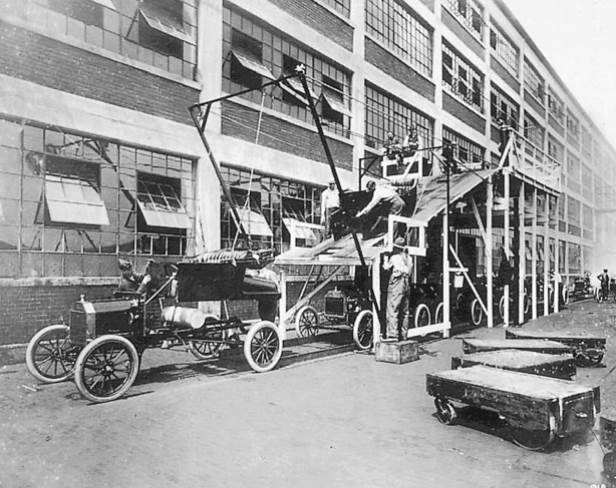
Fig. 17.1. The assembly line. Improved by Henry Ford, the assembly line greatly increased production. The case of the automobile illustrates well the nature of a technological system that must combine many subsystems.
Effective administration became crucial to twentieth-century technological systems. Frederick Winslow Taylor pioneered scientific management, emphasizing efficiency and rational manufacturing analysis. Achievements like Ford's assembly line or NASA's missions were as much managerial triumphs as technological ones, establishing technology management as integral to innovation. These systems evolved dynamically through user adaptation and feedback from manufacturers, distributors, users, and even non-users.
Manufacturing the automobile required multifaceted production mechanisms. Ford's factories, like Highland Park and River Rouge, were vast industrial complexes with subsidiary plants for steel, glass, and cement. To stabilize his workforce, Ford famously introduced the five-dollar day, doubling the prevailing wage and enabling workers to become consumers. This move was central to creating a sustainable system of mass production and consumption.
The automobile industry fostered and relied upon a vast network of ancillary technologies and social practices. It spurred innovations like the carburetor and sealed-beam headlights, while simultaneously driving the expansion of the oil industry and gasoline refining through cracking. Essential supporting elements emerged, including gas stations, repair shops, paved road systems, traffic laws, and dealerships. Financial innovations like the car loan (1915) and trade-in further sustained the system's growth.
Today's automobile is a technological marvel, featuring computer-controlled engines, intelligent safety systems, GPS navigation, and luxury interiors. It functions as a sophisticated mobile environment. This narrative extends beyond passenger cars to include the crucial technological systems of trucks, buses, and containerized shipping, which underpin global logistics and trade.
The internal-combustion engine also revolutionized agriculture through the tractor, an offshoot of automotive technology. Ford-manufactured plows were exported worldwide in the 1920s, contributing to increased food production. This mechanization, alongside improved distribution and fertilizers, led to the rise of agribusiness, where large-scale industrial farming now dominates production in industrialized nations, employing a small fraction of the population.
The spectacular rise of the American automobile industry fostered myths of "Yankee ingenuity." However, post-World War II developments revealed the contingent nature of this lead, as Japanese and German automakers matched and later surpassed American innovation and output, followed by the industrial ascent of East Asia. This underscores a universal industrial culture developed globally.
The automobile is synonymous with industrial civilization. By the early 21st century, global vehicle counts approached one billion, including passenger cars, trucks, and motorcycles. In 2002, Japan led in passenger car production, followed by Germany and the United States, with tens of millions of new vehicles added annually worldwide. This industry remains a central economic engine, driving employment and shaping societies, demonstrating the immense and enduring repercussions of the automobile technological system.
Date added: 2026-02-14; views: 369;